


Syllabus: GS2/International Relations
Context
- The recent escalation in the Strait of Hormuz, involving Iran detaining ships and the U.S. intercepting vessels on the high seas, has raised critical questions about the legality of such actions under international maritime law.
Background
- The Strait of Hormuz is one of the world’s most crucial chokepoints for global energy trade, through which nearly a fifth of global oil supplies pass.
- Any disruption in this region has significant implications for global shipping, energy markets, and geopolitical stability.
Legal Framework Governing Maritime Spaces
- The global maritime order is primarily governed by the United Nations Convention on the Law of the Sea (UNCLOS), which came into force in 1994. It treats the seas as a shared global commons and establishes clear rules for navigation and jurisdiction.
- High Seas: These areas lie beyond national jurisdiction and guarantee freedom of navigation to all states. Interception of vessels is permitted only under limited conditions, such as piracy, stateless vessels, hot pursuit, or authorisation by the UN Security Council.
- Territorial Waters: Coastal states exercise sovereignty, but foreign vessels enjoy the right of “innocent passage”, provided they do not threaten the security of the state.
- Straits Used for International Navigation: Such straits are governed by the principle of “transit passage”, which ensures continuous and unhindered movement of ships and aircraft.
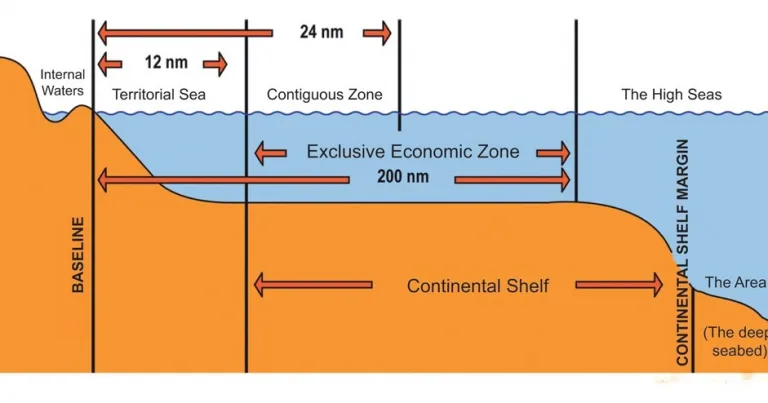
Does Iran Have the Right to Regulate the Strait?
- At its narrowest point, the territorial waters of Iran and Oman overlap, leaving no high seas corridor. Therefore, the Strait is governed by transit passage under UNCLOS.
- This implies that while Iran may regulate certain navigational aspects, such as designated shipping lanes, it cannot suspend or deny transit to merchant vessels.
- Attempts to impose tolls or restrict passage based on geopolitical considerations would violate the principle of free navigation.
- However, ships must comply with certain conditions, including continuous transit, adherence to traffic separation schemes, and refraining from activities that breach local laws.
Legality of U.S. Actions
- The United States has justified its interception of Iranian-linked vessels as part of enforcing sanctions and preventing illegal trade. However, such sanctions are based on domestic law and lack universal legitimacy unless backed by the United Nations.
- Under international law, interception on the high seas is permissible only in specific cases. In the absence of UN Security Council authorisation or flag state consent, such actions raise questions about their legality and may be viewed as unilateral enforcement.
Key Issues
- Conflict between geopolitics and legal norms: Both Iran and the U.S. actions challenge established maritime rules.
- Weaponisation of global commons: Strategic waterways are increasingly used as leverage in conflicts.
- Ambiguity in enforcement: Limited mechanisms exist to enforce compliance with UNCLOS provisions.
Implications for India
- India’s energy security is closely linked to the Strait of Hormuz, making it highly vulnerable to disruptions.
- India imports over 85% of its crude oil, with nearly 40–50% of these supplies transiting through the Strait. A large share of LNG imports (especially from Qatar) also passes through this route.
- India also depends on imports of fertilisers and fertiliser inputs (like ammonia and urea) from West Asia that move through this corridor.
- Further, India has one of the largest seafaring workforces globally, with over 2.5 lakh Indian seafarers employed in international shipping. Escalation in tensions in the region could pose risks to Indian crews and vessels, disrupt maritime operations, and increase insurance and freight costs.
Way Forward
- The International Maritime Organization (IMO) can play a key role in facilitating dialogue and ensuring safe navigation.
- Diplomatic engagement, adherence to UNCLOS principles, and multilateral cooperation are essential to prevent further escalation.
Source: TH
Next article
Digital Public Infrastructure (DPI)@2047 Roadmap
