


Sarnath Added To UNESCO World Heritage List
Syllabus: GS1/History and Culture
Context
- At the 48th Session of the World Heritage Committee in Busan, South Korea, the Ancient Buddhist Site of Sarnath was inscribed on the UNESCO World Heritage List.
About
- Sarnath was nominated under criteria (iii) and (vi) of the UNESCO World Heritage List.
- Criterion (iii) recognizes Sarnath’s enduring spiritual significance as one of the four principal destinations of Buddhist pilgrimage.
- Criterion (vi) recognizes Sarnath’s direct and tangible association with events in the life of the Buddha that hold outstanding significance for the Buddhist community.
- With 45 sites in the List, India ranks 6th globally and 2nd in Asia Pacific Region for the most number of World Heritage Sites.
- The last addition or ‘inscription’ was in 2024, with the Maratha Military Landscapes located Maharashtra and Tamil Nadu.
About Sarnath
- Location: It is situated near Varanasi, Uttar Pradesh.
- It is one of the four major Buddhist pilgrimage sites (others: Lumbini, Bodh Gaya, Kushinagar).
- Historical Importance:
- After attaining enlightenment at Bodh Gaya, Gautama Buddha delivered his first sermon at Sarnath (around 528 BCE).
- This event is called “Dhammachakrapravartana” or “Turning of the Wheel of Dharma”.
- It marked the beginning of the Buddhist Sangha (community of monks) and the establishment of the principles of the Noble Eightfold Path.
- Monuments & Structures:
- Dhamek Stupa: It was built by Ashoka and commemorates the Buddha’s first sermon.
- Chaukhandi Stupa: It marks the spot where Buddha met his first disciples.
- Ashokan Pillar: It was established by Emperor Ashoka; its lion capital is now the National Emblem of India.
- Monasteries & remains: These are the ruins of ancient viharas, temples, and sculptures.
- Ashoka’s Contribution: Emperor Ashoka visited Sarnath in 3rd century BCE.
- Built stupas, monasteries, and inscribed edicts promoting Dharma.
- The Lion Capital of Ashoka from Sarnath was adopted as India’s national emblem in 1950.
Significance
- World Heritage status would reinforce India’s identity as the birthplace of Buddhism and enhance cultural diplomacy with nations such as Japan, Thailand, Sri Lanka, Myanmar, Cambodia, Vietnam, South Korea, Mongolia, etc.
- This recognition would further support India’s efforts to promote Buddhist heritage as a bridge for international engagement and would also showcase India’s expertise in heritage conservation.
Source: PIB
UN Committee on the Elimination of Racial Discrimination (UNCERD)
Syllabus: GS2/IR
In News
- India has strongly rejected the “politically motivated and malicious” observations made by the UN Committee on the Elimination of Racial Discrimination (UNCERD) following its 11th periodic review in Geneva.
UN Committee on the Elimination of Racial Discrimination (UNCERD)
- It is an independent UN treaty body of 18 experts that monitors how countries implement the International Convention on the Elimination of All Forms of Racial Discrimination (ICERD).
- ICERD was adopted in 1965 and came into force in 1969. It is supported by the OHCHR.
- Its main function is to review periodic reports submitted by State parties and issues Concluding Observations.
- It uses early warning and urgent action procedures to prevent racial or ethnic conflicts.
UNCERD and India
- India signed ICERD in 1967 and ratified it in 1968.
- India’s constitutional framework, including Articles 14, 15, 16 and 17, along with laws such as the Protection of Civil Rights Act, 1955 and SC/ST (Prevention of Atrocities) Act, 1989, addresses discrimination.
- India maintains that caste-based discrimination is a matter of social stratification, addressed through its constitutional and legal framework, rather than racial discrimination under ICERD.
Source: TH
India’s Sugar Industry
Syllabus: GS3/Economy
Context
- India’s sugarcane production has reached 500 MMT in 2025-26 as per the Third Advance Estimate of Production released by the Ministry of Agriculture & Farmers Welfare.
About
- India is the world’s second-largest sugarcane producer and the largest consumer of sugar in the world.
- The largest sugar-producing countries are Brazil, India, China, Thailand, and the U.S.
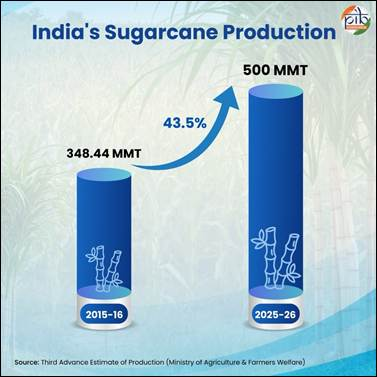
- Uttar Pradesh and Maharashtra are the top sugarcane-producing states in India.
- India exported 8 lakh MT of sugar in 2025-26, compared with 0.47 lakh MT in 2016-17.
- Major export destinations of Indian sugar include Sri Lanka, West Asia, and East Africa.
Source: PIB
Disaster Finance In India
Syllabus: GS3/Disaster Management
In News
- Recently, the Ministry of Home Affairs told the Lok Sabha that heatwaves and lightning had been added to India’s list of notified natural calamities.
Do you know?
- India is witnessing a sudden increase in heat danger, with more than 57% districts, encompassing nearly three-fourths of the population, in high to extremely high heat risk.
- Increasing hot days, hotter nights, humidity, and fast urbanisation are increasing heat stress, while recent monitoring has recorded thousands of heatstroke cases and deaths.
- The new disaster-finance framework allows States to use the SDRF for urgent aid and compensation and the SDMF for long-term initiatives such as cooling shelters, early-warning systems, blue-green infrastructure and cool roofs.
Disaster Finance in India
- Constitutional Provisions: Under Article 280 of the Constitution, the Finance Commission recommends arrangements for disaster management funds.
- Law: India’s disaster-response financing framework, established under the Disaster Management Act, 2005, rests on a two-tier structure.
- The State Disaster Response Fund (SDRF), financed jointly by the Centre and States in a 75:25 ratio, 90:10 for Himalayan and north-eastern States, provides immediate relief for shelter, food, medical care and compensation.
- The National Disaster Response Fund (NDRF), fully funded by the Union government, supplements this when a calamity is classified as severe
- Determinations: The FC-XVI recommended Rs 2.04 lakh crore for State disaster funds in the five years between 2026-27 and 2030-31, nearly 28% more than the previous Commission’s allocation.
- Of the total fund, ₹1.6 lakh crore goes to the State Disaster Response Fund (SDRF) and the rest to the State Disaster Mitigation Fund (SDMF).
- A State could notify a heatwave as a ‘local disaster’ and use the SDRF — but only up to 10% of its annual allocation
- Notified Disaster: Heatwaves, lightning, cyclones, droughts, earthquakes, fires, floods, tsunamis, hailstorms, landslides, avalanches, cloud bursts, pest attacks and frost & cold waves.
Source: TH
Nipun: Second Diving Support Vessel (DSV)
Syllabus: GS3/Defence
Context
- The Indian Navy is set to commission Nipun, the second Diving Support Vessel (DSV) of the Nistar-class, at the Naval Dockyard, Mumbai.
About
- Indigenously designed and constructed by Hindustan Shipyard Limited (HSL), Visakhapatnam, Nipun represents a significant milestone in India’s pursuit of self-reliance in defence shipbuilding.
- ‘Nipun’ is derived from Sanskrit and signifies one who is adept, capable and well-versed in a particular discipline.
- Its side-diving stage can support operations up to 75 metres, while Remotely Operated Vehicles (ROVs) can undertake diver monitoring and salvage operations down to 1,000 metres.
- The ship is equipped with modern diving systems and underwater intervention capabilities, enabling sustained support to divers operating in demanding conditions at sea. It will also augment the Indian Navy’s capability to support submarine rescue operations.

Source: PIB
Exercise ‘Pitch Black’ and Exercise ‘Udara Shakti’
Syllabus: GS3/Defence
Context
- The Indian Air Force (IAF) has successfully concluded its participation in two international flight engagements, including Exercise Pitch Black 2026 in Australia and Exercise Udara Shakti 2026 in Malaysia.
Exercise ‘Pitch Black’
- It is a biennial, multi- national exercise hosted by the Royal Australian Air Force (RAAF).
- The name ‘Pitch Black’ was derived from the emphasis on night time flying over large un-populated areas.
- The Indian Air Force previously participated in the 2018, 2022 and 2024 editions of the exercise.
Exercise ‘Udara Shakti’
- Udara Shakti is a biennial bilateral air exercise between the Indian Air Force (IAF) and the Royal Malaysian Air Force (RMAF).
- The exercise provides an opportunity for personnel of both air forces to train together and enhance interoperability by gaining familiarity with each other’s procedures, practices and approaches to air operations.
Source: AIR
Previous article
Securing Synthetic DNA in India
Next article
India-Kuwait Joint Defence Committee (JDC)
