


Syllabus: GS2/International Institutions
Context
- Recent analysis, based on more than 5,500 UN resolutions voted on by India from 1946 to June 2025, has found that India is altering its voting strategy at the United Nations (UN).
About the Voting in United Nations (UN)
- Voting in the UN is a cornerstone of global diplomacy, allowing member states to express their positions on international issues.
- Types:
- General Assembly (UNGA): One country, one vote; Non-binding resolutions; simple or two-thirds majority required.
- Most UNGA resolutions are adopted by consensus, but contentious issues often require formal votes.
- Security Council (UNSC): Weighted Voting; 5 permanent members have veto power; 9/15 votes needed for adoption;
- Economic & Social Council (ECOSOC): Majority Voting; Focuses on development and human rights;
- Human Rights Council: Majority voting; Elects members and adopts resolutions on rights issues.
- General Assembly (UNGA): One country, one vote; Non-binding resolutions; simple or two-thirds majority required.
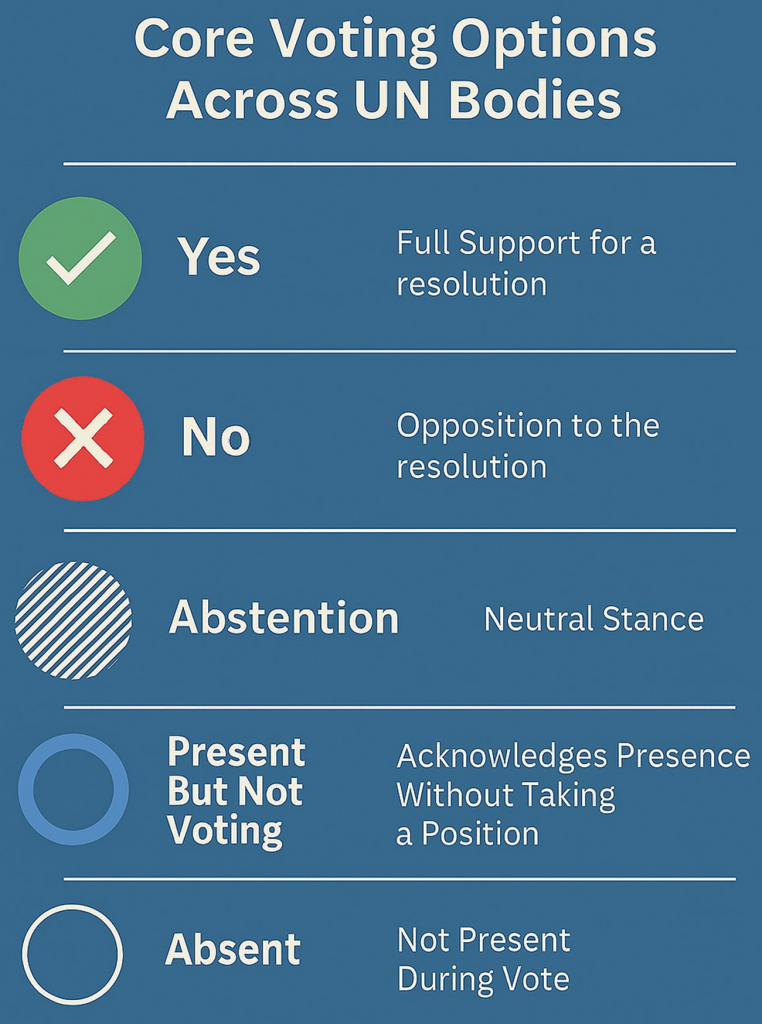
Key Examples: Recent Notable Abstentions
- Resolutions on Russia-Ukraine conflict (2022): India abstained in both the UN General Assembly and Security Council, signaling concern for sovereignty while avoiding direct condemnation.
- Israel-Palestine Issue: India has repeatedly abstained on votes condemning Israel or supporting Gaza, justifying abstention as reflecting a balanced approach or concern for missing context (e.g. terrorism).
- Myanmar: Abstentions on resolutions dealing with the Rohingya crisis and the military junta since 2017.
- China’s Human Rights Record: India avoided antagonizing an immediate neighbor, opting for abstention on several critical votes.
- Other Issues: India abstained on votes relating to the Taliban in Afghanistan, Islamophobia, and arms embargo proposals.
Reasons for the Strategic Shift
- Polarised Global Order: Growing tension between major powers (e.g., USA, China, Russia) has reduced the space for consensus and increased pressure on states to “pick sides.”
- India, as a rising global player, prefers greater autonomy and aims to avoid rigid alignments.
- Complexity of UN Resolutions: Modern UN resolutions often embody multiple, sometimes conflicting, provisions—making simple “yes” or “no” votes diplomatically risky.
- Abstention becomes a pragmatic tool to navigate these complexities.
- Assertion of Strategic Autonomy: For India, abstention serves as a deployment of sophisticated diplomatic signaling, allowing space for nuanced judgement on contentious or value-laden issues.
- This approach signals independence from Cold War–style alignments but may create ambiguity among allies.
- Middle Power Diplomacy: Abstention is seen as allowing India to express its priorities as an emerging middle power, maintain relationships with opposing blocs, and advance its own interests.
Implications for India’s Global Role
- India’s rising abstentions signal a shift toward issue-based diplomacy rather than bloc alignment which:
- Reinforces India’s identity as a middle power with independent judgment.
- Positions India as a bridge-builder in contentious debates.
- Reflects a desire to shape outcomes without being boxed into binary choices.
Previous article
China’s Mega-Dam on the Brahmaputra River
Next article
Kashi Declaration for Drug-Free India
