


Syllabus: GS3/ S&T
In News
- The Atomic Energy Regulatory Board (AERB) has cleared the First Approach to Criticality (FAC) for RAPP-8, a 700 MWe reactor at Rawatbhata, Chittorgarh (Rajasthan).
About
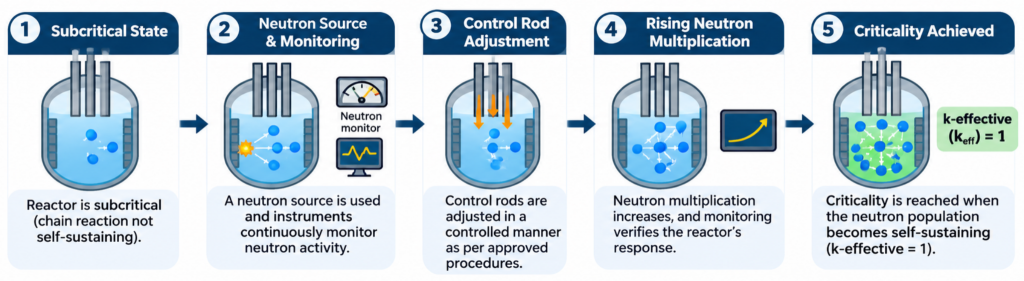
- First Approach to Criticality (FAC): The stage when a reactor starts a controlled, self-sustaining chain reaction for the first time, at very low power. It is the key step before power generation.
- RAPP-8: An indigenous 700 MWe Pressurised Heavy Water Reactor (PHWR) at the Rawatbhata site.
- NPCIL (Nuclear Power Corporation of India Ltd): A public-sector company under the Department of Atomic Energy. It designs, builds, commissions and runs the plant.
- AERB: India’s nuclear safety regulator. It reviews safety, inspects the plant and clears each commissioning stage.
How FAC works
- Safety review: AERB checks the reactor design, construction quality, equipment tests and fuel loading before it allows criticality.
- Removing poison: Heavy water (D₂O) slows neutrons so fission can continue. The neutron-absorbing chemicals added for safety are reduced gradually under close monitoring.
- Reaching criticality: Operators adjust the reactor’s control systems while watching neutron levels. The chain reaction becomes self-sustaining when k-effective equals 1.
- Testing and power rise: After criticality come low-power tests. Then the reactor is connected to the grid, its power is raised step by step, and commercial operation begins.
About RAPP-8 and the 700 MWe PHWR series
- Fourth in the series: It follows KAPS-3 and KAPS-4 (Gujarat) and its twin RAPP-7. All are part of a planned fleet of 16 such reactors.
- Fuel and coolant: Natural uranium dioxide is the fuel. Heavy water acts as both coolant and moderator.
- Safety design: It has a double containment structure and passive systems to remove decay heat during emergencies.
- Indigenous build: Most major components are made in India, which supports domestic industry and standardised construction. (Verify the exact percentage.)
- Oversight: An AERB resident observer team monitors commissioning and every power increase.
Where India stands
- KAPS-3, KAPS-4 and RAPP-7 are already operating (RAPP-7 began commercial operation in April 2025). RAPP-8 is expected to start commercial operation in FY27.
- Together with the Kudankulam units and the Prototype Fast Breeder Reactor at Kalpakkam, it supports India’s target of 100 GWe nuclear capacity by 2047.
Source: TOI
Previous article
COP31 and the Global Divide Over Fossil Fuel Phase-Out
Next article
News In Brief 20-11-2026
