


Syllabus: GS2/Governance/Social Security
Context
- The government is working on a new contributory pension scheme for unorganised and formal sector workers.
Major Features
- The scheme is a part of the 3.0 reforms phase of the retirement fund body Employees’ Provident Fund Organisation (EPFO).
- It will cover existing members and those excluded from the Employees’ Pension Scheme (EPS).
- Contributions: It is likely to allow contributions from multiple sources: workers themselves, employers, government co-contributions for workers in the lower wage segment, aggregators in the case of gig and platform workers, and corporate social responsibility (CSR) or third-party funds.
- Each member will have an individual pension account.
- The system will compute the proposed Target Retirement Sum (TRS) dynamically based on the member’s chosen pension goal and expected retirement age.
- Adjustments to TRS will be allowed and contribution requirements could then be recomputed accordingly.
- The flexibility to decide the amount for pension payouts or the drawdown will be given to the member.
- The system will provide inflation-adjusted projections as an optional feature.
- It would accumulate contributions over time, and will be invested in long-term government-backed securities, with annual crediting of interest.
- Other Types of Pensions: The scheme also proposes family and survivor pensions for spouse, children, and orphans funded through a pooled “Family Benefit Fund”,.
Significance
- The EPFO 3.0 reforms will bring new tech features and an upgrade to the core banking solution (CBS), and pave the way for PF contributions for all unorganised sector workers and gig workers.
- It is in line with the Code on Social Security that brings gig and platform workers into the social security net for the first time.
- The Code mandates aggregator contributions of 1-2% of annual turnover for social security, with the total contribution not exceeding 5% of the amount payable by the aggregator.
- The retirement fund models of other countries such as Singapore are being studied to incorporate the best practices.
Pension Coverage in India
- A Pension provides a steady monthly income to people during their unproductive years.
- Declining earnings, rise of nuclear families, migration of earning members, rising living costs and longer lifespans weaken financial security. Pensions ensure a dignified and independent life.
- India’s pension architecture:
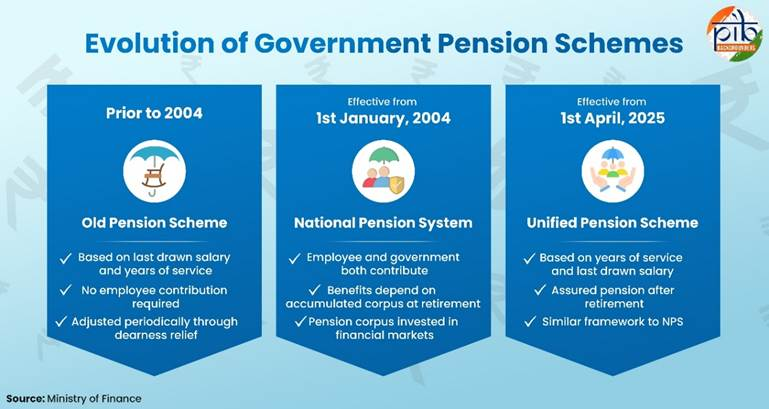
- Defined benefit pension systems for eligible Government employees, which guarantee a fixed post-retirement income.
- Contributory pension arrangements where individuals or/and employers contribute to retirement savings.
- Statutory payroll-linked schemes for organised private-sector workers that mandate employer and employee contributions.
- Tax-funded social assistance pensions, which support elderly, widowed and vulnerable individuals with limited or no formal income sources.
All-Citizen Contributory Pension Mechanisms
- To extend retirement savings beyond formal employment, voluntary contributory options are available.
- These include the NPS and the APY (Atal Pension Yojana) for individuals outside statutory payroll coverage.
- The NPS all-citizen model: It allows voluntary enrolment within prescribed age limits, flexible contributions and choice of investment options. It operates through a two-tier account structure:
- Tier I, which is the primary retirement account with certain withdrawal restrictions and;
- Tier II, a voluntary savings account offering greater liquidity.
- NPS Vatsalya: Pension Account for Minors: Under this scheme, parents or legal guardians can open and operate a pension account for a minor. Contributions are made until the minor attains the age of majority.
- The scheme promotes early retirement savings and long-term financial planning.
- Atal Pension Yojana (APY):It is a contributory scheme for low-income subscribers, with enrolment facilitated through banks and post offices.
- Non-Contributory Social Pension Framework: It provides basic income support through tax-funded transfers to elderly individuals in informal employment who lack retirement savings.
- National Social Assistance Programme (NSAP): NSAP provides financial assistance to the economically vulnerable individuals.
- States/UTs are encouraged to provide top-up of at least an equivalent amount to the assistance provided by the Central Government.
- This ensures that the beneficiaries avail decent level of assistance.
Conclusion
- As demographic transition accelerates, retirement income security becomes vital for long-term stability.
- Wider coverage, prudent asset management and efficient service delivery are also essential.
- Ongoing policy and institutional evolution strengthen the pension system.
- It supports inclusive and sustainable old-age income security in the years ahead.
Source: IE
Previous article
M.P. Cabinet Approves Draft UCC Bill
Next article
Rural growth Reshapes Urban Markets
