
Deep Ocean Mission: India’s Gateway to the Ocean Floor

Syllabus: GS3/Science & Technology

Context

  • Recently, two Indian aquanauts successfully conducted deep-sea dives in the Atlantic Ocean, part of Samudrayaan Project, under the Deep Ocean Mission.
    • Over 100 kg of cobalt-rich polymetallic nodules were collected from 1,173 meters depth in the Andaman Sea.

About the Deep Ocean Mission

  • It was launched by the Ministry of Earth Sciences (MoES) with an investment of ₹4,077 crore over five years on September 7, 2021.
  • It aims to develop technologies for exploring and sustainably utilizing deep ocean resources, and to support India’s Blue Economy and scientific leadership.
    • Blue Economy is a core growth dimension, with potential to push India’s maritime economy beyond ₹100 billion.
  • It is being implemented in phases and aligns with the UN Decade of Ocean Science for Sustainable Development (2021–2030).

Key Components of the Mission

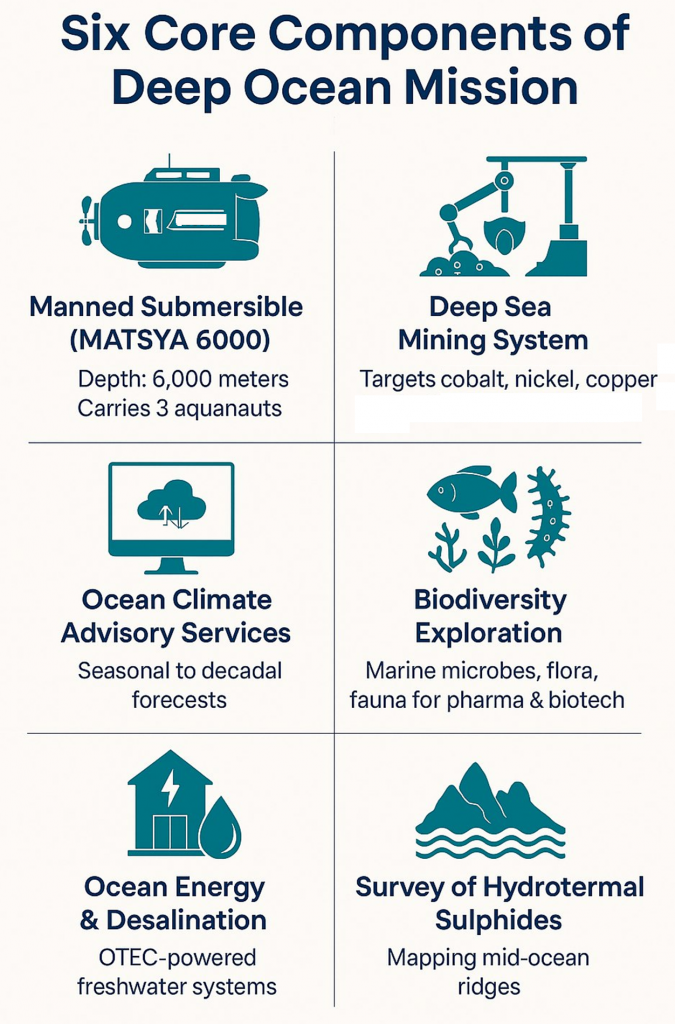
  • Samudrayaan Project (Deep-Sea Mining & Manned Submersible): Development of a manned submersible to carry three people up to 6,000 metres depth.
    • Creation of an Integrated Mining System for extracting polymetallic nodules in the Central Indian Ocean.
  • Ocean Climate Change Advisory Services: Building observations and model suites to forecast climate variables from seasonal to decadal scales.
    • Supports better planning for coastal communities and tourism.
  • Biodiversity Exploration & Conservation: Bio-prospecting of deep-sea flora, fauna, and microbes.
    • Promotes sustainable use of marine biological resources for fisheries and allied sectors.
  • Deep Ocean Survey & Exploration: Identification of multi-metal hydrothermal sulphide sites along the mid-ocean ridges.
    • Expands India’s access to deep-sea mineral reserves.
  • Energy and Freshwater from the Ocean: Proof-of-concept for Ocean Thermal Energy Conversion (OTEC) powered desalination plants.
    • Advances offshore renewable energy and water security.
  • Advanced Marine Station for Ocean Biology: Establishment of a research hub for ocean biology and engineering.
    • Facilitates innovation, incubation, and industrial applications of marine science.
six-core-components-of-deep-ocean-mission

Strategic Importance

  • India’s unique maritime geography — with 11,098.81 km of coastline, nine coastal states, and 1,382 islands — makes it a natural leader in ocean science. The mission supports:
    • Fisheries and aquaculture;
    • Marine biotechnology;
    • Coastal tourism;
    • Energy security
  • Prime Minister, in his recent Independence Day address, emphasized India’s push toward a ‘Samudra Manthan’ — a mission-mode effort to explore oil and gas reserves beneath the ocean floor.
  • The Deep Ocean Mission is now being expanded into a National Deep Water Exploration Mission.

Source: DD News

 
Previous article Soaps and Detergents

Other News of the Day

Syllabus: GS2/ International Relations Context Against the backdrop of BRICS 2026 in India, a stronger India–Africa–UAE (IAU) trilateral framework is emerging with the entry of new members including the UAE, Egypt, and Ethiopia in the group. Background The India-Africa-UAE trilateral partnership is an evolving concept focused on strengthening economic cooperation and connectivity, particularly in the...
Read More

Syllabus: GS3/ Space In News The recent Group Captain Shubhanshu Shukla journey to ISS marks India’s ascent as a major space power, aligning with the vision of Viksit Bharat 2047 and embracing the philosophy of Vishwabandhu Bharat in the space sector. Dimensions of India’s Space Programme Scientific & Technological Dimension: Cost-effective innovation: India’s missions, such...
Read More

Syllabus :GS2/Governance/GS3/Economy  In News  The Public Accounts Committee (PAC) of Parliament has proposed major changes to toll collection on national highways, including a recommendation to end the practice of perpetual tolling.  Laws linked to Toll Collection Under the National Highways Act, 1956, the government is empowered to levy user fees on national highways, with the...
Read More

Syllabus:GS3/Economy Context Indian states are reducing reliance on off-budget borrowings, with the Centre tightening norms by including such loans within states’ fiscal limits under Article 293(3) of the Constitution. Article 293(3) of the Constitution of India stipulates that a state cannot borrow money without the permission of the union government if it still owes a...
Read More

Syllabus: GS2/ Health, GS3/ Environment Context The Parliamentary Standing Committee on Water Resources raised concern over the continued presence of uranium contamination in drinking water sources in Punjab and called for urgent solutions to safeguard public health. What is Uranium Contamination? Uranium contamination refers to the presence of excessive levels of uranium in the environment,...
Read More

Syllabus: GS3/ S&T In Context During World War I, shortages of animal fats and oils spurred chemists to find alternatives. This led to the development of synthetic cleaning agents: the first commercial “soap-like” detergents emerged in the mid-1930s. What are Soaps & Detergents? Soaps: Naturally derived, made from fatty acids and alkali; work through surfactant...
Read More

Jan Vishwas (Amendment of Provisions) Bill, 2025 Syllabus: GS2/Governance  In News The Union Minister for Commerce and Industry introduced the Jan Vishwas (Amendment of Provisions) Bill, 2025 in the Lok Sabha. Jan Vishwas (Amendment of Provisions) Bill, 2025 The Bill builds upon the Jan Vishwas (Amendment of Provisions) Act, 2023, which was the first consolidated...
Read More
scroll to top