


Syllabus: GS3/Agriculture
Context
- India’s honey production has nearly doubled over the last decade, but the sustainability of its sweet revolution depends on protecting bees as essential pollinators and an unpaid agricultural workforce.
Bees as an Unpaid Agricultural Workforce
- According to the Food and Agriculture Organization (FAO), pollinators contribute to almost one-third of global crop production and enhance yields in 87 of the 115 leading food crops.
- Pollination by bees is particularly important for crops such as oilseeds, fruits, vegetables and several other food crops, making bees an important component of sustainable agriculture.
- Beekeeping contributes to rural livelihood diversification, employment generation and agricultural productivity.
India’s Beekeeping and Honey Sector
- India has emerged as the second-largest honey producer in the world after China, reflecting the expansion of apiculture and commercial beekeeping.
- India’s honey production has nearly doubled over the last decade, from about 76,000 tonnes in 2013-14 to roughly 151,000 tonnes in 2025-26.
- India exports a variety of natural honey, like rapeseed/mustard honey, Eucalyptus Honey, Lychee Honey, sunflower honey, etc.
- Major Indian states producing honey are: Uttar Pradesh (17%), West Bengal (16%), Punjab (14%), Bihar (12%) and Rajasthan (9%).
- Major export destinations included the U.S.A, UAE, Saudi Arabia, Qatar and Libya.
- Almost 70 per cent of India’s honey production is exported ($208 million in 2025-26), and India accounts for around 8.4 per cent of global honey exports.
National Beekeeping and Honey Mission (NBHM)
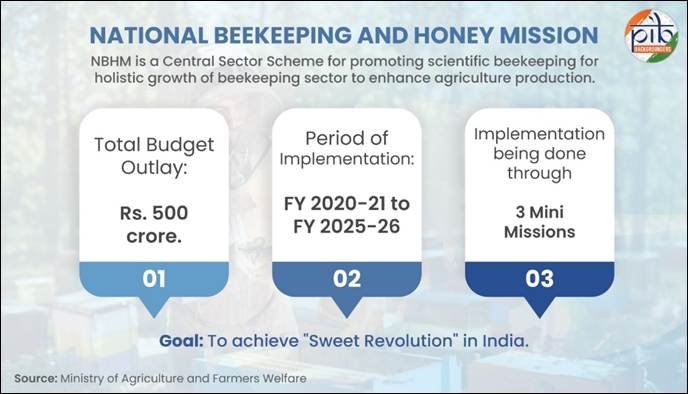
- NBHM is a Central Sector Scheme, implemented through the National Bee Board (NBB), launched for the overall promotion and development of scientific beekeeping and the production of quality honey and other beehive products.
Challenges
- India’s honey exports have been highly concentrated in the US market, which accounted for approximately 76% of India’s honey exports in 2025-26.
- Such dependence exposes Indian beekeepers and exporters to tariff changes, trade restrictions, regulatory barriers and changes in demand in a single major market.
- Low Value Realisation: India largely exports honey in bulk and relatively unbranded forms, limiting its ability to capture premium prices.
- Untapped Potential of the Domestic Market: India’s per capita honey consumption remains low at around 37 grams per year, despite the country’s large population and expanding production.
- A weak domestic market also increases the sector’s dependence on international demand.
- Declining bee health: indiscriminate use of pesticides, particularly during flowering periods, adversely affects bee populations and reduces the pollination services.
- Inadequate testing: Inadequate infrastructure for Nuclear Magnetic Resonance (NMR)-based testing, quality certification, residue testing and traceability can restrict access to premium export markets.
Way Ahead
- India should expand beyond honey into beeswax, propolis, royal jelly and bee pollen to increase beekeeper incomes and access higher-value markets.
- Investment in NMR-based testing laboratories, certification and traceability systems is essential to meet stringent international standards and improve the credibility of Indian honey.
- Sustainability: The expansion of honey production must not compromise the health of bee populations. Therefore, bee conservation should be treated as an agricultural policy priority as well as an environmental priority.
Source: IE
Previous article
Meghalaya’s Delay in Implementing Mine Closure Policy
Next article
Coastal Erosion in Odisha
