


Syllabus: GS3/Economy
In Context
- India’s services sector has emerged as one of the strongest performers of the economy, playing an increasingly important role in driving growth, productivity, and global integration.
India’s Services Performance
- GDP Contribution: According to the World Bank, the share of services in India’s GDP rose to 49.9% in 2024, which is about 1.5 percentage points above the pre-pandemic average, an increase greater than the global average and the majority of developed economies.
- Exports: India’s services exports have maintained strong momentum in FY2025-26, supported by sustained global demand for Indian services.
- Over the period April-January 2025-26, services exports are estimated at USD 348.4 billion.
- India’s services exports share in GDP averaged 9.7% during FY23-FY25, marking a notable rise from 7.4% in the pre-pandemic period.
- Employment: The services sector has also emerged as a major source of employment generation. It accounts for nearly 30% of total employment.
- Over the past six years, the sector added nearly 40 million jobs, in the post-COVID recovery period, highlighting its role as an important labour market shock absorber.
Sectoral Drivers of Services Exports
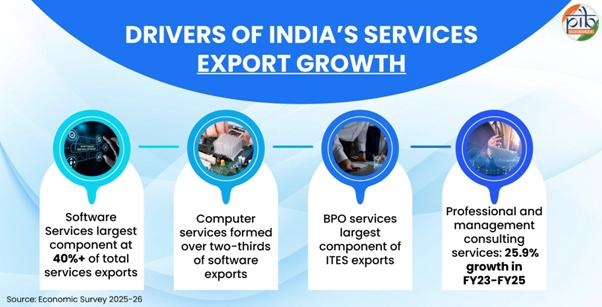
- According to the RBI survey, India’s software services exports grew 7.3% YoY in FY25, with computer services making up over two-thirds of software exports and BPO remaining the largest ITES component.
- Software services account for over 40% of total services exports, growing at 13.5% during FY23–FY25, while professional and management consulting grew 25.9%, increasing its share to 18.3%.
- Together, these segments now represent over 65% of services exports, reflecting India’s strength in knowledge-intensive, cross-border services.
- India has become a global hub for Global Capability Centres (GCCs), hosting over 1,700 centres employing 1.9 million professionals, growing at a 7% CAGR (FY20–FY25).
- GCCs now handle high-value functions like product development, AI services, cybersecurity, analytics, and engineering, driving knowledge-intensive service exports.
- India is also leading in cloud infrastructure and expanding digital capabilities, with data centre capacity set to grow from 1.4 GW (2025) to 8 GW (2030).
- Rising AI adoption, cloud usage, and innovation—including start-ups, venture funding, and generative AI patents—further reinforce its position as a major exporter of digitally enabled services.
Initiatives Taken
- The Union Budget 2026–27 proposes targeted tax reforms for IT services, incentives for cloud and data centres, simplified compliance, and trade facilitation to boost India’s competitiveness in services trade.
- Key measures include:
- IT & ITES: Tax incentives for foreign cloud providers using India-based data centres, 15.5% safe harbour margin, automated compliance, and fast-tracked Advance Pricing Agreements.

- Care Economy: Training 1.5 lakh multiskilled caregivers for geriatric and allied services to meet growing global demand.
- AYUSH: Expansion of global reach via three new All India Institutes of Ayurveda, upgraded WHO Traditional Medicine Centre, and improved certification labs.
- Tourism & Medical Travel: Development of five medical tourism hubs, 10,000 guides trained, 15 archaeological sites upgraded, a new Buddhist Circuit, trekking/hiking promotion, and high-speed rail connectivity to boost cultural and business tourism.
Challenges Facing the Sector
- Employment Issues : High GDP contribution but relatively lower job absorption compared to manufacturing.
- Skill Gaps: Shortage of advanced digital and managerial skills in emerging areas like AI, cybersecurity, and green finance.
- Global Competition: Rising competition from countries like the Philippines and Eastern Europe in outsourcing.
- Regulatory Bottlenecks: Complex compliance requirements in financial services and healthcare.
- Regional Imbalances: Services growth concentrated in urban hubs (Bengaluru, Hyderabad, Gurugram), leaving rural areas underserved.
Conclusion and Way Forward
- India’s services exports have shown strong and consistent growth, becoming a key driver of the country’s external sector performance.
- The Union Budget 2026-27 further supports this growth through targeted tax reforms, digital infrastructure incentives, skill development programs, and measures to enhance global competitiveness.
- To sustain long-term growth and achieve India’s global services ambitions, addressing skill gaps, infrastructure limitations, and regulatory complexities will be essential.
Source :PIB
Previous article
The Transgender Persons (Protection of Rights) Amendment Bill, 2026
