


Syllabus: GS3/Economy/ Resources, GS3/ Environment
In Context
- India must revive its leadership role in shaping the governance, sustainability, and security architecture of the Indian Ocean, guided by the principle “From the Indian Ocean, for the World.”
- This comes at a time when:
- The climate crisis is intensifying stresses on marine ecosystems.
- Global attention to oceans is rising through COP30, UNOC3, and new blue finance commitments.
- India is positioned to drive a cooperative, sustainable, and inclusive ocean agenda.
India’s historical role in Ocean Governance
- During UNCLOS negotiations (1970s–80s), India sided with small island nations to promote the “common heritage of humankind” principle for seabed resources beyond national jurisdiction.
- This echoes Jawaharlal Nehru’s vision of the ocean’s centrality to India’s security and prosperity.
- Perhaps, India has long projected itself as a maritime nation as well as a maritime leader.
Rising Pressure on Oceans
The Indian Ocean is increasingly threatened by climate-induced challenges like ocean warming, acidification, rising sea levels, and illegal fishing, presenting India with a strategic chance to spearhead regional solutions and geopolitical rivalries in the Indo-Pacific (China’s naval presence, U.S.-China competition).
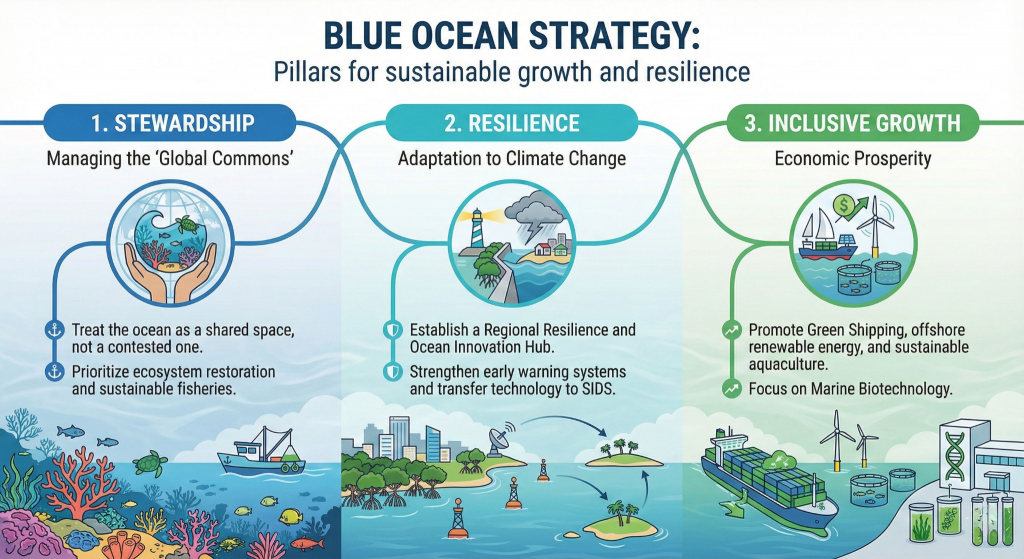
India’s Blue Ocean Strategy: Three Pillars
The Indian Ocean is increasingly threatened by climate-induced challenges like ocean warming, acidification, rising sea levels, and illegal fishing, presenting India with a strategic chance to spearhead regional solutions and geopolitical rivalries in the Indo-Pacific (China’s naval presence, U.S.-China competition).
Global Key Developments in 2025
- Blue Economy and Finance Forum (Monaco): At the forum held in Monaco, governments, development banks, and private investors presented a strong pipeline of ocean-related investments worth €25 billion. They further announced new commitments amounting to €8.7 billion.
- COP30 in Belém: At COP30, the Brazilian Presidency launched the “One Ocean Partnership.” This initiative aims to mobilise $20 billion for ocean protection and sustainable ocean activities by the year 2030.
- Development Bank of Latin America: The Development Bank of Latin America doubled its financial target for blue economy projects. It revised its earlier target and now plans to invest $2.5 billion by 2030.
Security Via Sustainability
- Beyond naval rivalries, environmental threats like IUU fishing, coral loss, and intensified storms erode livelihoods and stability in the Indian Ocean.
- And, India’s SAGAR doctrine integrates ecosystem health with maritime security through enhanced cooperation in domain awareness and disaster response.
India’s Leadership Imperative
- Echoing Indira Gandhi’s 1972 Stockholm ethos, India can leverage BBNJ ratification (effective 2026), UNOC3/COP30/G20 momentum, and IORA chairmanship to pioneer an Indian Ocean Blue Fund, green shipping, and blue bonds—transforming pledges into sustainable prosperity.
- 2026 is a pivotal year with the UN Ocean Conference (UNOC3) and the entry into force of the BBNJ Agreement (Biodiversity Beyond National Jurisdiction), India’s role is to ratify the BBNJ Agreement & utilize chairmanship of the Indian Ocean Rim Association (IORA) to push for green shipping corridors and blue bonds with guiding Principle of “From the Indian Ocean, for the World”.
Way Forward
- Institutional Leadership: India should work toward establishing mechanisms such as an Indian Ocean Sustainability and Security Council within IORA. It must also operationalise the Indian Ocean Blue Fund to support long-term regional projects.
- Strengthening Regional Partnerships: India can deepen partnerships with small island developing states and African coastal nations. It should also use initiatives like the Indo-Pacific Oceans Initiative (IPOI) to expand cooperation in areas such as marine ecology, resource management, and maritime security.
- Domestic Reforms: Modernising the fisheries sector, expanding marine protected areas, and improving coastal regulation frameworks are essential steps. India also needs stronger climate adaptation measures for its coastal populations.
- Maritime Diplomacy: India should continue to promote the Indian Ocean as a space for cooperation. Its diplomatic approach must remain inclusive, respectful of sovereignty, and rooted in shared development goals.
- Technology and Innovation: India can invest in technologies such as satellite-based ocean monitoring, AI-driven early warning systems, and green port infrastructure. Advancing marine biotechnology and responsible carbon sequestration research will further enhance India’s leadership in sustainable ocean practices.
| Daily Mains Practice Question [Q]India must move from viewing the Indian Ocean primarily as a strategic theatre to viewing it as an ecological and developmental space.” Discuss in light of recent global momentum in ocean governance and India’s maritime initiatives. |
Source: TH
Previous article
The Stark Reality of Educational Costs in India
Next article
Courts Must Protect, Not Regulate Free Speech
