


Syllabus: GS3/Economy
Context
- Recently, the Prime Minister of India urged citizens to postpone non-essential gold purchases and reduce petroleum consumption to conserve India’s foreign exchange reserves with the West Asia crisis entering its third month.
Why Gold Imports Matter for India?
- India is one of the world’s largest consumers of gold. However, domestic production is negligible, forcing the country to rely heavily on imports.
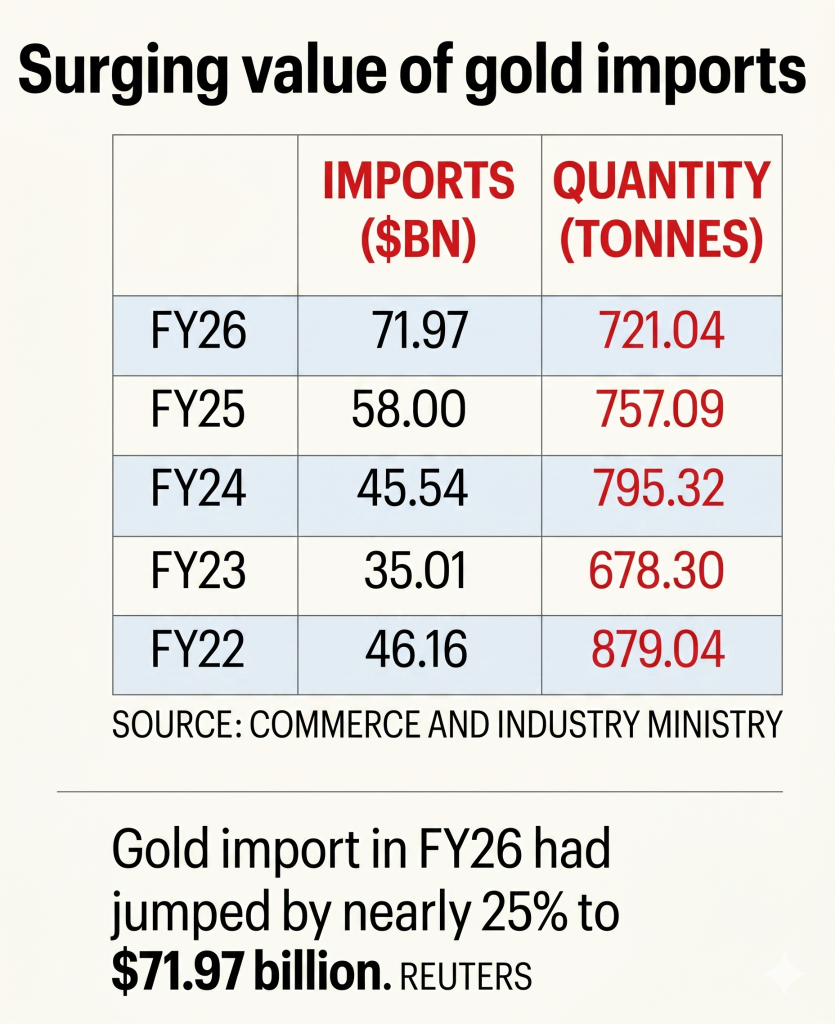
Rising Gold Import Bill
- India’s gold imports in FY26 rose sharply despite lower physical volumes because of a steep increase in global gold prices.
- Key Observation:
- Gold import value rose by nearly 25% in FY26.
- Physical imports declined, but prices surged by over 40% globally, inflating the import bill.
- It demonstrates how commodity price shocks can affect India’s balance of payments even without a rise in consumption.
- Excessive gold imports become a macroeconomic challenge during periods of global uncertainty because they increase the Current Account Deficit (CAD); put pressure on foreign exchange reserves; depreciate the rupee; increase imported inflation; and worsen external sector vulnerability.
Impact on India’s Economy
- Pressure on Current Account Deficit (CAD): Gold constitutes a major non-essential import item.
- Rising imports widen the trade deficit, especially when oil prices are simultaneously high.
- A higher CAD increases dependence on foreign capital inflows.
- Stress on Forex Reserves: Higher import payments require larger outflows of dollars. It reduces the Reserve Bank of India’s ability to stabilise the rupee during external shocks.
- According to RBI data and government assessments, maintaining adequate forex reserves is crucial for import cover, exchange-rate stability, and investor confidence.
- Rupee Depreciation: Large dollar demand for gold and crude oil imports weakens the rupee.
- A depreciated rupee further raises import costs, creating a vicious cycle of inflation.
- Inflationary Pressures: Rising gold and oil prices increase imported inflation. This complicates monetary policy management for the RBI.
India-UAE CEPA and Gold Imports
- India and the UAE signed the Comprehensive Economic Partnership Agreement (CEPA) in February 2022 to strengthen bilateral trade and investment.
- However, some tariff concessions under the agreement unintentionally increased bullion imports.
- The agreement inadvertently inverted the intended duty differential between Bullion (refined gold), and Dore (semi-pure gold alloy).
- As a result, India imports more finished gold instead of refining it domestically.
- A working paper of IIM Ahmedabad highlighted that, India imports large quantities of finished bullion rather than raw dore, and tariff structure under CEPA made bullion imports relatively more attractive than dore imports. It reduced opportunities for domestic refining and value addition.
Weak Gold Refining Ecosystem
- Despite being one of the world’s largest consumers of gold, India has not emerged as a major global gold refining and trading hub.
- Countries such as Switzerland and the United Arab Emirates have developed strong refining ecosystems despite having negligible domestic gold production.
- They developed world-class refining infrastructure, LBMA-accredited refineries, and integration with global supply chains.
- Refining generates nearly 40% value addition, helping offset trade deficits through exports.
Challenges For India
- Lack of LBMA-Accredited Refineries: India currently lacks globally recognised LBMA-certified refineries, limiting access to international bullion markets.
- Underutilised Capacity: Existing refineries operate below potential due to policy and structural issues.
- Limited Global Integration: India remains largely an end consumer rather than a value-added participant in global gold supply chains.
- Import Structure Bias: The import ecosystem favours refined bullion imports over domestic processing.
Government Measures and Policy Suggestions
- Short-Term Measures:
- Demand Management: Discouraging non-essential gold purchases, and encouraging financial savings instruments
- Import Controls: Historically, India has used higher import duties, gold monetisation schemes, and sovereign gold bonds (SGBs) to reduce physical gold demand.
- Long-Term Structural Reforms:
- Develop Refining Ecosystem: Establish LBMA-accredited refineries, and encourage domestic value addition.
- Promote Gold Recycling: India has significant idle household gold reserves.
- Expand Financial Alternatives: Encourage SGBs, gold ETFs, and digital gold, to reduce dependence on physical imports.
- Review CEPA Tariff Structure: Ensure trade agreements support domestic manufacturing and refining.
- Strengthen External Sector Resilience to diversify exports, reduce oil dependence, and improve forex management.
Previous article
Rural Development in India
Next article
News In Short 13-05-2026
