
Magnetic Flip-Flop

Syllabus: GS1/ Geography, GS3/ Science and technology

Context

  • Recent studies indicate that Earth’s magnetic field is weakening and shifting, raising concerns over possible magnetic excursions or even a full-scale polarity reversal.

Earth’s magnetic field 

  • It is generated by the complex flow of molten metallic material in the outer core of the planet. 
  • The flow of this material is affected both by the rotation of Earth and the presence of a solid iron core, which results in a dipolar magnetic field where the axis roughly aligns with the rotational axis of the planet. 

Cause of magnetic field reversal

  • Short-term variations (milliseconds to days) are caused by solar activity and interaction with charged particles in space.
  • Long-term changes, such as reversals and excursions, result from turbulent flows in the outer core, driven by heat released from the inner core and modulated by planetary rotation.
  • A reversal happens when the flow of molten material in the core changes direction—for instance, from clockwise to anticlockwise—altering the magnetic field’s orientation.
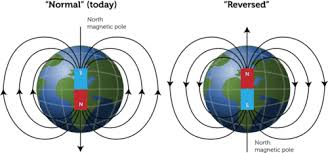
Cause of magnetic field reversal

Magnetic Reversals and Excursions

  • Magnetic reversal is a phenomenon where the magnetic north and south poles swap places. It occurred 183 times in the past 83 million years.
    • The last major reversal was the Brunhes-Matuyama reversal, about 780,000 years ago.
    • It can take thousands of years to complete, estimated at 22,000 years.
  • Magnetic excursions are temporary and incomplete shifts in the magnetic field direction. It occurs 10 times more frequently than full reversals. Theexamples are as:
    • Norwegian-Greenland Sea event (64,500 years ago),
    • Laschamps and Mono Lake (34,500 years ago),
    • Bagwalipokar excursions ( Uttarakhand): researchers found evidence of two excursions—15,500–14,700 years ago and 8,000–2,850 years ago.

Concerns Arising from Field Instability

  • Atmospheric Vulnerability: During weak-field phases, Earth’s atmosphere is more exposed to harmful solar wind and cosmic rays.
  • Technological Impacts: It could disrupt power grids, satellite operations, and communication systems.
  • Biological Impact: Many animals, such as birds, sea turtles, and whales, rely on Earth’s magnetic field for navigation. A flip or fluctuation could disrupt migratory patterns and breeding cycles.

Concluding Remarks

  • Though Earth’s magnetic field has reversed and fluctuated many times in geological history, the precise timing and triggers of such events remain uncertain. 
  • However, as human society grows increasingly dependent on electromagnetic infrastructure, understanding and predicting the behavior of the magnetic field becomes vital.

Source: DTE


Other News of the Day

Syllabus: GS2/Governance Context The Sample Registration System (SRS) Statistical Report 2021, released by the Registrar General of India (RGI), highlights that India’s Total Fertility Rate (TFR) has remained constant at 2.0 in 2021, the same as in 2020. The survey was conducted in 8,842 sample units across all States, covering about 84 lakh sample population....
Read More

Syllabus: GS2/ International Institutions In News The Executive Board of the International Monetary Fund (IMF) decided to allow for “an immediate disbursement” of $1 billion (around Rs 8,500 crore) to Pakistan. This disbursal was done as part of IMF’s Extended Fund Facility (EFF) to Pakistan. What is the Extended Fund Facility (EFF)? The Extended Fund...
Read More

Syllabus: GS3/Agriculture Context Indian farmers continue to choose rice and wheat as their primary crops despite growing discourse around crop diversification, and complex interplay of historical legacy, economic security, policy incentives, and agro-ecological conditions. Rice and Wheat Production in India (2024-25) Wheat Production: It is estimated at 122.724 million tonnes, covering 330.8 lakh hectares. Major...
Read More

Syllabus: GS3/Environment  Context The Commission for Air Quality Management (CAQM) in the National Capital Region and adjoining areas announced a 19-step directive for state governments to eliminate stubble burning. About The comprehensive plan outlined here represents one of the most robust multi-tiered efforts to curb stubble burning and its associated air pollution across Punjab, Haryana,...
Read More

Syllabus: GS3/Science and Technology Context May 11 marked the 27th National Technological Day of India. This year’s theme is “YANTRA”, which signifies transformation through advanced research and technological acceleration. About Former Prime Minister Atal Bihari Vajpayee designated May 11 as National Technology Day in India to commemorate the Pokhran nuclear tests conducted by the Indian...
Read More

Syllabus :GS 3/Environment In News The International Energy Agency (IEA) released Global Methane Tracker 2025. The IEA’s Global Methane Tracker  It is a vital tool for reducing methane emissions in the energy sector.  It offers updated estimates of emissions using the latest satellite and ground-based data, alongside information on the costs and opportunities for reduction. ...
Read More

Buddha Purnima Syllabus: GS1/ History and Culture Context This year the Vaishakh Buddha Purnima is being celebrated on 12th May. Buddha Purnima Buddha Purnima is the most sacred festival for Buddhists, observed on the full moon day of Vaishakh (April-May). The festival acts as a reminder to live a life of kindness, non-violence and wisdom....
Read More
scroll to top