


Syllabus: GS3/Science & Technology
Context
- According to the latest data disclosed by the Department of Science and Technology (DST), India’s spending on research and development (R&D) surged to 0.83% of GDP in 2021-22, , marking the first time since 2009-10 that the country crossed the 0.8% threshold.
What is Gross Expenditure on Research and Development (GERD)?
- It is the sum of all resources dedicated to research and development during a given period.
- It includes money spent on personnel, equipment, materials, and other costs associated with R&D activities by the Central Government, State Governments, Higher Educational Institutions (HEIs), Public Sector Enterprises (PSEs) and Private Industry.
- GERD is a key indicator of a country’s investment in innovation and its capacity to generate new knowledge and technologies.
- The estimates imply a significant rise in the share of the private sector, with industry accounting for more than half (51.8%) of the total R&D expenditure of India in 2023-24.
- Factors Behind the Increase: Possible contributors could be:
- A jump in private sector investment.
- Broadening the scope of DST surveys to embrace international corporations and enterprises not covered under the former recognition framework of DSIR.
- Economic activity recovery following the pandemic.
- Increasing importance of technology demanding areas like electronics, pharmaceuticals, biotechnology, digital technologies and space.
National Science and Technology Management Information System (NSTMIS)
- It is a programme of DST that was established in 1982 under the Ministry of Science and Technology.
- It serves as the country’s nodal system for collecting, analysing and disseminating Science, Technology and Innovation (STI) data to support evidence-based policymaking.
Key Functions
- It compiles India’s official Research and Development (R&D) statistics, including GERD.
- It uses internationally accepted methodologies based on UNESCO and OECD (Frascati Manual) guidelines.
- It publishes reports such as R&D Statistics at a Glance and other STI indicators for policy formulation and international comparison.
Key Highlights (GERD in ₹ lakh crore)
- GERD was reduced in the COVID-19 pandemic in 2020-21.
- Expenditure bounced back sharply in 2021-22, rising by over 53%.
- R&D investment has been growing since then.
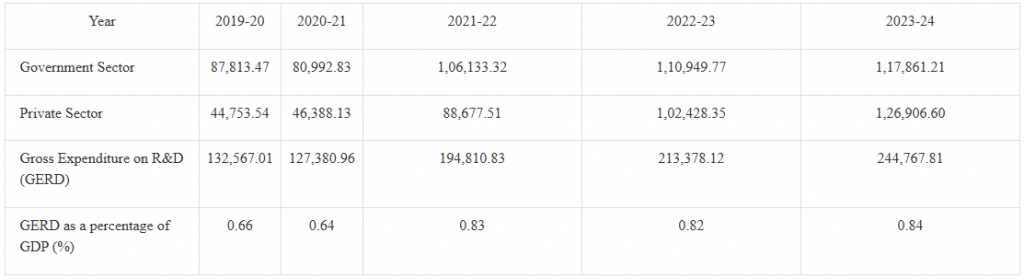
- Structural Shift to Private Sector-led Innovation: For the first time, private industry accounted for more than all levels of government combined.
- It is a structural shift in India’s innovation ecosystem.
- It brings India closer to the advanced economies where the corporate sector is the biggest spender on R&D.
- Industry R&D Spending Almost Doubled: It suggests Indian companies are investing more in research, technological development and innovation.
Why is this Significant?
- Increased Innovation Capability: More R&D investment improves scientific research, technical innovation, industrial competitiveness, productivity growth, and long-term economic development.
- Larger Role of Industry: Rise in share of private investment indicates increased confidence of industry in innovation-led growth, growth in in-house R&D by Indian and global firms and greater collaboration between university, government and industry.
- Global Competitiveness: India is amongst the top countries in the world in scientific publications, availability of scientific talent and start-up environment.
- The report finds that increased R&D investment can help translate these strengths into commercial innovation and sophisticated manufacturing.
India’s Position Compared to Major Economies
- India’s R&D intensity still lags behind other innovation-driven economies. For example:
- Israel (~5%); South Korea (4.8%); United States (3.5%); Japan (3.3%); China (2.4%); and India (0.83% in 2021-22).
- It indicates considerable scope for further expansion.
Challenges
- R&D expenditure remains below the levels of major economies.
- Public sector investment has grown only gradually.
- Stronger industry-academia collaboration is still needed.
- Commercialisation of research remains limited.
- Regional disparities in research infrastructure persist.
Government Initiatives to Promote R&D
- National Research Foundation (NRF) under the act Anusandhan National Research Foundation.
- Research, Development and Innovation (RDI) Scheme to catalyse private sector investment.
- Promotion of industry-academia collaboration through various DST, DBT and CSIR programmes.
- Introduction of Enabling Policy Frameworks such as the Geospatial Policy 2022, Space Policy 2023, and BioE3 (Biotechnology for Economy, Environment and Employment) Policy 2024 with the provisions for increased participation from the private sector.
- National Missions such as National Quantum Missions, National Mission on Interdisciplinary Cyber-Physical Systems, India Semiconductor Mission, National Supercomputing Mission, etc.
- NITI Aayog has assessed India’s performance in the Global Innovation Index, released by WIPO.
- India’s rank in the Global Innovation Index (GII) moved up from 46th in 2021 to 38th in 2025.
- Other efforts include Atal Innovation Mission (AIM), Startup India, National Quantum Mission, and IndiaAI Mission.
Way Forward
- Gradually raise GERD for India to about 2% of GDP over the medium term.
- Keep investing heavily in public basic research, but also encourage more private sector involvement.
- Promote further collaboration between industry and academia.
- Enhance mechanisms for technology transfer and commercialisation.
- Promote developing technologies such as artificial intelligence, semiconductors, biotechnology, quantum technologies, and clean energy.
- Strengthen innovation ecosystems across states through research infrastructure and skilled human resources.
Previous article
Supreme Court Seeks Union’s Response On Plea Challenging CAPF Act
Next article
Emerging Challenges Faced by the ISRO
