


Syllabus: GS3/ Economy
In News
- The “Blooming Beyond Borders” report highlighted floriculture as a sunrise industry, with production of about 4.9 million tonnes in 2025-26 and exports of USD 258 million.
About Floriculture
- Meaning: Floriculture is the branch of horticulture that deals with the cultivation, production of planting material and marketing of flowers and ornamental crops.
- Cultivation Systems: Flowers are grown both in open fields and under protected cultivation such as greenhouses.
- Open field crops include marigold, tuberose and chrysanthemum, while export crops like gerbera and carnation are grown in greenhouses for uniform quality.
| Category | Features | Examples |
| Loose Flowers | Harvested without long stems and sold by weight, mainly for garlands and worship | Marigold, Jasmine |
| Cut Flowers | Harvested with stems for bouquets and vase arrangements | Rose, Gerbera, Carnation, Orchid |
| Others | Cut foliage, potted and bedding plants, seeds and dry flowers | Ferns, Ornamental plants |
India’s Floriculture at a Glance
- Area and Production: About 4.1 lakh hectares were under floriculture in 2025-26, producing 36.5 lakh tonnes of loose flowers and 12.3 lakh tonnes of cut flowers (3rd Advance Estimates).
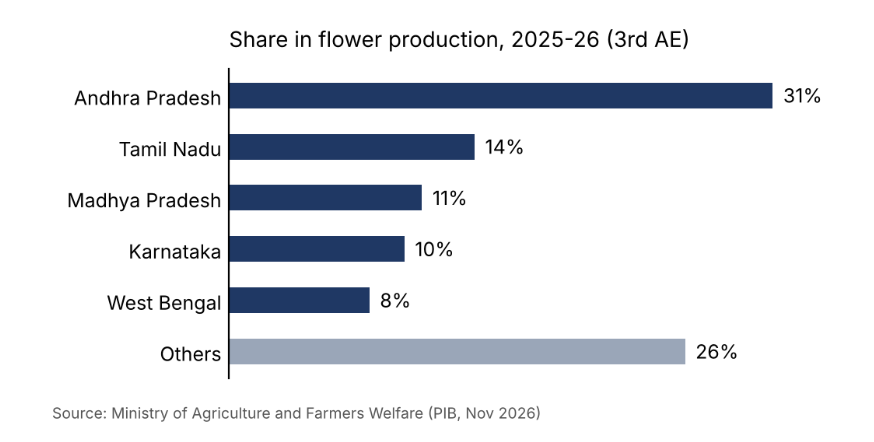
- Regional Concentration: Andhra Pradesh alone accounts for nearly a third of flower production, while the North East contributes about 4%, led by Assam and Nagaland.
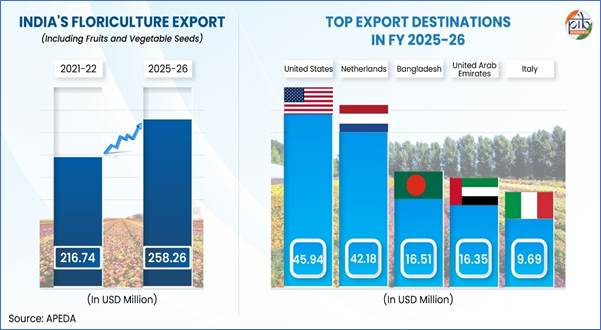
- Exports: Floriculture exports, including seeds, rose from USD 216.74 million (FY22) to USD 258.26 million (FY26). Dry flowers form the largest share due to their longer shelf life.
- E.g., the first export of Anthurium flowers from Mizoram to Singapore was flagged off in February 2025 by APEDA.
Significance of Floriculture
- Higher Farm Incomes: Flowers earn far more per hectare than cereals, which makes them suitable for small farmers seeking crop diversification.
- Employment Generation: The sector is labour intensive across harvesting, grading and garland making, and employs a large number of women.
- Value Addition: Flowers feed into perfumery, cosmetics, natural dyes and medicines.
- E.g., Jasmine and rose in fragrances, calendula and chamomile in pharmaceuticals, and marigold in natural dyes.
- Stable Domestic Demand: Religious, social and urban lifestyle uses such as weddings and event décor ensure a large home market.
- Tourism and Regional Branding: The Tulip Garden at CSIR IHBT, Palampur attracted over 1.5 lakh visitors (May 2026).
Key Challenges
- High Perishability: Weak cold chain and poor post harvest handling lead to heavy losses, especially for loose flowers.
- Small Global Footprint: Despite its scale, India’s exports are tiny compared with leaders like the Netherlands, Colombia and Kenya.
- Costly Inputs: Greenhouses are expensive for small farmers, and quality planting material and new varieties are often imported with royalty payments.
- Logistics Bottlenecks: High air freight costs and limited perishable cargo capacity reduce export competitiveness.
- Unorganised Markets: Most flowers are sold through informal mandis with little grading or price discovery.
Government Initiatives
- Mission for Integrated Development of Horticulture (MIDH): Supports floriculture through the National Horticulture Mission, the Horticulture Mission for North East and Himalayan States, and the National Horticulture Board.
- Export Support: APEDA promotes exports, with concessions on seeds, planting material, equipment and air freight. NABARD finances protected cultivation and precision farming.
- Research: ICAR, CSIR, State Agricultural Universities and the All India Coordinated Floriculture Improvement Project develop new varieties and practices.
- CSIR Floriculture Mission (2021): Brought over 2,208 hectares under flowers, benefiting 16,220 people across 399 clusters in 26 States and UTs.
- CSIR Aroma Mission (2017): Expanded aromatic crops to over 51,000 hectares and enabled about 6,000 tonnes of essential oils worth around ₹600 crore.
- Lab to Land Innovations: Tulips at Palampur (Himachal Pradesh) and Eustoma at Sambalpur (Odisha) show that exotic flowers can be adapted to Indian conditions.
Way Forward
- Cold Chain and Auction Centres: Set up pack houses, reefer transport and organised auction platforms in major flower belts.
- Indigenous Varieties: Breed Indian varieties and protect them under the PPV&FR Act, 2001 to reduce royalty dependence.
- Cluster and FPO Model: Aggregate small growers to share greenhouses, grading and export logistics.
- Value Added Products: Promote dry flowers, essential oils, natural dyes and incense made from temple flower waste.
- Market Access: Use new FTAs with the UK and the EU to target premium European markets, and develop the North East for orchids and anthuriums.
Source: PIB
Next article
News In Brief 25-11-2026
