


Syllabus: GS2/International Relations
Context
- India and Nepal adopted a comprehensive 10-pillar Joint Vision titled ‘Viksit Bharat and Samunnat Nepal’ during the state visit of the PM of Nepal, H.E. Balendra Shah, to India.
Ten Pillars of the India–Nepal Joint Vision
- Comprehensive Economic and Development Partnership: Promote cross-border special economic zones/parks for export-oriented manufacturing near the India-Nepal border.
- India will extend INR 15,000 crore in development assistance, including INR 3,500 crore grant assistance and INR 11,500 crore Line of Credit for energy projects.
- Physical and Digital Connectivity: Launch of direct express rail service between Ayodhya and Janakpur and a motorable bridge across the Mahakali River between Dharchula and Darchula.
- Develop cross-border petroleum infrastructure, including the proposed Siliguri–Jhapa pipeline.
- Expedite railway projects, including Jayanagar–Bardibas, Jogbani–Biratnagar and Raxaul–Kathmandu Rail Link.
- Expedite cross-border retail payments, building on the linkage between India’s UPI and Nepal’s national payment system.
- Energy, Water Resources and Climate Resilience: Accelerate multipurpose projects, including Pancheshwar and Saptakoshi–Sunkoshi.
- Explore a pilot project on green hydrogen in Nepal.
- Good Governance: Exchange technical expertise and best practices in Digital Public Infrastructure (DPI), including digital identity, payments and e-governance.
- Arrange training of Nepali civil servants through the National Centre for Good Governance (NCGG).
- Technology, Space and Innovation: Expand the Indian–Nepal Startup Partnership Network (IN-SPAN) and establish a Startup Centre of Excellence in Kathmandu and a Digital Nomads and Innovation Hub in Pokhara.
- Develop a Nepali-language Large Language Model through collaboration with Bhashini.
- Education and Skill Development: The opening of branches/campuses of reputed Indian higher educational institutions in Nepal will be explored, beginning with an IIT.
- A vocational training institute will be established through Indian assistance in Nepal.
- Sports: India will support the establishment of a national cricket coaching/training academy in Nepal and the development of cricket infrastructure.
- Similar opportunities in other sports such as badminton, tennis, shooting, and athletics will also be explored.
- Culture and Tourism: Development of Ramayana, Buddhist and Shiv–Shakti circuits by linking Janakpur–Ayodhya, Lumbini–Bodhgaya–Sarnath–Kushinagar and Kathmandu (Pashupatinath)–Varanasi, and through sister-city agreements.
- Establishment of a Nalanda Centre at Lumbini Buddhist University (LBU).
- Organise an annual youth cultural festival alternately in India and Nepal.
- Health: Strengthen research collaboration between Indian Council of Medical Research (ICMR) and Nepal Health Research Council (NHRC), and the drug regulatory authorities of India (CDSCO) and Nepal (Department of Drug Administration).
- Establish India–Nepal Jan Aushadhi Kendras to improve access to affordable quality medicines.
- Collaborate for upgrading the National Medical Laboratory of Nepal.
- Agriculture: Expedite implementation of the Work Plan for 2026-2030 between Indian Council of Agricultural Research (ICAR) and Nepal Agricultural Research Council (NARC).
- Establish an Agro-Industrial Park in Chitwan with India’s grant assistance.
- Establish an ICAR Centre of Excellence in Nepal.
About India-Nepal Relations
- Shared Border: The country shares a border with five Indian states – Sikkim, West Bengal, Bihar, Uttar Pradesh and Uttarakhand.
- Land-locked Nepal relies heavily on India for the transportation of goods and services and access to the sea is through India.
- The India-Nepal Treaty of Peace and Friendship: Signed in 1950, it forms the bedrock of the special relations that exist between India and Nepal.
- Nepalese citizens avail facilities and opportunities on par with Indian citizens in accordance with the provisions of the Treaty.
- Defence Cooperation: India has been assisting the Nepal Army (NA) in its modernisation by supplying equipment and providing training.
- Both countries conduct Joint Military Exercise SURYA KIRAN alternately in India and in Nepal.
- Since 1950, India and Nepal have been awarding each other’s Army Chief with the honorary rank of General.
- The Gorkha regiments of the Indian Army are raised partly by recruitment from hill districts of Nepal.
- Economic Relations: The India-Nepal goods trade was worth about US$ 9.38 billion in Financial Year 2025-26. This represents more than 60% of Nepal’s total external goods trade.
- India is also Nepal’s biggest export destination, receiving more than 80% of Nepal’s goods exports in FY 2025-26.
- India is also the largest source of foreign investment in Nepal accounting for almost 1/3rd of the total FDI received by the country.
- Connectivity and Development Partnership: India is the largest developmental donor of Nepal in the field of priority sectors such as health, education and connectivity.
- Some of the major projects include Gauchar Airport (presently Tribhuvan Airport), East West Highway, development of cross-border rail links and establishment of Integrated Check Posts.
- Since 2006, India has provided Lines of Credit worth US$ 750 million to Nepal.
- Energy Cooperation: India and Nepal have had a Power Exchange Agreement since 1971 for meeting the power requirements at the border.
- Joint Vision Statement on Power Sector Cooperation 2022: It includes joint development of power generation projects in Nepal, development of cross-border transmission infrastructure, and coordinated operation of the national grids.
- Humanitarian Assistance and Disaster Relief (HADR): In the wake of the 2015 earthquake in Nepal, India was the first responder and carried out its largest disaster relief operation abroad (Operation Maitri).
- India launched a Humanitarian Assistance and Disaster Relief (HADR) response after devastating flash floods hit Nepal in August 2026.
- It also demonstrates India’s role as a first responder in the neighbourhood, while strengthening humanitarian and people-to-people ties with Nepal.
- Cultural Ties: The leaders of the two countries have often noted the age-old ‘roti beti’ relationship, which refers to cross-border marriages between people of the two countries.
Areas of Concerns between India & Nepal
- Treaty of Peace and Friendship of 1950: It was an effort to strengthen and develop ties and to perpetuate peace between the two countries.
- Over time, Nepal believed the treaty was asymmetrical and incompatible with the national interest of Nepal.
- India has consistently stated it is open to reviewing the treaty “in a constructive and forward-looking manner”.
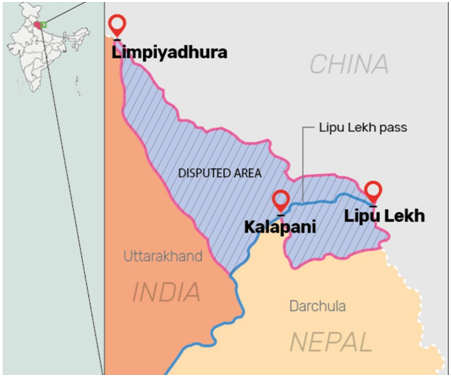
- Kalapani dispute: The area is in India’s control, but Nepal claims the region because of historical reasons. The area is the largest territorial dispute between Nepal and India.
- Trust Deficit between the Two Countries: Perception in Kathmandu that India interferes in Nepal’s internal political processes.
- India’s concerns about growing Chinese influence in Nepal’s infrastructure, trade, and political decisions.
- Occasional political narratives in Nepal portraying India as hegemonic.
- Security Concerns: Both India and Nepal have shared security concerns, including issues related to cross-border terrorism, trafficking, and border security.
- Perception of Unequal Relationship: Some segments of Nepalese society have expressed concerns about what they perceive as an unequal relationship with India, with concerns of economic dependence and a lack of reciprocity in the bilateral relationship.
Way Ahead
- Strengthen India’s development partnership with Nepal through timely project implementation, connectivity, trade facilitation and investment, while addressing concerns over growing external influence.
- Strengthen cooperation against cross-border trafficking, terrorism and illegal activities while preserving the open border and people-to-people movement.
- Further Strengthen cultural, educational, tourism, employment and community-level exchanges to sustain the traditional ties between the two countries.
Source: PIB
Previous article
News In Brief 23-11-2026
Next article
India–Germany Strategic Partnership
