


Syllabus: GS1/ Geography
Context
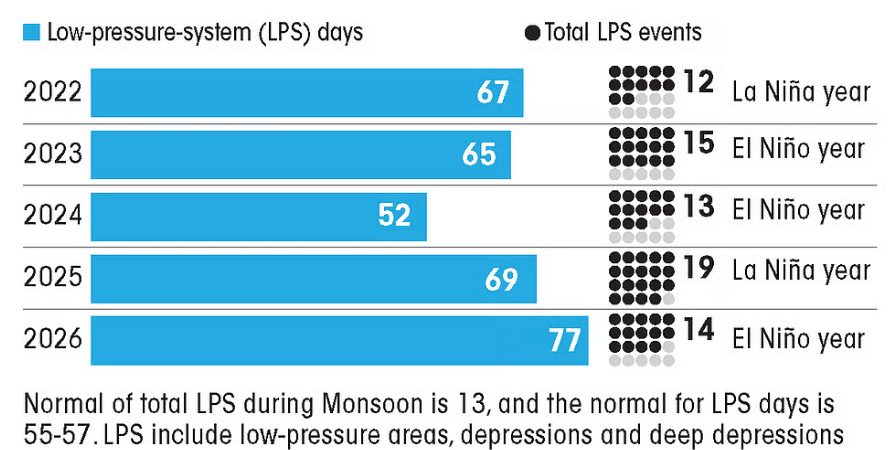
- Recently, an analysis highlights how prolonged low-pressure system (LPS) activity is concentrating monsoon rainfall over particular regions, contributing to extreme rainfall events even when the country records an overall rainfall deficit.
About Low-Pressure Systems
- A low-pressure system is a region where the atmospheric pressure is lower than that of the areas around it.
- This causes air to concentrate and ascend, leading to the formation of clouds and sometimes rain, if there is enough moisture.
- Low-pressure systems emerge in the Bay of Bengal and migrate inland over the Indian subcontinent, bringing moisture and altering the pattern of southwest monsoon rainfall.
- Their rainfall depends on factors such as moisture availability, atmospheric instability, wind patterns, the system’s movement and interaction with geographical features such as mountains.
Monsoon
- The monsoon is a seasonal reversal of winds because of differential heating and the resulting pressure differences between land and sea.
- Onset and Retreat: The monsoon season in India starts in early June and lasts until September.
- The arrival of the southwest monsoon winds, which bring moisture-laden air from the Indian Ocean, marks the onset of the monsoon.
- The withdrawal or retreat of the monsoon typically begins in October.
- The northeast monsoon, occurring from October to December, brings rainfall to parts of southern India.
- The northeast monsoon is key for Tamil Nadu, Kerala, Puducherry, Karaikal, coastal Andhra Pradesh, Rayalaseema, and Yanam in southern India.
Factors Influencing Low-Pressure Systems
- Monsoon circulation: The moisture of the southwest monsoon is carried from the Indian Ocean to the subcontinent.
- The monsoon circulation determines the position of low-pressure systems, their path and the amount of rainfall they bring.
- El Niño–Southern Oscillation (ENSO): El Niño is a cyclical warming of the central and eastern equatorial Pacific Ocean, which might impair the Indian summer monsoon circulation.
- However, the effects are variable over years and areas and do not predict rainfall results on their own.
- Indian Ocean Dipole (IOD): A positive IOD, characterised by relatively warmer sea-surface temperatures in the western Indian Ocean than in the eastern equatorial Indian Ocean, can sometimes offset the adverse influence of El Niño on Indian monsoon rainfall.
- Madden–Julian Oscillation (MJO): This eastward-moving pattern of tropical atmospheric convection influences active and break phases of the monsoon, affecting conditions favourable for rainfall-producing systems.
- Somali Jet: This strong cross-equatorial low-level wind current transports moisture towards the Arabian Sea and the Indian subcontinent, thereby supporting monsoon circulation.
- Western Disturbances: These eastward-moving extratropical weather systems can interact with monsoon circulation and influence rainfall over northwestern India, particularly during the monsoon withdrawal period.
Impact of Prolonged Low-Pressure System (LPS)
- Rainfall concentration: Persistent systems can repeatedly bring moisture to the same geographical corridor, producing heavy rainfall in some regions while leaving areas outside their tracks relatively dry.
- Agricultural productivity: Delayed rainfall can disrupt sowing and crop establishment, while concentrated heavy rainfall can cause waterlogging, soil erosion and crop damage.
- Food security: Uneven rainfall can affect crop yields, agricultural prices and farm incomes, particularly in regions dependent on rain-fed agriculture.
- Disruption of Hydropower and Reservoir Operations: Sudden inflows and increased sedimentation can complicate dam operations, increase pressure on reservoir management and affect hydropower generation.
- Interaction with the Himalayas: When moisture-laden systems move towards the Himalayan foothills, the forced ascent of air over mountain slopes can intensify rainfall and increase the risk of landslides and flash floods.
Concluding remarks
- India’s monsoon resilience depends not only on the total rainfall received but also on its timing, geographical distribution and intensity.
- Improved understanding of low-pressure systems, combined with better forecasting and region-specific water and agricultural planning, is essential to manage the risks associated with an increasingly uneven rainfall pattern.
Source: DTE
Previous article
IDBI Bank Sale and India’s Disinvestment Strategy
Next article
India’s Inland Navigation Ecosystem
