


Khadi and Village Industries (KVI)
Syllabus: GS3/ Economy
Context
- Khadi and Village Industries (KVI) have continued to play a significant role in promoting rural livelihoods, generating employment and strengthening the vision of an Atmanirbhar Bharat.
Khadi and Village Industries Commission (KVIC)
- The Khadi and Village Industries Commission (KVIC) is a statutory body established in 1957 under the Khadi and Village Industries Commission Act, 1956.
- It functions under the Ministry of Micro, Small and Medium Enterprises (MSME) and promotes khadi and village industries to generate rural employment, encourage self-employment and strengthen local production.
- Its major functions include providing financial assistance, training artisans, supporting marketing and developing village-based enterprises.
Initiatives to Promote Khadi and Village Industries
- Khadi Vikas Yojana (KVY) promotes Khadi sector through the existing schemes components like;
- Modified Market Development Assistance (MMDA),
- Interest Subsidy Eligibility Certificate (ISEC),
- Workshed Scheme for Khadi Artisans,
- Strengthening infrastructure of existing weak Khadi Institutions,
- Assistance for Marketing Infrastructure and Khadi (Science and technology).
- Gramodyog Vikas Yojana (GVY) promotes village industries through common facilities, technology upgradation, training and toolkit distribution.
- A Centre of Excellence for Khadi (CoEK) has been established by KVIC in collaboration with the National Institute of Fashion Technology (NIFT), New Delhi to provide design intervention, product development, and market support for khadi products.
Source: PIB
Global Greenfield Investments
Syllabus: GS3/Economy
Context
- As per the report of the UN Conference on Trade and Development (UNCTAD), India’s share in global greenfield investments during 2020-25 is at 5.7%.
Greenfield Investments
- A greenfield investment is a type of foreign direct investment (FDI) where a parent company launches a business operation abroad by building everything up on its own.
- Greenfield projects involve building from the ground up, contrasting with brown-field investments that use existing structures.
- Greenfield investments have their risks, including large investments of capital, time, and effort, as well as the need to deal in potentially unfamiliar business and political environments.
- Through incentives, developing countries attract greenfield investments that create jobs and boost economies.
Findings of the Report
- From 2020 to 2025, strategic sectors grew from 16% to 44% of global greenfield investment.
- Strategic sectors such as artificial intelligence (AI) infrastructure and related technologies attracted the largest share of overall global greenfield investment.
- AI infrastructure was followed by the semiconductor value chain (8.1%) and energy transition technologies and services (7.8%).
- Region-wise Investment: Europe accounted for 28.4% of strategic investment and North America captured another 28%.
- Among developing economies, capital is primarily funnelled into developing Asia (26.5%), with China, India, Indonesia, Malaysia and Singapore as leading jurisdictions for new investments.
- India Specific: India accounted for 5.7% of global greenfield investments during 2020 to 2025, followed by Malaysia (4%), Indonesia (3.8%), and China (2.8%).
- India ranks high in terms of the number of industrial policies it has implemented over the last two decades or so.
- During 2008-21, India implemented 1,416 industrial policies, behind only China (4,201) and the U.S. (4,025).
Source: TH
The Central Asian Flyway (CAF)
Syllabus: GS3/Biodiversity
Context
- The Central Asian Conservation Network (CACN) has launched a new Central Asian Flyway Digital Hub.
About Digital Hub
- It aims to strengthen the sharing of knowledge and information for the conservation of migratory birds across one of the world’s major migration routes.
- It will bring together information on migratory bird species, important flyway sites, conservation projects and opportunities for participation.
- It will also provide dedicated portals for recording bird collisions and sightings of marked birds.
The Central Asian Flyway (CAF)
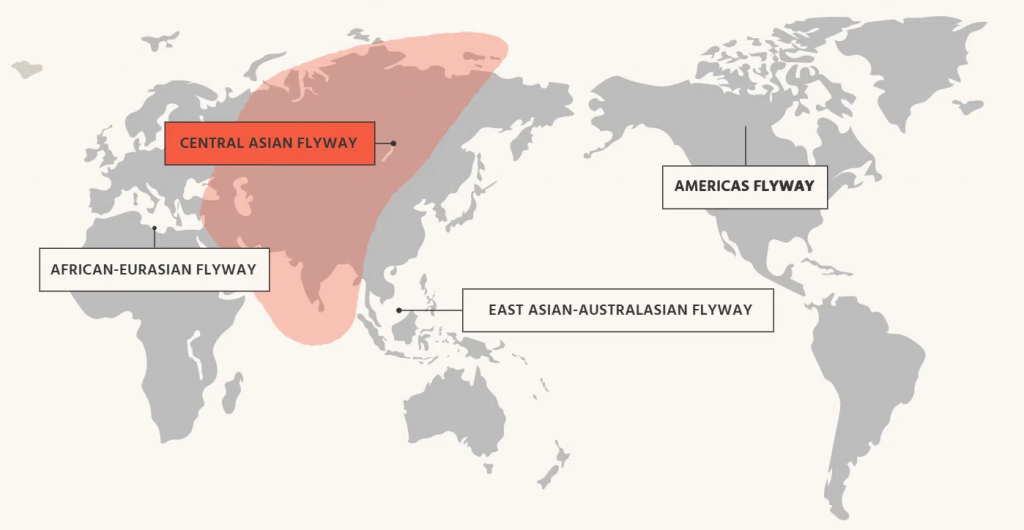
- CAF is a vast migratory corridor stretching across 30 countries of North, Central and South Asia and the Trans-Caucasus, connecting the Arctic and Indian Oceans.
- It encompasses some of the world’s most important routes for migratory waterbirds, landbirds, and raptors, many of which are threatened or declining.
- The CAF is one of the major migratory bird flyways recognised in international conservation efforts, particularly under the Convention on Migratory Species (CMS).
- More than 600 bird species use the flyway, making cooperation and information sharing across national boundaries essential for their conservation.
Source: DTE
CAQM Panel Proposes 100% Electric Cars in Delhi by 2030
Syllabus: GS3/ Environment
Context
- A 15-member expert committee appointed by the Commission for Air Quality Management (CAQM) has recommended a phased phase-out of older vehicles in Delhi-NCR.
Key Recommendations
- The committee has recommended the immediate phase-out of BS-I, BS-II and BS-III vehicles in Delhi-NCR.
- It has proposed phasing out BS-IV vehicles by 2030, with a pilot restriction during winter 2026.
- It has recommended phasing out BS-VI two-wheelers by 2035 and BS-VI four-wheelers by 2040.
- From 2035, the committee has suggested considering restrictions on BS-VI vehicles if the average AQI exceeds 200.
Commission for Air Quality Management (CAQM)
- CAQM was constituted under the Commission for Air Quality Management in National Capital Region and Adjoining Areas Act, 2021.
- Objective: The Act provides for the constitution of a Commission for better coordination, research, identification, and resolution of problems related to air quality in the National Capital Region (NCR) and adjoining areas.
- Powers of the Commission include;
- Restricting activities influencing air quality,
- Preparing codes and guidelines to prevent and control air pollution,
- Issuing directions on matters including inspections, or regulation which will be binding on the concerned person or authority.
- The Commission may impose and collect environmental compensation from farmers causing pollution by stubble burning prescribed by the central government.
- The Commission issues orders to combat air pollution in NCR under the Graded Response Action Plan (GRAP).
- In case of any conflict, the orders or directions of the Commission will prevail over the orders of the respective state governments, the Central Pollution Control Board (CPCB), state PCBs, and state-level statutory bodies.
Source: THE PRINT
SIDM Champion Awards 2026
Syllabus: Miscellaneous
Context
- Defence Minister Rajnath Singh presented the SIDM Champion Awards 2026 at the 8th Annual Session of the Society of Indian Defence Manufacturers (SIDM).
About
- A total of 15 Champion Awards were presented to recognise organisations for achievements in indigenous technology development, product innovation, design, import substitution, manufacturing excellence and exports.
- Objectives: To encourage Indian industries to invest in technology and product innovations to address capability gaps of defence forces.
- Eligibility Criteria
- All Indian manufacturing companies are eligible to participate in the SIDM Champion Awards.
- Companies with upto max 50% foreign holding and not a subsidiary of a foreign company.
About SIDM
- The Society of Indian Defence Manufacturers (SIDM) is a not-for-profit association formed to be the apex body of the Indian defence industry.
- It acts as an advocate, catalyst and facilitator for the growth and capability development of India’s defence industry.
Source: PIB
Noida Airport to Be Renamed After PM Modi
Syllabus: GS2/Governance; GS3/Economy
Context
- The Uttar Pradesh Cabinet has approved a proposal to rename the Noida International Airport at Jewar as ‘Narendra Modi International Airport’.
About
- The Cabinet passed the resolution to mark Prime Minister Narendra Modi’s 25 years of continuous service as the head of a government, beginning with his tenure as Gujarat Chief Minister in 2001.
- Once implemented, it will become the first airport to be named after a sitting Prime Minister. Other airports — Indira Gandhi International Airport, New Delhi; Chaudhary Charan Singh Airport, Lucknow and Lal Bahadur Shastri Airport, Varanasi — are all named after former PMs.
- Located in Jewar, Gautam Buddha Nagar district, Noida International Airport was developed through a public-private partnership between Yamuna International Airport Private Limited — a subsidiary of Zurich Airport International AG — and UP state authorities.
- It is Uttar Pradesh’s largest airport and is poised to become a major aviation hub for the National Capital Region (NCR), alongside Delhi’s Indira Gandhi International Airport.
Source: IE
Previous article
Dignity and Humility: Essential Virtues for Ethical Governance
Next article
News In Short 10-10-2026
