


Syllabus: GS3/Economy
Context
- The Permanent Missions of India and Mali to the United Nations jointly organized an event on the theme “Cotton for Sustainability: Livelihoods, Value Addition and Partnership” at the United Nations commemorating World Cotton Day.
World Cotton Day
- The United Nations General Assembly proclaimed 7 October as World Cotton Day.
- The idea for World Cotton Day originated from the Cotton Four nations, Burkina Faso, Benin, Chad, and Mali aiming to promote cotton by-products and their markets.
- They are the top cotton-producing and exporting countries in sub-Saharan Africa.
- The first World Cotton Day (WCD) event was initiated in Geneva and observed on October 7, 2019.
Cotton Production in India
- Cotton accounts for around 23% of global fibre production.
- Due to its economic importance in India, it is also termed as “White-Gold”.
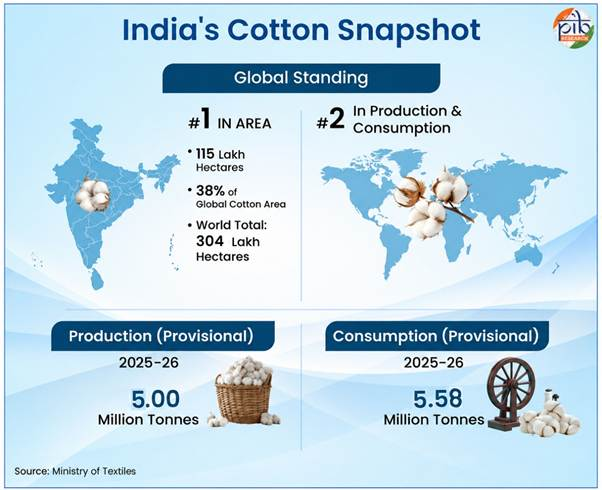
- India is the only country that cultivates all four recognized cotton species. These include G. Arboreum and G. Herbaceum, commonly referred to as Asian cotton.
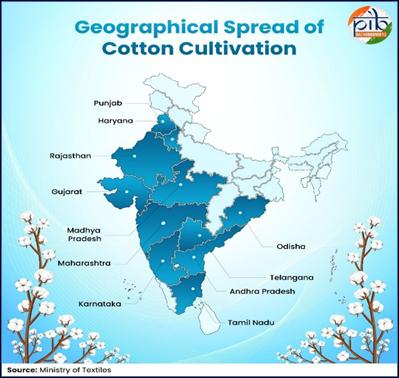
- Cotton production in India is largely concentrated in 9 major states, grouped into 3 distinct agro-ecological zones:
- Northern Zone comprising Punjab, Haryana, and Rajasthan
- Central Zone comprising Gujarat, Maharashtra, and Madhya Pradesh
- Southern Zone comprising Telangana, Andhra Pradesh, and Karnataka
- In addition to these states, cotton is also grown in Odisha and Tamil Nadu.
- Bt Cotton: Bt refers to Bacillus thuringiensis, a naturally occurring soil bacterium. These genes provide resistance against bollworms, a major pest affecting cotton cultivation.
- It was introduced commercially in India in 2002, Bt cotton significantly reduced bollworm infestation and lowered the need for insecticide sprays.
Cotton Exports of India
- In 2024-25, India accounted for 3.37% of total world cotton exports, amounting to 541.69 lakh bales (9.21 million metric tonnes).
- In value terms, cotton exports reached US$ 11.49 billion in FY25.
- The United States of America emerged as the largest destination for Indian cotton fabrics and made-ups exports, followed by Bangladesh.
- Other important destinations included the United Kingdom and the United Arab Emirates.
Challenges Faced by the Sector
- Low Productivity: India’s cotton productivity remains constrained by fragmented landholdings, inadequate irrigation, poor-quality seeds in some areas, and limited adoption of modern farming practices.
- Climate Change: Erratic monsoons, rising temperatures, droughts and unseasonal rainfall affect cotton yields and fibre quality.
- Pest and Disease Attacks: Pink bollworm, whiteflies and other pests cause significant crop losses and increase farmers’ expenditure on pesticides.
- Quality Issues: Contamination during harvesting, storage and transportation, along with inconsistent fibre quality, reduces the competitiveness of Indian cotton in premium markets.
- Issues with Seed Technology: Limited availability of high-yielding, pest-resistant and climate-resilient varieties, along with concerns over the cost and effectiveness of existing seed technologies, affects productivity.
Government Initiatives to Support Cotton Sector
- Strengthening Cotton Farmers through MSP: For 2026-27, the MSP for cotton was increased to Rs. 8,267 per quintal for medium-staple cotton and Rs. 8,667 per quintal for long-staple cotton. This marked an increase of Rs. 557 per quintal for both varieties.
- Mission for Cotton Productivity: A five-year Mission for Cotton Productivity was launched in 2025-26 to strengthen cotton production nationwide.
- It aims to develop climate-resilient, pest-resistant, and high-yielding cotton varieties.
- Cotton production is targeted to increase from 297 lakh bales to 498 lakh bales by 2031.
- Special Project on Cotton under National Food Security Mission: It focuses on large-scale demonstrations of technologies suited to different agro-ecological zones. It covers major cotton-growing states across the country.
- The objective is to improve productivity, fibre quality, and farmer incomes.
- Kapas Kisan App: The mobile application has been introduced to streamline procurement under the MSP system, it enables cotton growers to complete self-registration and book procurement slots.
- Branding of Indian Cotton – Kasturi Cotton Bharat: It seeks to enhance the value and global positioning of Indian cotton through traceability, certification, and branding.
Conclusion
- Efforts to improve productivity, strengthen farmer incomes, modernize procurement, and enhance global competitiveness are shaping a more resilient cotton ecosystem.
- As new initiatives expand quality, sustainability, and value addition, the sector is well-positioned to support livelihoods, industry, and economic growth in the years ahead.
Source: PIB
Previous article
World Mental Health Day 2026
