


Gross Domestic Knowledge Product
Syllabus: GS3/Economy
Context
- The NITI Aayog member said that India is working on a “Gross Domestic Knowledge Product” (GDKP).
Gross Domestic Knowledge Product (GDKP)
- It is a proposed concept for measuring the knowledge generated, accumulated, shared and applied within a country, rather than assessing its economic performance solely through Gross Domestic Product (GDP).
- GDP measures the monetary value of final goods and services produced, whereas GDKP would focus on a country’s knowledge resources and their contribution to development.
- GDKP could consider research and development (R&D), scientific discoveries, patents, innovation and academic output.
- At present, all expenditures on Intellectual Property Products (IPP) are recorded under Gross Fixed Capital Formation (GFCF) — the indicator for capital investments in the GDP dataset for the economy.
What Is the Knowledge Economy?
- A knowledge economy is one where human capital like skills, information, innovation, and intellectual property drives growth, rather than physical inputs or natural resources.
- It operates on two types of knowledge:
- Codified Knowledge: Documented, transmittable (know-what, know-why) like patents, software, academic research
- Tacit Knowledge: Experience-based, harder to transfer (know-how, know-who) like artisanal skills, traditional medicine.
- In major OECD economies, knowledge-based activities contribute over 50% of GDP.
- India’s IT sector, start-up ecosystem, pharmaceutical R&D, and traditional knowledge systems are all part of this, yet remain invisible in standard national accounts.
Source: BS
The National SC-ST Hub (NSSH)
Syllabus: GS2/Governance
Context
- The National SC-ST Hub (NSSH) is emerging as an important initiative to strengthen entrepreneurship among Scheduled Caste and Scheduled Tribe communities.
National SC-ST Hub
- It was launched in 2016 by the Ministry of Micro, Small and Medium Enterprises (MSME).
- The scheme helps address barriers faced by SC/ST-owned enterprises and supports their participation in public procurement.
- Implemented through the National Small Industries Corporation (NSIC).
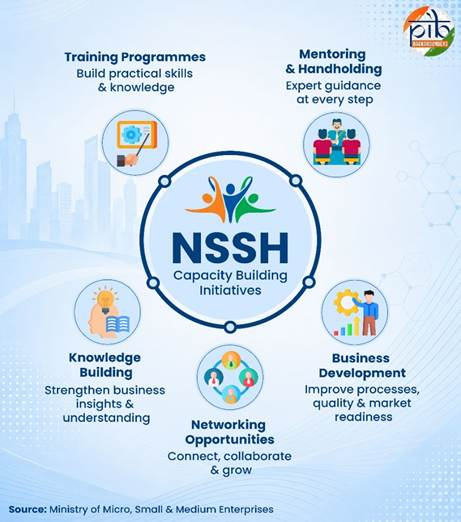
- Enterprise development initiatives under NSSH include training, mentoring, business development, networking and knowledge support.
- Uttar Pradesh, Maharashtra, Karnataka, Tamil Nadu and Assam emerged as the five leading States under the scheme.
- Financial Support: New and existing SC/ST-owned MSEs can receive a 25% capital subsidy, capped at ₹25 lakh, for investment in plant, machinery and equipment financed through institutional credit.
- Single Point Registration Scheme (SPRS): SPRS helps MSEs access Government procurement opportunities through registration with NSIC. Registered MSEs receive free tender sets and exemption from payment of Earnest Money Deposit (EMD).
- Marketing Assistance: The Special Marketing Assistance Scheme (SMAS) supports SC/ST enterprises in improving product visibility and competitiveness through exhibitions, trade fairs, workshops and awareness campaigns.
- Reducing the cost of doing business: Under the Bank Loan Processing Reimbursement Scheme, enterprises can receive reimbursement of 80% of loan processing fees or ₹1 lakh, whichever is lower.
- Market Access: Beyond financial assistance and market access, the National SC-ST Hub provides structured mentorship through its Business Accelerator Programme (BAP).
Source: PIB
BrahMos
Syllabus: GS3/Defence
Context
- The Ministry of Defence has signed a contract worth over 660 crore rupees with BrahMos Aerospace Private Limited for procurement of BrahMos Fire Control System and Launchers for Indian Navy ships.
About
- The BrahMos System fitted onboard various frontline warships is the Indian Navy’s primary Surface to Surface Missile system for maritime strike operations.
BrahMos Missile
- Joint Venture: Between DRDO (India) and NPO Mashinostroyeniya (Russia).
- Name Origin: Derived from the Brahmaputra (India) and Moskva (Russia) rivers.
- First Test: Conducted on June 12, 2001.
- Induction Timeline: Navy (2005), Army (2007) and IAF (2017).
- Type: “Fire and forget” supersonic cruise missile — can be launched from land, sea, or air in all-weather conditions, and is nearly impossible to intercept.
- Combat Use: Reportedly used for the first time during Operation Sindoor.
- Speed:
- Current: Mach 2.8 (Supersonic)
- Future: Mach 5+ (Hypersonic version under development)
- Range:
- Initially 290 km (under MTCR limit)
- Extended to 400 km, with a 600+ km variant under development.
- Stages: BrahMos is a two-stage missile with a solid propellant booster engine.
- Its first stage brings the missile to supersonic speed and then gets separated.
- The liquid ramjet or the second stage then takes the missile closer to three times the speed of sound in the cruise phase.
Source: AIR
SAREX-2026
Syllabus: GS3/Defence
Context
- The Indian Coast Guard conducted the 12th National Maritime Search and Rescue Exercise (SAREX-2026) off Paradip, Odisha.
About
- The exercise witnessed participation by 32 international observers from 30 countries, highlighting international cooperation and interoperability in maritime Search and Rescue (SAR).
- The exercise simulated a Mass Rescue Operation (MRO) involving simultaneous aeronautical and maritime distress situations.
- SAREX-2026 aimed to strengthen a faster, technology-enabled and coordinated Search and Rescue framework, aligned with India’s vision of SAGAR and the spirit of MAHASAGAR.
Source: PIB
Nobel Literature Prize 2026
Syllabus: Miscellaneous
Context
- The 2026 Nobel Prize in Literature has been awarded to Canadian author Anne Carson “for her bold and inventive oeuvre that, in playful dialogue with the classical tradition, has created new forms for contemporary literature.”
About
- Born in 1950 in Toronto, Canada, Anne Carson is a poet, essayist, translator and classicist whose work often brings ancient Greek literature into dialogue with contemporary experiences.

- Her notable works include The Glass Essay (1995), Autobiography of Red: A Novel in Verse (1998) and Float (2016), reflecting her experimental approach to literary form and genre.
Nobel Prize
- The Nobel Prize in Literature is one of the five Nobel Prizes established by the will of Alfred Nobel in 1895.
- It is awarded annually, since 1901, to an author from any country who has produced the most outstanding work in the field of literature in an idealistic direction.
- The award is generally based on an author’s body of work as a whole.
Do you know?
- Rabindranath Tagore is the only Indian to have received the Nobel Prize in Literature so far.
- He was awarded the prize in 1913 for Gitanjali, a body of verse whose spare lyricism and philosophical clarity carried Bengali poetry to a world audience.
- He was also the first Asian to win a Nobel Prize.
Source: TH
Nobel Peace Prize 2026
Syllabus: Miscellaneous
Context
- The 2026 Nobel Peace Prize has been awarded to Navanethem “Navi” Pillay for her efforts to promote peace and international law.
About
- Born into a family of Indian Tamil origin under apartheid in Durban, South Africa, Pillay became a lawyer and legal pioneer, confronting deep structural discrimination, segregation and exclusion.
- She chaired the United Nations Commission of Inquiry on the Occupied Palestinian Territory, which concluded in 2025 that Israel had committed genocide in Gaza.
Nobel Peace Prize
- The prize is awarded by the Norwegian Nobel Committee, whose members are appointed by the Norwegian Parliament.
- The first Nobel Peace Prize was awarded in 1901, jointly to Frédéric Passy of France and Henry Dunant of Switzerland, a co-founder of the International Committee of the Red Cross (ICRC).
- It can be awarded to individuals and organisations, but individuals cannot be awarded the prize posthumously.
Do you know?
- Mahatma Gandhi was nominated for the Nobel Peace Prize five times but never received it, despite his ideals closely align with the UN Charter.
Source: DDNews
Angioplasty
Syllabus: GS2/ Health
Context
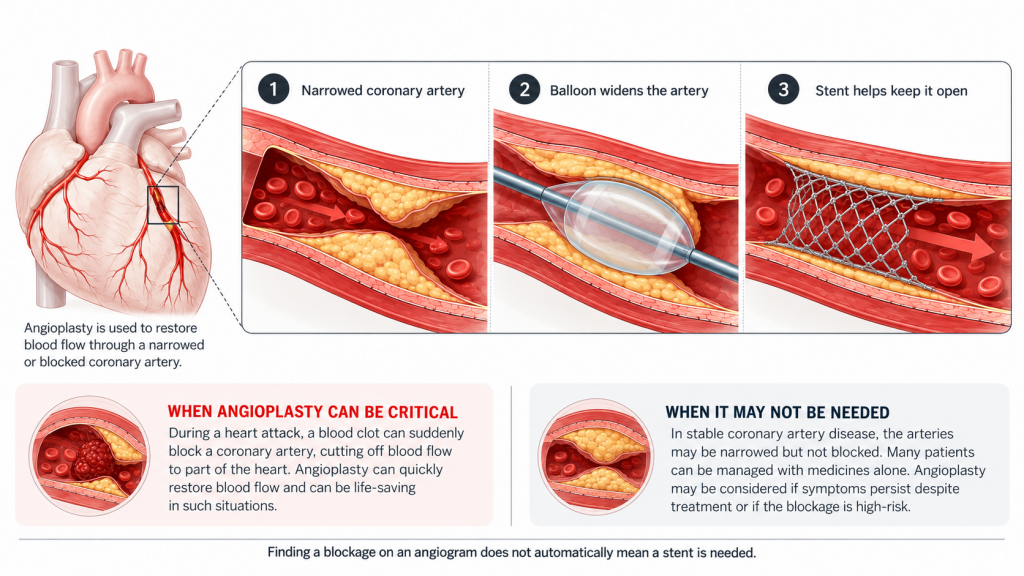
- The Chief Minister of Keralam called for a campaign against unnecessary angioplasty.
What is an angioplasty?
- An angioplasty is a procedure to open a narrowed or blocked heart artery with a small balloon, often followed by placement of a stent or a mesh bridge to keep it wide enough for oxygenated blood to flow.
- Modern stents are drug-coated with clotting medicines and are designed to last a lifetime.
Source: IE
Previous article
PM Modi Calls for Global Cooperation on Cybercrime
Next article
News In Short 09-10-2026
