


Syllabus: GS3/Economy
Context
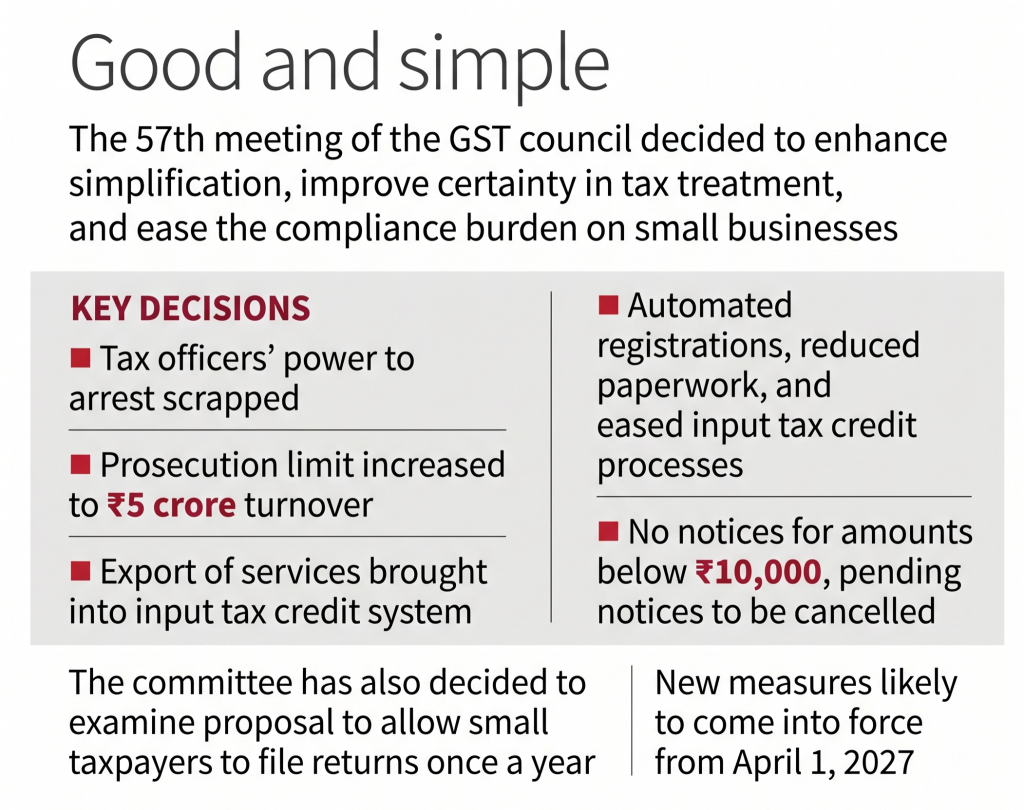
- The 57th GST Council meeting introduced major process and enforcement reforms, including easing registration, refunds and litigation, while proposing to raise the prosecution threshold from ₹1 crore to ₹5 crore.
About GST Council
- The GST Council is a constitutional body established under Article 279A, inserted by the 101st Constitutional Amendment Act, 2016.
- It is chaired by the Union Finance Minister and comprises the Union Minister of State for Finance/Revenue and Finance/Taxation Ministers of States.
- It embodies cooperative federalism, with the Centre having one-third of the weighted voting power and States collectively having two-thirds.
- The Council recommends GST rates, exemptions, model laws, principles of levy and other major GST-related matters.
Key Decisions & Reforms at the 57th GST Council Meeting
- Trust-based Enforcement:
- Recommended removal of arrest powers of GST officers.
- Prosecution threshold proposed to rise from ₹1 crore to ₹5 crore.
- General penalty reduced from ₹25,000 to ₹10,000.
- Goods in inter-State movement can be inspected/detained/seized only by the supplier or destination State officer.
- Interception will require specific intelligence and authorisation of an officer not below Joint Commissioner.
- Simplified Registration:
- Greater certainty regarding documents required for registration.
- At present, 61% of taxpayers receive automatic registration within three working days.
- Low-risk taxpayers will face fewer queries and rejections.
- Small e-commerce sellers can register in one State, rather than every State where they sell.
- Faster refunds and ITC:
- Refund applications are proposed to be acknowledged within 10 days instead of 15 days.
- About 90% of claims are expected to be released within three working days of acknowledgement, based on risk assessment.
- Reforms also seek to reduce hold-ups in Input Tax Credit (ITC).
- Relief For Small Businesses:
- An optional annual-return scheme is proposed for B2C businesses with turnover up to ₹5 crore, subject to final approval.
- Amendments and cancellation of GST registration are also being simplified.
- Digital & Predictable Taxation:
- Faceless assessment for Central GST is proposed, similar to income-tax assessment.
- GST rate changes will henceforth be considered once a year and implemented from the beginning of the subsequent financial year.
- Most changes are expected from 1 April 2027.
Significance for India
- Ease of Doing Business: Lower compliance costs can particularly benefit MSMEs and small e-commerce firms.
- Taxpayer Confidence: Reduced coercive powers and trust-based enforcement can encourage voluntary compliance.
- Lower Logistics Friction: Specific-intelligence-based interception can reduce arbitrary stoppage of inter-State goods.
- Faster Working Capital: Quicker refunds and smoother ITC release can improve business cash flows.
- Cooperative Federalism: Clearer allocation of enforcement powers can reduce Centre-State and inter-State friction.
- Administrative Efficiency: Risk-based and faceless systems can shift GST administration from physical scrutiny towards data-driven compliance.
Related Challenges
- Balancing taxpayer rights with action against fraud, fake invoices and ITC misuse.
- Risk-based systems require high-quality data, cybersecurity and robust algorithms.
- Annual rate-setting may improve predictability but could reduce flexibility during economic shocks.
- Smaller firms may continue to face difficulties due to digital literacy and frequent procedural changes.
- Effective implementation requires coordination among Centre, States and GSTN.
Way Forward
- The next phase of GST reform should focus on stable rules, predictable litigation, stronger data analytics and taxpayer facilitation.
- A transparent faceless system, time-bound refunds, effective appellate mechanisms and targeted action against deliberate evasion can help realise the vision of ‘minimum intrusion, maximum compliance’.
Previous article
Central Armed Police Forces Act Comes into Force
