


GOBARdhan Scheme
Syllabus: GS3/Environment
In News
Union Minister of Petroleum and Natural Gas launched the GOBARdhan Scheme for development of the Compressed Biogas (CBG) sector.
GOBARdhan Scheme
- Galvanising Organic Bio-Agro Resources Dhan (GOBARdhan) was launched in 2018 as an integral part of Solid and Liquid Waste Management (SWM) under Swachh Bharat Mission (Grameen).
- It aimed to convert bio-waste – animal waste, kitchen leftovers, crop residue, and market waste- into biogas and bio-slurry, thereby ensuring cleanliness in villages and enhancing rural lives.
- In August 2026, the Union Cabinet approved the National Circular Bioenergy Scheme- GOBARdhan with a total budget of ₹23,731 crore.
- It is a Central Sector Scheme that provides a ten-year framework from FY 2026-27 to FY 2035-36 to fast-track CBG development in India.
Components
- Assured CBG Offtake: GOBARdhan establishes a dedicated CBG Offtake Assurance framework to provide a reliable and predictable market for producers. Procurement by City Gas Distribution entities will support achievement of the notified CBG Obligation trajectory of 3% in FY 2026-27, 4% in FY 2027-28 and 5% from FY 2028-29 onwards in the CNG (Transport) and PNG (Domestic) segments.
- Stable CBG Pricing Framework: GOBARdhan introduces a stable administered CBG price of Rs.2,110 per Metric Million British Thermal Unit (MMBTU), supported through a government-backed pricing framework.
- Capital Assistance: Eligible greenfield CBG projects will receive capital assistance of up to Rs.2 crore per ton per day (TPD) of installed CBG capacity.
- The support extends beyond core plant machinery to critical value-chain assets for feedstock aggregation, organic manure processing and value addition.
- Brownfield projects expanding their production capacity will also be eligible.
- Development of Pipeline Infrastructure: The Scheme supports both cluster-based and standalone pipeline infrastructure connecting CBG plants with trunk pipelines and City Gas Distribution networks.
- Credit Guarantee Support: A dedicated Credit Guarantee mechanism will strengthen lender confidence and expand the flow of institutional credit to eligible MSME-based CBG projects.
- CBG Ecosystem Challenge Fund: GOBARdhan establishes a dedicated CBG Ecosystem Challenge Fund to accelerate district-level implementation and strengthen local value chains across the CBG ecosystem.
Objectives
- It intends to expand domestic CBG output by around 10 times (to around 5 MMSCMD) using a long-term framework that provides better assurance to investors and lenders.
- It aims to drive a 10-fold increase in compressed biogas (CBG) production, save more than ₹40,000 crore in fuel imports, add over ₹75,000 crore to GDP and create more than 1.5 lakh jobs, as the government seeks to turn agricultural and organic waste into a new source of domestic energy.
Source :TH
Great Indian Bustards
Syllabus: GS3/Environment
In News
Ten captive-bred Great Indian Bustards (GIBs) are set to be released into their natural habitat in Rajasthan’s Jaisalmer as part of an effort to rebuild the species’ wild population.
The Great Indian Bustard (GIB)
- The GIBs are large birds standing about one metre tall and weighing about 15 to 18 kgs.
- It is a keystone species of arid and semi-arid open natural ecosystems, has been on the brink of extinction with its wild population hovering in the range of 120-150 for many years.
- According to latest population estimates, the largest population, 130 (+/-20) is in Rajasthan with about 5-6 individuals across Gujarat, Maharashtra and Karnataka.
- It is the State bird of Rajasthan.
- Conservation
- Listed in Schedule I of the Indian Wildlife (Protection)Act, 1972, in the CMS Convention and in Appendix I of CITES, as Critically Endangered on the IUCN Red List
- Threat: They have faced threats ranging from habitat loss, poaching, and depredation of individuals and GIB eggs by predators.
- More recently, mortality due to collisions with power lines erected to evacuate power from renewable energy projects have posed a threat.
- The Supreme Court has ordered that renewable energy project power lines situated in areas outside the DNP have to be buried underground by December 2027.
- More recently, mortality due to collisions with power lines erected to evacuate power from renewable energy projects have posed a threat.
Source :IE
Exercise ‘Varuna’
Syllabus: GS3/Defence
In News
Indian Naval Ship Trishul arrived at Toulon, France, to participate in the 24th edition of Exercise ‘Varuna’
Exercise ‘Varuna’
- It is the annual bilateral maritime exercise between the Indian Navy and the French Navy.
- It began in 2001, and it has evolved into a cornerstone of cooperation, showcasing the two nations’ commitment to enhancing naval interoperability and operational synergy.
- It will witness professional engagements in harbour and at sea, including cross-deck visits, operational interactions and sporting engagements.
Importance
- It will provide opportunities for both Navies to share experiences and Best Practices, enhance interoperability, and foster greater mutual understanding.
Source: PIB
India-specific tool to predict Sickle Cell Anaemia severity
Syllabus: GS3/Science and Tech
In News
Scientists at the CSIR-Centre for Cellular and Molecular Biology (CCMB) have developed an India-specific disease severity score for sickle cell anaemia (SCA).
Sickle Cell Anaemia
- It is an inherited blood disorder caused by a mutation in the beta globin gene, which produces abnormal haemoglobin causing red blood cells to assume a sickle shape, leading to anaemia, severe pain episodes, organ damage and other complications.
- It is most common in individuals of African, Mediterranean, Middle Eastern, and Indian descent.
- Causes and Symptoms: It is a single-gene mutation illness with a wide range of severity. It is caused by a mutation in the HBB gene, which provides instructions for making haemoglobin.
- Indians seem to have a more benign profile of disease, partly attributable to higher levels of foetal haemoglobin, with certain catastrophic repercussions less common than in African people.
- However, nutritional deficiencies, infections and environmental stressors can aggravate anaemia and disease outcomes.
- Diagnosis : Sickle-cell anemia is typically diagnosed through a blood test. These tests look for the abnormal hemoglobin (HbS) that characterizes the disease.
- Treatment: The management of sickle cell disease (SCD) is aimed at symptomatic relief and prevention of consequences.
- Bone marrow/stem-cell transplantation is possibly curative but is costly, has substantial risks and needs a compatible donor.
- Hydroxyurea, pain medications, blood transfusions and antibiotics are common therapies. More recently, gene-editing medicines have been developed.
- In December 2023, the US FDA approved Casgevy and Lyfgenia, the former being the first FDA-approved therapy using genome-editing technology for SCD.
- India’s Steps: In 2023, the Centre launched the National Sickle Cell Anaemia Elimination Mission to eliminate sickle cell disease as a public health problem by 2047.
- The overall aim of the mission is to enable access to affordable and quality health care to all SCD patients, and to lower the prevalence through awareness, change of practices and screening interventions
Latest Developments
- Scientists at CSIR-CCMB developed an India-specific Severity Score (ISS) for sickle cell anaemia (SCA) utilising clinical data of 171 Indian children.
- The International Paediatric Severity Score had a concordance of just 67% with expert assessment, and researchers have now incorporated clinical criteria often found in Indian infants, such as recurring blood transfusions, severe anaemia and recurrent febrile infections.
- The revised ISS1 improved accuracy to around 83%, and ISS2, based mostly on visible clinical signs, reached almost 85% concordance and reduced reliance on laboratory tests.
- The tool has the potential to support clinicians in making timely treatment decisions, including the management of hydroxyurea, but validation needs to be performed on larger and more diverse cohorts.
Source :TH
Buxa Tiger Reserve
Syllabus: GS3/ Environment
Context
- A three-year-old tigress, T138, has been released into West Bengal’s Buxa Tiger Reserve, marking the beginning of a phased tiger reintroduction programme to establish a self-sustaining tiger population.
About Buxa Tiger Reserve
- Location: It is in the Alipurduar district of northern West Bengal, along the India–Bhutan border.
- Buxa was declared a tiger reserve in 1983 under Project Tiger.
- Ecological significance: It forms part of the Eastern Himalayan foothills and has ecological linkages with the forests of Assam and Bhutan.
- Fauna: Mammals present include the Asian elephant, gaur, Sambar deer, clouded leopard, Indian leopard, and Asian golden cat.
- Tiger population: The reserve has experienced a prolonged absence of a stable resident tiger population due to habitat degradation, fragmentation and declining prey availability.
- Rivers: Sankosh River forms part of the eastern boundary of the reserve along the Assam border.
- Jayanti River: A prominent seasonal river flowing through the Buxa landscape.
Source: TH
Antelope Reef in the Paracel Islands
Syllabus: GS1/ Geography, GS2/ International Relations
Context
- China is constructing a runway on Antelope Reef in the disputed Paracel Islands in the South China Sea, potentially expanding its military reach in the region.
About Antelope Reef
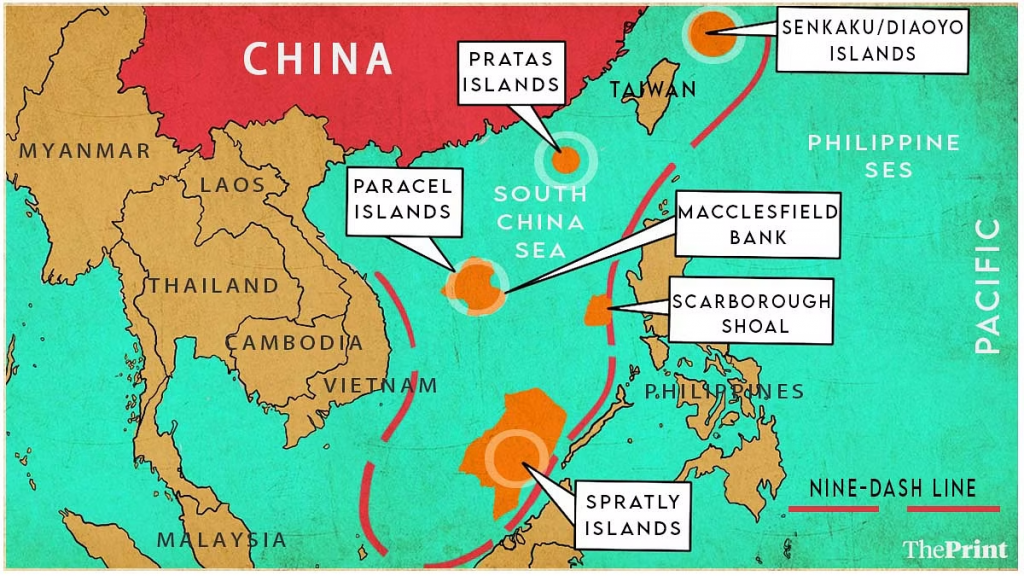
- Location: Antelope Reef is part of the Paracel Islands (Xisha Islands in Chinese), located in the northern South China Sea, near China’s Hainan Island.
- Territorial claims: The Paracel Islands are claimed by China, Vietnam and Taiwan. However, China has exercised effective control over the archipelago since 1974.
South China Sea
- It is a marginal sea of the Western Pacific Ocean.
- It is located between southern China, Taiwan, the Philippines, Indonesia, Vietnam, Thailand, Cambodia and Malaysia.
- It is a crucial maritime gateway and junction for shipping between the Pacific and Indian Oceans.
Dispute in South China Sea
- Southeast Asian countries like China, Vietnam, the Philippines, Brunei, Malaysia and Taiwan have had disputes over the contentious South China Sea region for centuries.
- The two primary points of contention are: The Spratly Islands and the Paracel Islands in the sea.
- Nine-dash line: China stakes claim to most of the region and at the heart of this claim is the U-shaped ‘nine-dash line’ that includes as much as 90 percent of these waters.
- This dotted line was adopted from Chinese maps in the 1940s, and represents Beijing’s claim over the sea and all the land features that are contained within the line.
Source: RT
G7 Nations to Release 100 Million Barrels of Oil
Syllabus: GS2/ IR, GS3/ Energy,
Context
- The Group of Seven (G7) nations have agreed to release 100 million barrels of oil over four months to ease soaring fuel prices, with a substantial release of diesel planned in the first 20 days.
About
- The coordinated release aims to increase the short-term availability of petroleum.
- The International Energy Agency (IEA) will coordinate the release, highlighting the importance of international cooperation during major energy-market disruptions.
Group of Seven (G7)
- It is an intergovernmental organization of seven countries that are the world’s most industrialized and developed economies.
- Member: France, Germany, United Kingdom, Italy, United States of America, Canada and Japan.
- History: It traces its origin to an informal meeting of the Finance Ministers of France, West Germany, the US, Great Britain and Japan (Group of Five) in the wake of the 1973 oil crisis.
- Canada joined the group in 1976 and the European Union (EU) began attending the meetings from 1977.
- It was called the G8 after the original seven were joined by Russia in 1997 and it returned to being called G7 when Russia was expelled as a member in 2014 following the latter’s annexation of the Crimea region of Ukraine.
International Energy Agency (IEA)
- The International Energy Agency (IEA) was set up in the wake of the 1973-1974 oil crisis to help industrialised countries respond to major oil shocks.
- Headquarters: Paris, France.
- Members: The IEA is made up of 32 Member countries including the United States, Canada, Turkey, United Kingdom, Australia, Japan, New Zealand, South Korea etc.
- Association Countries: India, China, Indonesia, Singapore, South Africa, Thailand etc.
- Criteria for membership: A candidate country to the IEA must be a member country of the OECD. In addition, it must demonstrate several requirements. These are:
- Crude oil and/or product reserves equivalent to 90 days of the previous year’s net imports,
- A demand restraint programme to reduce national oil consumption by up to 10%,
- Legislation and organisation to operate the Coordinated Emergency Response Measures (CERM) on a national basis.
Source: Air
SCO national coordinators’ meeting in Pakistan
Syllabus:GS2/IR
In News
India sent a senior official to Pakistan for the Shanghai Cooperation Organisation (SCO) national coordinators’ meeting, the first visit by an Indian official delegation since Operation Sindoor last year.
Shanghai Cooperation Organization (SCO)
- It is a ten-member multilateral organization, established on 15 June 2001 by the leaders of Kazakhstan, China, Kyrgyzstan, Russia, Tajikistan and Uzbekistan.
- These countries, except Uzbekistan, had been members of the Shanghai-5 group formed in April 1996.
- Members: the Republic of Belarus, the Republic of India, the Islamic Republic of Iran, the Republic of Kazakhstan, the People’s Republic of China, the Kyrgyz Republic, the Islamic Republic of Pakistan, the Russian Federation, the Republic of Tajikistan, and the Republic of Uzbekistan;
- 2 observer states – the Islamic Republic of Afghanistan and Mongolia;
- Mandate : It has since developed into a major regional organisation focused on peace, security, stability, economic cooperation and social-cultural development.
- Its core principles, known as the “Shanghai Spirit,” include mutual trust, respect for sovereignty and territorial integrity, non-aggression, non-interference in internal affairs and peaceful resolution of differences.
- It describes itself as open and not directed against any other state or region, and it is not a military or defence alliance.
SCO national coordinators’ meeting
- The SCO Council of National Coordinators meets under a rotational annual chair. Pakistan assumed the presidency after the Bishkek summit on August 31-September 1, so the meeting took place in Islamabad.
- For India, as an SCO member, attending was an obligation.
- It was also the first such visit since External Affairs Minister S Jaishankar travelled to Pakistan for the SCO heads of government meeting in October 2024
Key takeaways for India
- Diplomatic tightrope: India is walking a diplomatic tightrope to monitor developments by engaging with Pakistan and China through the SCO and BRICS, as it has strained relations with both countries, and to preserve its interests and not allow any narrative or territorial claim to go unchallenged.
- PM Modi’s possible Pakistan visit: Pakistan likely to invite PM Modi at next SCO leaders’ conference in Pakistan. India’s choice on participation will be a political one, and the existing SCO involvement can help in assessing if such a visit is viable.
- Trump factor:The Trump factor adds an element of unpredictability in India-Pakistan ties as the continuing Russia-Ukraine and US-Iran disputes have diverted world attention, while Trump’s alleged backing for Pakistan’s military leadership has reinforced its position.
- Therefore, India has to weigh the implications of any future war with Pakistan during Trump’s tenure carefully, while retaining limited diplomatic engagement to keep the channels of communication open and lower the risk of escalation.
- Replying to Pakistan’s claims: India is likely to respond strongly to Pakistani pronouncements on Kashmir and terrorism, as it has done in international platforms like SCO and the UN.
- China problem: The China challenge is more relevant for India than the Pakistan front, especially because to the border dispute since 2020.
- Hence, stability on both sides continues to be a strategic objective, and multilateral fora offer an opportunity for easing tensions.
