

Syllabus: GS3/ Science & Technology/ Energy Security
Context
- India’s expanding nuclear programme and the entry of private players into nuclear power have brought renewed attention to the long-term financial and institutional responsibilities for radioactive waste management.
About
- In a conventional once-through fuel cycle, used nuclear fuel is treated as waste and ultimately destined for permanent disposal.
- India follows a closed fuel cycle, under which spent fuel is reprocessed to recover uranium and plutonium for further use.
- Therefore, India considers spent fuel not merely as waste but also as a potential resource for recovering reusable nuclear material.
- Reprocessing can significantly reduce the volume of high-level waste requiring geological disposal, but it does not make radioactivity disappear.
Management of Nuclear Fuel
- Cooling and interim storage: Freshly discharged fuel remains highly radioactive and generates considerable heat, requiring storage in cooling pools and subsequently in other storage systems.
- Reprocessing: Spent fuel can be chemically processed to recover reusable uranium and plutonium.
- Waste conditioning: Radioactive residues that cannot be reused are converted into stable forms, such as vitrified waste, for long-term storage.
- Final disposal: Long-lived high-level radioactive waste eventually requires isolation from the environment, generally through a deep geological repository.
Geological Repository
- A deep geological repository is designed to isolate long-lived radioactive waste deep underground using suitable geological formations and multiple containment barriers.
- Such a facility is different from an interim storage facility because its purpose is long-term isolation rather than temporary storage.
- India has been examining the need for geological disposal.
Need for Long-Term Waste Management
- Intergenerational Responsibility: Radioactive waste can remain hazardous for extremely long periods, making its management fundamentally different from ordinary industrial waste
- Financial Uncertainty: Nuclear-waste management and geological disposal involve costs that may arise decades after a reactor begins operation.
- Without dedicated financial provisions, the eventual burden could disproportionately fall on the government and taxpayers.
- Institutional Continuity: Nuclear plants have operational lifetimes of several decades, whereas radioactive-waste management can continue for much longer.
- The responsibility therefore needs to remain institutionally defined even when an operator changes ownership, exits the sector or shuts down a plant.
What are the Concerns?
- India’s nuclear sector is opening to greater private participation, creating a need to clearly define responsibilities across the entire nuclear fuel cycle.
- Public Acceptance: People may resist hosting radioactive-waste facilities because of concerns over health, environmental safety and long-term land use.
- There are concerns over institutional mechanisms capable of ensuring continuous monitoring, regulatory oversight and safety standards over the long timeframes associated with radioactive waste.
- Adequate financial provisions are required to meet waste management and disposal costs that may arise decades after a nuclear power plant has ceased operation.
Way Ahead
- Create a Dedicated Nuclear Waste Fund: A ring-fenced waste-management fund can be created through a levy linked to nuclear electricity generation.
- Contributions can accumulate throughout the operating life of a nuclear plant and finance future storage, transportation, decommissioning and disposal activities.
- Nuclear regulations should clearly specify the financial and operational responsibilities of private operators for spent fuel and radioactive waste.
- Early Repository Planning: India need not immediately construct a geological repository, but it should begin systematic site identification, geological assessment and public consultation well in advance.
- Polluter-Pays Principle: The costs associated with radioactive waste should be internalised into the economics of nuclear power rather than being transferred entirely to future taxpayers.
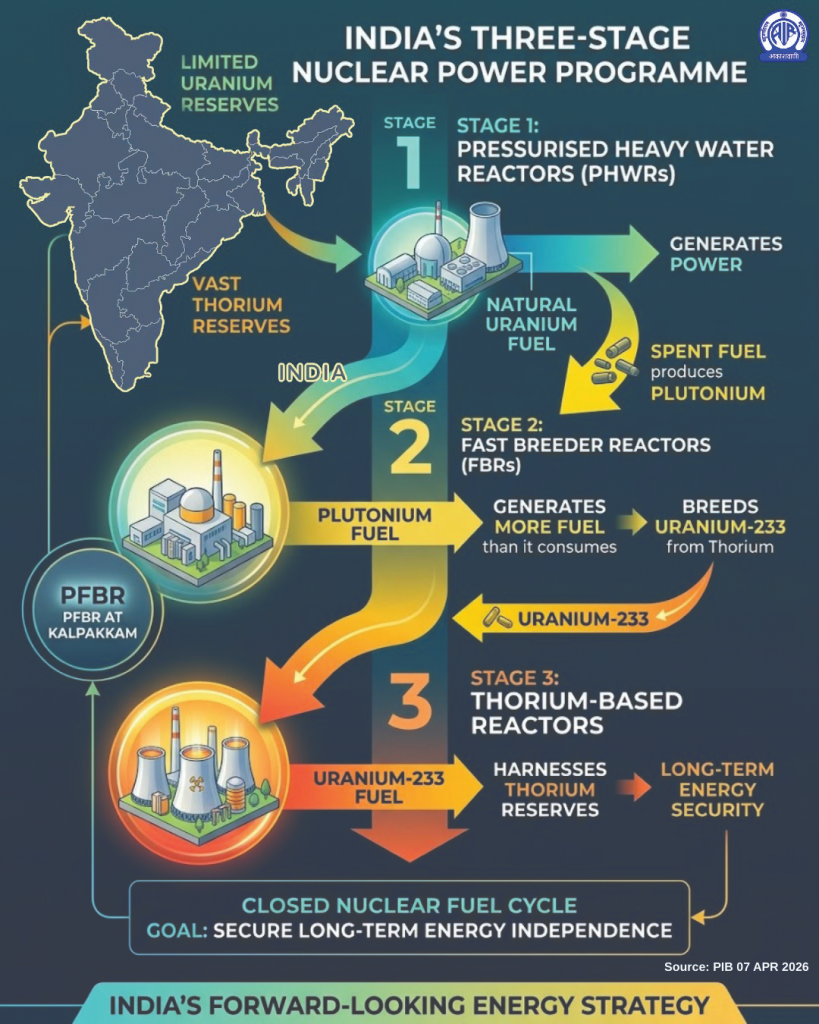
India’s Three-stage nuclear programme
- Establishment: India established the Atomic Energy Commission in 1948.
- In 1956, Asia’s first research reactor, Apsara, was commissioned at the Bhabha Atomic Research Centre (BARC) in Trombay.
- India was the second Asian nation to build a nuclear power plant in 1969 at Tarapur, just after Japan and long before China.
- India has a three-phase programme of nuclear power visioned by Dr Homi J Bhabha, the father of India’s nuclear programme.
- First Stage (Pressurized Heavy Water Reactors – PHWRs): India’s nuclear program initially focused on establishing a fleet of PHWRs.
- These reactors use natural uranium (U-238), which contains minuscule amounts of U-235, as the fissile material.
- Heavy water (deuterium oxide) as both moderator and coolant.
- The primary purpose of this stage was to produce plutonium-239 as a byproduct from the uranium fuel.
- Plutonium-239 is a fissile material used as fuel in nuclear reactors.
- Second Stage (Fast Breeder Reactors – FBRs): The second stage of the program involves the deployment of Fast Breeder Reactors (FBRs).
- FBRs are designed to produce more fissile material than they consume by utilizing a fast neutron spectrum.
- In this stage, plutonium-239 produced in the first stage is used as fuel along with U-238 to produce energy, U-233, and more Pu-239.
- Uranium-233 is another fissile material that can be used as fuel in nuclear reactors.
- Third Stage (Advanced Heavy Water Reactors – AHWRs): The final stage of the program entails the deployment of Advanced Heavy Water Reactors (AHWRs).
- Pu-239 will be combined with thorium-232 (Th-232) in reactors to produce energy and U-233.
- Thorium is abundantly available in India, and this stage aims to harness its potential as a nuclear fuel.
Source: IE
Previous article
Armed Forces (Special Powers) Act, 1958
Next article
News In Short 26-09-2026
