

Syllabus: GS3/Science and Technology
Context
- Major space-sector reforms undertaken by India have expanded private-sector participation and enabled the development of advanced, globally competitive space technologies.
Major Reforms in the Space Sector of India
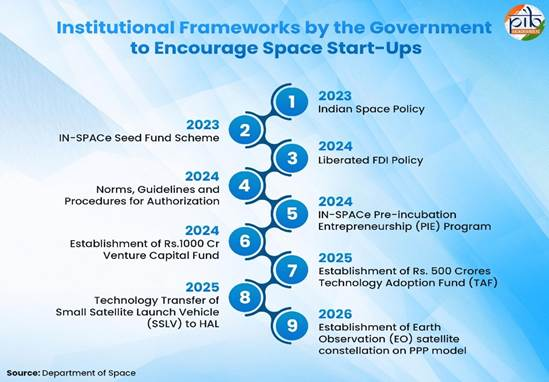
- Establishment of IN-SPACe (Indian National Space Promotion and Authorisation Centre, 2020): Acts as a single-window regulator and facilitator for private companies, authorising and promoting their participation in space activities.
- Corporatisation via NewSpace India Limited (2019): It was set up as ISRO’s commercial arm to transfer technology, manufacture satellites/launch vehicles through industry, and provide commercial satellite services.
- Schemes to encourage the private sector have been implemented by IN-SPACe: Seed Fund Scheme, Pricing Support Policy, Mentorship Support, Design Lab for NGEs, Skill Development in Space Sector, ISRO facility utilisation support and technology transfer to non-governmental entities (NGEs).
- The ₹1,000 crore Venture Capital (VC) Fund under IN-SPACe aims to accelerate private participation in the space sector.
- IN-SPACe also introduced the ₹500 crore Technology Adoption Fund (TAF).
- Liberalised FDI Policy for Space: The revised policy permits up to 74% automatic FDI in satellite manufacturing and operations, 49% automatic FDI in launch vehicles and spaceports, and 100% automatic FDI in the manufacturing of satellite components and subsystems.
- SpaceTech Innovation Network (SpIN): SpIN is a one-of-its-kind public-private collaboration for start-ups and SMEs in the space industry.
India’s Emerging Private Space Ecosystem
- India’s space economy currently stands at $8.4 billion, accounting for 2–3% of the global space economy. It is expected to be $40–45 billion by 2030.
- The Indian Space Policy 2023 led to the entry of private players to space-related activities in India.
- Companies such as Pixxel, Dhruva Space, Skyroot Aerospace, Agnikul Cosmos, and Bellatrix Aerospace have emerged as pioneers of a new space era.
- Skyroot Aerospace became India’s first space-tech unicorn. Its Vikram-1 became the first privately developed Indian orbital-class rocket to successfully place a payload into Low Earth Orbit (LEO).
- Pixxel Space is building hyperspectral imaging satellites that provide Earth observation data to commercial customers and government agencies in India, Europe and the United States.
Self-Reliant Space Transportation
- India has operationalised four indigenous launch vehicles:
- Polar Satellite Launch Vehicle (PSLV),
- Geosynchronous Satellite Launch Vehicle (GSLV),
- Geosynchronous Satellite Launch Vehicle Mark III (GSLV Mk III), and
- Small Satellite Launch Vehicle (SSLV).
- These launch vehicles support Earth observation, communication, navigation, space science and exploration, besides commercial launches for national and international customers.
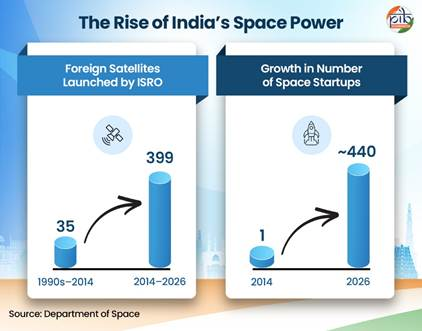
- From 2023 to 2026, India successfully completed 12 launch vehicle missions, carrying 11 national satellites and nine satellites for international customers.
Major Space Achievements of India
- Chandrayaan-3 (2023) made India the first country to soft-land near the Moon’s south pole and the fourth nation to soft-land on the Moon.
- Mars Orbiter Mission (Mangalyaan) was inserted into the Martian orbit in 2014, making it India’s maiden interplanetary mission.
- AstroSat, India’s first dedicated Indian astronomy mission aimed at studying celestial sources in X-ray, optical and UV spectral bands simultaneously.
- Aditya-L1 (2023) is India’s first space-based mission to study the Sun, positioned nearly 1.5 million km from the Earth at the Sun-Earth L1 point.
- Space Docking Experiment (SPADEX) 2025, made India the fourth nation to demonstrate autonomous space docking and undocking.
- Navigation with Indian Constellation (NavIC) provides positioning, navigation and timing across India and up to 1,500 km beyond its boundary.
What are the challenges?
- Dependence on critical technologies: India continues to face gaps in areas such as advanced propulsion, high-end sensors, space-grade electronics, materials and semiconductor components.
- Infrastructure constraints: Limited access to specialised testing facilities, launch infrastructure and other space-grade facilities can increase the time and cost of technology development.
- Global competition: Indian companies compete with well-established international firms that have greater access to capital, mature supply chains and advanced technologies.
- Limited private-sector scale: Most Indian space start-ups are still at an early stage and face difficulties in scaling technologies from prototypes to commercially viable systems.
Way Ahead
- India’s space-sector reforms have transformed the sector from a predominantly government-led domain into a growing public–private ecosystem.
- Sustained investment in indigenous technologies, private innovation, skilled human capital and enabling regulation can help India build a self-reliant, globally competitive and sustainable space economy.
Source: AIR
Previous article
France Proposed to Enhance Functioning of the UN
Next article
Smart Meters
