

Syllabus: GS3/Economy
Context
- MoSPI released the 8th revised National Accounts Series with 2022-23 as the base year in 2026, introducing methodological changes, notably double deflation in manufacturing GVA.
What are National Accounts?
- National Accounts Statistics (NAS) provide a systematic picture of an economy’s production, income and expenditure.
- They measure aggregates such as GDP, GVA, consumption, investment, saving and external trade, following the framework of the UN System of National Accounts (SNA).
Evolution of Base Year
- India has revised its national-accounts base year periodically.
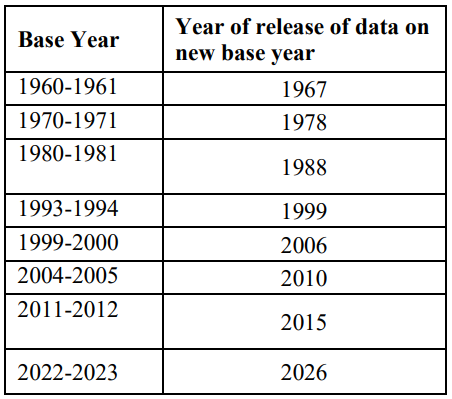
- The objective is to incorporate structural changes, improve data sources and ensure that constant-price estimates better represent the contemporary economy.
Calculation Methodology
- GDP can be viewed through three approaches:
- Production Approach: GVA of industries + taxes less subsidies on products.
- Expenditure Approach: Final consumption + gross capital formation + exports − imports.
- Income Approach: Compensation of employees + operating surplus/mixed income + taxes less subsidies.
- For real GDP/GVA, current-price values need to be adjusted for price changes through appropriate deflators.
Key Change: Double Deflation in Manufacturing
- Under the earlier approach of using a single price index, nominal manufacturing GVA is converted into real GVA using an aggregate deflator.
- The 2022-23 series introduces double deflation for manufacturing that separately adjusts:
- Value of goods produced by manufacturers, and
- Cost of inputs consumed in production.
- The 2022-23 series introduces double deflation for manufacturing that separately adjusts:
- MoSPI uses ASI data and elementary item-level output Producer Price Indices (PPI) based on ex-factory prices, released by the Office of the Economic Adviser, DPIIT.
- The output PPI covers both final and intermediate goods, including wheat, milk, bauxite, coking coal, electricity, refined palm oil, besan, cotton yarn, sacks/gunny bags, leather, naphtha, phosphoric acid, cement and semi-finished iron and steel.
- Thus, the output price of one industry can serve as an input price for another.
- Items representing 80% of output and input value are selected after ranking by value. ASI-derived weights are then used to deflate individual items separately.
- Two of the 30 manufacturing categories i.e. processed food and oils and pharmaceuticals are excluded because imported-input shares are high and direct mapping with elementary output PPI is difficult.
- For service inputs without PPIs, consumer prices and implicit deflators are used.
Other Important Changes
- The new series revises the treatment of defined-benefit pensions by estimating the present value of pension entitlements accruing to serving government employees, rather than using pension payments to retirees as a proxy.
Significance
- Double deflation can provide a more theoretically appropriate measure of real manufacturing GVA, because changes in both output prices and input prices are captured separately.
- Greater item-level granularity can improve consistency between production and price statistics.
Concerns and Issues
- A major concern is that India’s PPI remains experimental, creating questions about the robustness and continuity of input-price measurement.
- Mapping intermediate inputs, especially imported inputs and services to domestic PPIs also remains difficult.
- Consequently, changes in real manufacturing GVA require careful interpretation and comparison with other indicators such as IIP.
Way Forward
- India needs to institutionalise a comprehensive PPI, improve item-level price collection, strengthen ASI and administrative datasets, improve coverage of imported inputs and services, and ensure transparent documentation and periodic validation of deflators.
Previous article
News In Short 21-09-2026
Next article
India-New Zealand FTA
