


Syllabus: GS2/Governance/GS3/Economy
In News
- Pradhan Mantri Awas Yojana–Urban (PMAY-U) has sanctioned over 1.25 crore houses, with more than 1 crore completed and delivered to beneficiaries.
Pradhan Mantri Awas Yojana – Urban (PMAY-U)
- It was launched in 2015 to transform the urban housing landscape in India.
- It aimed at providing dignified housing for urban migrants and the economically disadvantaged.
- It addresses the acute housing shortage faced by the Economically Weaker Section (EWS), Low Income Group (LIG), and Middle-Income Group (MIG), including slum dwellers.
- Guarantee that all eligible urban households have access to permanent, durable housing.
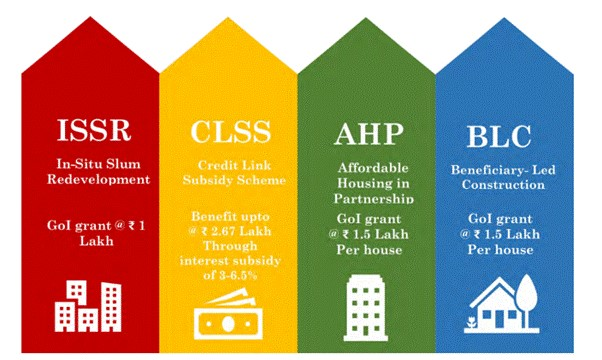
Implementation Verticals of PMAY-U
Progress
- Pradhan Mantri Awas Yojana–Urban (PMAY-U) has reached a major milestone with more than 1.25 crore houses sanctioned and more than 1 crore completed and delivered under PMAY-U and PMAY-U 2.0.
- Recently, sanction was given for the construction of more than 2.09 lakh additional houses for EWS families, which includes 1.42 lakh houses under Beneficiary Led Construction (BLC) and 67,045 houses under Affordable Housing in Partnership (AHP). With these approvals, PMAY-U 2.0 has crossed 18.38 lakh sanctioned houses.
- The scheme also lays a lot of emphasis on women empowerment.
- Of the latest allotment of 2.03 lakh houses, 2.03 lakh have been allotted to women and around 1 crore houses are registered in women’s names or in joint ownership.
Significance
- Economic: Huge housing construction generates huge demand in allied sectors like steel, cement, brick making, hardware etc., and also creates huge employment opportunities for skilled and unskilled labour.
- Women Empowerment: Mandatory female head ownership or joint ownership has resulted in a substantial increase in legal asset ownership among women.
- social inclusion : It also encourages social inclusion by facilitating support to SC, ST, OBC, senior citizens and other marginalised groups.
- Slum Rehabilitation: It improves basic quality of life, sanitation and safety by relocating informal dwellers from unsafe shanties to all-weather pucca homes.
- Infrastructure Convergence: It complements national infrastructure schemes like Jal Jeevan Mission (water connection), PM Saubhagya (electricity), and Swachh Bharat Mission (sanitation), promoting integrated habitat development instead of isolated housing units.
Implementation Challenges
- Acquisition Costs: The limited availability of land and high prices in city centers push affordable housing projects to the periphery, which leads to a spatial mismatch and increases workers’ commuting time and transportation costs.
- Low Private Sector Participation: Adverse profit margins, complicated land titling issues, and long lead time for statutory regulatory clearances have limited private developer participation in joint housing partnerships.
- Identification Issues: A large proportion of urban poor are informal sector workers who do not have formal proof of income, pay slips and credit histories.
- This makes primary lending institutions (PLIs) reluctant to give home loans.
- Project Delays: Inflation of raw construction materials (cement, steel, aggregate) costs imposes fiscal burdens, leading to project timelines being stretched and units remaining unfinished.
Way Forward
- Urban Local Bodies should implement land pooling policies, land banking and GIS-based land mapping to unlock unutilised government and municipal lands in the inner-city zones for affordable housing.
- Financial institutions may consider the introduction of alternative mechanisms for the evaluation of creditworthiness such as utility payment histories, registrations with trade unions and cash-flow banking to enable them to extend housing finance to informal sector workers.
- With time-bound digital single-window approvals at the city level, pre-construction holding costs can be reduced, and project delays can be avoided.
- Tax incentives can encourage private builders to enter the domain of Affordable Housing in Partnership (AHP) and Affordable Rental Housing (ARH).
- Scaling up modern, low-carbon building materials and climate-resilient designs will reduce lifecycle operational costs for low-income residents and contribute to national decarbonisation targets.
Source:PIB
Previous article
India’s Next Energy Transition: To Electrify Industrial Heat
