

Syllabus:GS2/Governance
In News
- The e-Courts Mission Mode Project has transformed India’s paper-based judiciary into a digitally enabled and trackable justice delivery system.
Background
- India’s judiciary, which serves over a billion people, has long relied on paper records and brick-and-mortar infrastructure. Many citizens incurred excessive travel and other expenses visiting courts and other establishments for their matters and documents.
- This archaic system made the delivery of justice slow, cumbersome and expensive for the people it served.
Digitisation of Indian Judiciary
- It means the infusion of Information and Communication Technology (ICT) in all levels of the judicial system from the Supreme Court to the district and subordinate courts.
Various Initiatives
- e-Courts Mission Mode Project : The e-Courts Mission Mode Project was launched in 2007 with a vision to make Indian judiciary faster, affordable, accessible and transparent through technology.
- Phase I (2011-15) was to computerise courts
- Phase II (2015-23) introduced services such as NJDG, e-Filing, eSewaKendras and expanded video conferencing.
- Phase III (2023-27) aims to create paperless and intelligent courts through digitisation, virtual hearings, interoperability, AI, analytics and OCR.
- National Judicial Data Grid (NJDG): An online public dashboard that provides real time information on court cases, orders and judgements of the Supreme Court, High Courts and District Courts.
- ICJS (Interoperable Criminal Justice System): Platform letting police, courts, prisons, forensics and prosecution exchange FIRs, charge-sheets, orders and reports electronically.
- CCTNS (Crime & Criminal Tracking Network and System): Computerises police processes from FIR to charge-sheet, with Nyaya Sanhita-linked deadline alerts for investigating officers.
- ITSSO (Investigation Tracking System for Sexual Offences): dashboard tracking investigations in women/child sexual-offence cases against charge-sheet deadlines.
- e-Sakshya: Secure app for capturing and managing digital evidence, preserving its integrity from collection to court.
- MedLEaPR (Medico Legal Examination and Postmortem Reporting): Hospitals’ online system for medico-legal exams and postmortem reports.
- Nyaya Shruti: Video-conferencing platform for virtual testimony by the accused, witnesses, police, prosecutors and forensic experts.
- e-Forensic: End-to-end digital case handling across forensic labs.
- e-Prison: Cloud-based national network for prison and prisoner management.
- e-Prosecution: Digital workflow linking police and prosecution for timely legal opinions.
- NAFIS (National Automated Fingerprint Identification System): Centralised biometric database for real-time fingerprint matching against criminal records.
- e-SEWA Kendras: Citizen-friendly help centres in court complexes that assist with case-status tracking, e-filing, certified copies, e-payments, digital signatures, virtual hearings, traffic challans and access to free legal aid.
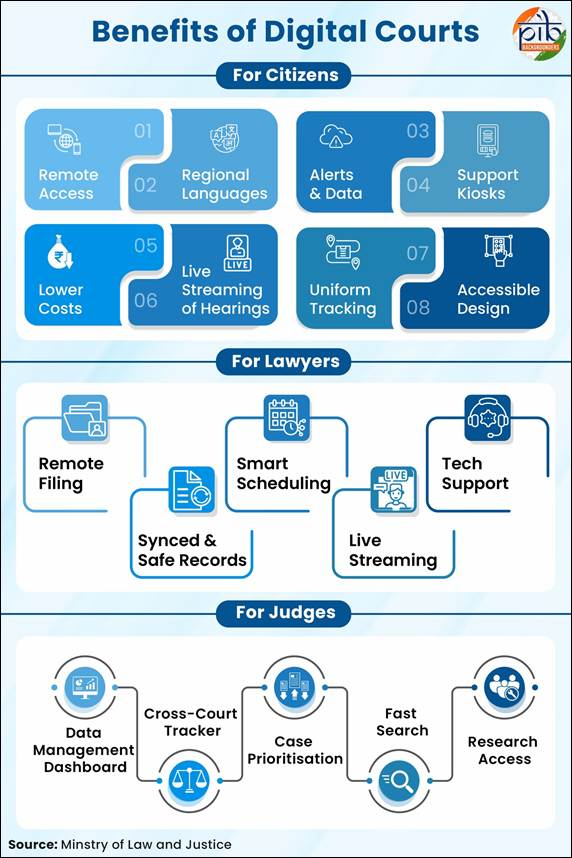
Benefits of Digitising India’s Judiciary
- Accessibility and Inclusivity: Litigants can check case status, download judgements, and attend hearings remotely, without having to travel large distances.
- Video conferencing has improved access to the courts, enabling litigants, lawyers, witnesses and others to participate remotely, saving travel costs and delays.
- Speeding up of processes: Automated listing, e-service of summons with GPS tracking and speedier document retrieval assist cut down administrative delays.
- The e-Filing system enables citizens and lawyers to file court documents on-line from anywhere without the need to physically visit and thereby speeding up judicial proceedings.
- It is available across District Courts, High Courts and the Supreme Court and supports English and regional languages
- The e-Filing system enables citizens and lawyers to file court documents on-line from anywhere without the need to physically visit and thereby speeding up judicial proceedings.
- Transparency and Trust: Public portals for real-time case tracking and live streaming of court sessions reduce systemic opacity.
- Cost Efficiency and Eco-Friendliness – No more storage of millions of paper records, which drastically reduces storage footprints and administrative overheads.
- Data-Driven Judicial Management Real-time dashboards like the National Judicial Data Grid (NJDG) help judges to identify bottlenecks and proactively manage pendency.
- Lawyers, litigants and judges can track case status, cause lists and updates thru digital platforms like e-Courts Services Portal, mobile apps, SMS and email, thus decreasing physical visits and increasing transparency.
- Preservation : Under e-Courts Mission, crores of old court records are being digitised to preserve them from physical deterioration and enable faster, easier retrieval, access and legal research, thereby improving judicial efficiency.
- Integration : Police, courts, prisons, prosecution and forensic institutions are now connected through digital platforms, thus enabling a smooth electronic exchange of criminal justice information.
Challenges and Issues
- Digital Divide : Millions of citizens in rural and semi-urban areas lack access to high-speed internet, functional devices, and basic digital literacy skills.
- Cybersecurity and Data Privacy Risks: Centralising judicial records and sensitive evidence brings risks of data breaches, cyberattacks, and unauthorised tampering, especially in the absence of a dedicated legal framework for legal tech standards.
- Behavioural Barriers: A significant part of the legal fraternity especially senior advocates and employees in the rural district courts, reluctant to move away from the traditional paper briefs.
- Infrastructural Shortcomings : The Supreme Court and the High Courts are well equipped with technology but many subordinate courts still face problems such as inconsistent power supply, outdated hardware and low internet bandwidth.
- Algorithmic Bias and Reliability: The application of AI tools for legal research or case management carries the risk of inherent algorithmic bias and inaccuracy errors, requiring strict oversight by humans before AI outputs are incorporated into formal judgements.
Conclusion
- Digitisation of Indian judiciary is a paradigm shift from being a location bound institution to a citizen centric legal service.
- It is a step toward a speedier, transparent and citizen-centric justice system. The strengthening of e-Sewa Kendras, constant digital training, robust cyber security, data protection and hybrid court model can enable inclusive access.
- Meanwhile, ethical AI must aid, not supplant, human judicial judgement. Technology, in this sense, should be a force multiplier to the rule of law and the constitutional guarantee of equal justice.
Source :PIB
Previous article
Mecca Joint Defence Agreement: Pakistan, Saudi Arabia, Turkiye
Next article
India’s Model Bilateral Investment Treaty
