


Syllabus: GS2/International Relations; GS3/Security
Context
- Recently, Pakistan, Saudi Arabia and Türkiye signed the Mecca Joint Defence Agreement in Mecca, pledging to pursue ‘collective defense’ and ‘collective deterrence’.
- This is against a backdrop of growing instability in West Asia, including the ongoing conflict involving Iran and attacks involving Yemen’s Houthis.
Key Features of the Agreement
- The agreement seeks to:
- Strengthen collective deterrence against aggression.
- Enhance defence cooperation among Pakistan, Saudi Arabia and Türkiye.
- Promote greater military coordination and security cooperation.
- Treat an armed attack on one member as an attack on all.
- Contribute to regional peace, security and stability.
- Türkiye has described the arrangement as a defence-oriented partnership rather than an alliance directed against any particular country.
- It has indicated that the agreement is intended to complement, rather than replace, existing security arrangements.

Strategic Significance
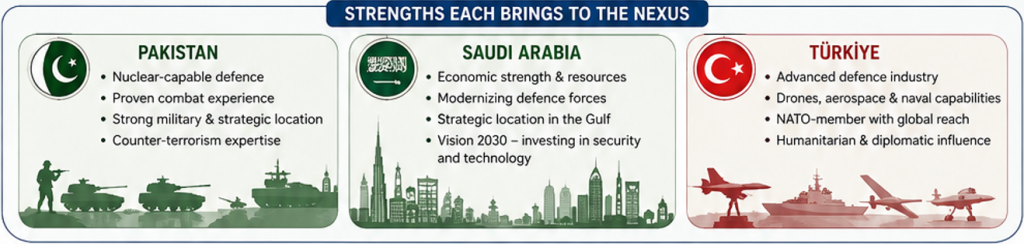
- Rise of a New Regional Security Arrangement: The accord underscores the rising relevance of regional as opposed to solely external security relationships in West Asia.
- Saudi Arabia has relied historically on security arrangements with the United States and other Western powers.
- The new deal adds another layer of collaboration between two big Muslim-majority states outside the Gulf.
- Strategic Convergence between Pakistan and Saudi Arabia: Pakistan and Saudi Arabia have had long-standing tight defence links.
- Their bilateral foundation for mutual security had previously been defined in their Strategic Mutual Defence Agreement (2025).
- The Mecca agreement adds Türkiye to a trilateral framework, extending this cooperation.
- Türkiye’s Growing Regional Role: A NATO Ally with Significant Military Strength and an Increasingly Assertive West Asia Foreign Policy.
- Its involvement broadens the geographical and strategic scope of the arrangement.
- It reflects a broader effort on the part of Türkiye to present itself as a significant regional security player.
- Saudi Arabia’s Quest for Strategic Diversification: Saudi Arabia’s security situation is defined by drone and missile threats, tensions with Iran and instability in Yemen and the Red Sea.
- Saudi Arabia’s policy is progressively to diversify strategic alliances rather than depend on one external security supplier.
How Effective Will Collective Defence Be?
- Saudi Arabia and Pakistan had already agreed in 2025 to treat aggression against one as aggression against the other.
- Yet subsequent security crises did not necessarily result in direct military intervention by one state on behalf of the other.
- Therefore, the effectiveness of the Mecca agreement will depend upon:
- Clarity of obligations in case of an attack.
- Command and coordination mechanisms.
- Intelligence and early-warning cooperation.
- Interoperability and joint military training
- Availability of rapid response capacity.
- The importance of the agreement should therefore be seen in light of the potential for improved security cooperation and not on the assumption of automatic joint military action.
Implications for India
- Need For Strategic Vigilance: India has massive economic, energy and diaspora stakes in the Gulf.
- Any serious deterioration in West Asian security might impact crude oil and gas supply, shipping and maritime trade, remittances, Indian expatriates and vital connectivity projects.
- Balancing Relations: India has major contacts with Saudi Arabia, the UAE, Iran, Israel and other regional actors, while also maintaining developing ties with Türkiye.
- The rise of new security groupings underscores the necessity of India’s policies of strategic autonomy and multi-alignment.
- Maritime Security: Instability in the Red Sea, the Gulf of Aden, the Arabian Sea and the Persian Gulf can have a direct impact on India’s trade routes.
- India has hence a continual interest in maritime domain awareness, protection of commercial shipping and cooperation with regional partners.
- Pakistan’s Growing Role in West Asia: Greater Pakistani involvement in West Asian security might boost Islamabad’s diplomatic and strategic standing in the area.
- For India, this makes it important to monitor the evolving Pakistan–Saudi Arabia–Türkiye security relationship, while avoiding unnecessary securitisation of India’s own relations with Gulf states.
Broader Geopolitical Significance
- The Mecca agreement reflects a wider transformation in the international system:
- From heavy dependence on external security providers towards regional partnerships, strategic diversification and collective deterrence
- This trend is consistent with the emergence of a more multipolar West Asian security environment, in which Saudi Arabia, Türkiye, Iran, Israel, the UAE and other regional actors increasingly pursue overlapping partnerships.
- However, the region remains characterised by competing interests and fluid alignments.
- The new agreement should therefore be viewed as one component of a larger and evolving security architecture.
Challenges
- Divergent Strategic Interests: Pakistan, Saudi Arabia and Türkiye do not have identical foreign-policy priorities.
- Iran Factor: Although the agreement is officially not directed against any country, its implementation will inevitably be assessed in the context of Saudi-Iranian strategic competition.
- NATO Dimension: Türkiye’s NATO membership adds a further layer of complication to its external security duties.
- Ambiguity of Action: The statement ‘attack on one is an attack on all’ needs precise guidelines to determine the kind and scale of collective action.
- Risk of Regional Bloc Politics: The multiplication of competing military organisations could result in increased fragmentation of West Asian security.
Way Forward
- The agreement can have a favourable impact on regional stability if it concentrates on:
- Cooperation in defence, rather than bloc confrontation
- Intelligence sharing and counter-terrorism
- Air and maritime security
- Shared procedures for humanitarian and disaster response
- Regional powers confidence building measures
- Respect for international law and sovereignty
- Diplomacy tools for conflict avoidance
- Regional security arrangements should complement broader diplomatic efforts to decrease tensions, not undermine them.
Conclusion
- The Mecca Joint Defence Agreement is a key development in the changing security architecture of West Asia.
- Its immediate significance lies less in the creation of a new military bloc and more in the institutionalisation of defence cooperation among Saudi Arabia, Pakistan and Türkiye.
Previous article
SC Seeks Govt’s Reply on Pleas Against RTI Changes through DPDP Act
Next article
Digital Transformation of the Indian Judiciary
