

Syllabus: GS2/Polity and Governance
Context
- The Foreign Contribution (restrictions) Amendment Bill, 2026, which was put on hold earlier amid protests, has been listed for consideration in the Monsoon Session of Parliament, renewing the discussion on foreign finance restrictions.
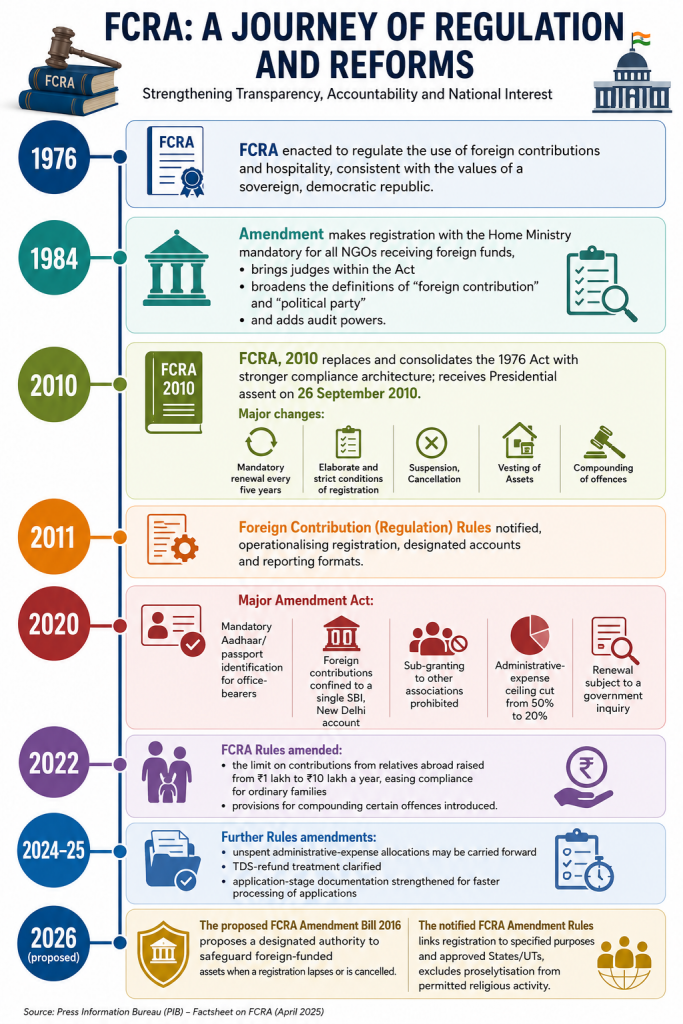
Background: Evolution of Foreign Contribution (Regulation) Act (FCRA)
- It was first introduced during the Emergency in 1976 to restrict foreign funding and to avoid external interference in India’s democratic institutions.
- Its aim was to prevent foreign donations from having a negative impact on national sovereignty, electoral politics or the public interest.
- The FCRA, 2010 was a replacement of the earlier Act and provided for a tougher regulatory framework for acceptance and utilisation of foreign contributions.
- It barred foreign donations to political parties, election candidates, lawmakers, judges, public servants, media workers and politically orientated organisations.
- Associations carrying out educational, cultural, religious, social or economic activities needed registration or prior authorisation.
- Later modifications, especially in 2020, brought in stricter compliance norms such capping administrative expenses, forbidding sub-granting of foreign funds and mandating Aadhaar identification for essential office-bearers.
Key Provisions of the FCRA Bill, 2026
- Vesting of Foreign-funded Assets: In case an organisation’s FCRA registration is cancelled, all foreign contributions and assets arising out of them shall vest provisionally in a designated body.
- Where such vesting is not recovered within the prescribed period it shall be permanent;
- Partial Foreign Funding: Where an asset has been partly funded by foreign sources, the whole asset may vest in the designated authority under Section 16A(2).
- Disposal of Assets: The designated authority may transfer assets to Central or State Government departments or local authorities; dispose of them through sale or auction; and credit the proceeds and unutilised foreign contributions to the Consolidated Fund of India.
- Surrender of Registration: Even where an organisation voluntarily surrenders its FCRA registration, all remaining foreign contributions and assets created from them may vest in the designated authority.
- Government Exemption Power: The Bill empowers the Central Government to exempt any person or organisation from its provisions if considered necessary in the public interest.
Major Concerns and Issues
- Broad executive discretion: Section 14 of the FCRA gives the Central Government broad powers to terminate registration if it thinks it is required in the ‘public interest’.
- The expression is not properly defined, and critics say it gives sweeping discretionary rights with few safeguards.
- Serious Consequences for NGOs: Unlike the existing legal framework, the Bill provides for the permanent transfer of assets after the cancellation or non-renewal of registration.
- Without foreign funding, organisations may be forced to close, with an impact on education, health care, environmental conservation, charitable work and disaster assistance.
- Risk of Misuse: Registration may be affected in case of prosecution of an organisation on charges of forceful religious conversion or communal strife.
- Even prosecution before final adjudication could subject organisations to extended uncertainty and possible abuse through spurious allegations.
- Concerns regarding Voluntary Surrender: The need to transfer assets even after voluntary surrender of registration is questioned as entities ending foreign sponsorship may lose assets properly created during the validity of their registration.
- Constitutional Issues: The exemption clause, which provides for selective exemptions based only on the Government’s view of public interest, may be challenged on the grounds of Article 14 (Right to Equality) as it does not provide clear parameters for discriminatory treatment.
Way Forward: Strengthening the Regulatory Framework
- Define ‘public interest’ with realistic legislative parameters, to minimise arbitrary interpretation.
- Strengthen procedural protections, including notice in advance, orders supported by reasons, and independent appellate review before assets are cancelled or forfeited.
- Distinguish between significant infractions and procedural lapses, and apply sanctions proportionately.
- Allow genuine charities to continue to use or orderly transfer assets that have been properly formed, when there is no demonstrated misuse.
- Transparency should be increased through digital reporting, frequent audits and public disclosure, without imposing unnecessary compliance requirements.
- Ensure regulation is consistent with national security and civil society engagement, and does not infringe sovereignty by allowing only genuine humanitarian, educational and developmental activity.
| Daily Mains Practice Question [Q] The Foreign Contribution (Regulation) Amendment Bill, 2026 seeks to strengthen accountability in the utilisation of foreign funds, but it has also raised concerns regarding federalism, civil liberties, and constitutional safeguards. Analyse. |
