

Syllabus: GS2/International Relations
Context
- India’s growing profile in the Indo-Pacific, G20 and changing geopolitical realities have revived discussions about expanding its strategic vision beyond South Asia to a global and interest-based engagement.
About India’s Strategic Outlook
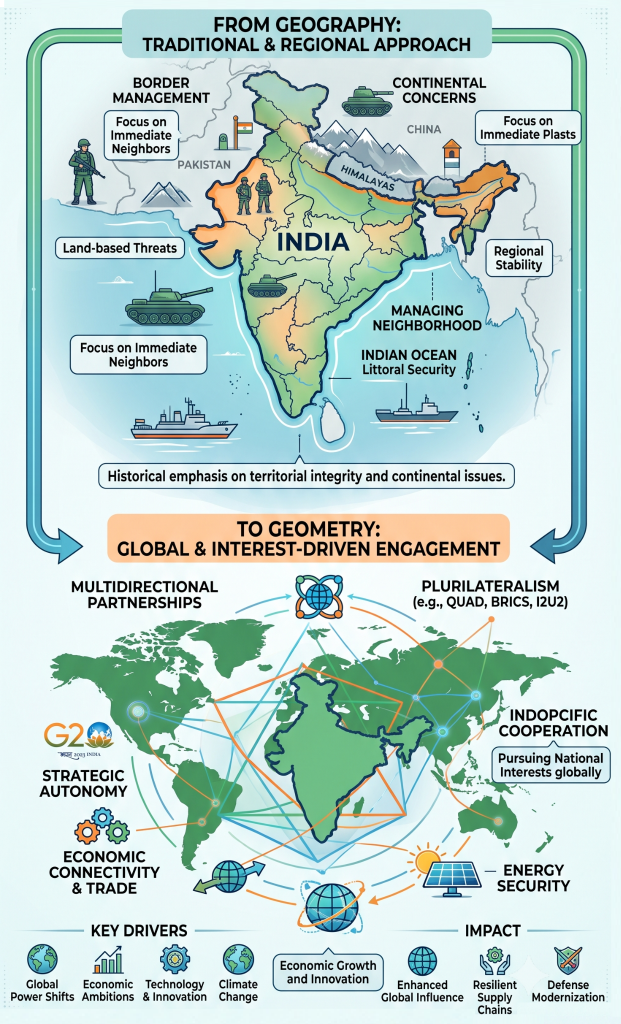
- India’s strategic vision was traditionally geographical, with a focus on territorial security, the Himalayas, the Line of Control (LoC), the Line of Actual Control (LAC), the Indian Ocean and immediate neighbourhood.
- It was in line with the aims of protecting sovereignty and maintaining regional stability.
- But India has emerged as a major economic, technological and maritime force.
- It means that national security is no longer limited to land boundaries but increasingly connected to marine connections, technology, energy security, supply chains, cyberspace and strategic partnerships.
- Thus, India’s strategic thinking is increasingly moving from the geography of borders to the geometry of interests, where connectivity, technology, maritime influence, supply chains and strategic partnerships matter as much as territorial boundaries.
Past Experience: Geographic Proximity
- India’s strategic priorities were traditionally determined by its close neighbours because of:
- Enduring security risks from Pakistan (cross-border terrorism) and China (border disputes and military standoffs).
- Neighbourhood First Policy: Promoting regional stability and peace in South Asia.
- Indian Ocean security, Sea Lines of Communications (SLOCs) and marine trade protection
- Focus on continental defence, with emphasis on territorial integrity and border management.
- The paradigm was effective in dealing with the strategic realities of the twentieth century but is becoming unsuitable for present geopolitical concerns.
Need to Reimagine India’s Strategic Outlook
- Rise of the Indo-Pacific: India’s economic and geopolitical interests now span the Indo-Pacific. Maritime trade, naval presence and strategic ties influence the region’s security.
- Energy and Supply Chain Security: The Gulf accounts for over 80% of India’s crude oil imports. Critical minerals, semiconductor supply chains and emerging technologies need varied global relationships beyond South Asia.
- China’s Growing Strategic Presence: China now has a strategic presence in marine infrastructure (String of Pearls), digital technologies, Belt and Road Initiative (BRI), trade and investments across Asia and Africa.
- Hence, India’s answer has to be beyond the Himalayan frontier.
- Emerging Non-Traditional Security Threats: Cybersecurity, Artificial Intelligence, space security, climate change, and resilient supply chains have reduced geographical boundaries making events far away directly important to India’s national interests.
- Civilisational Diplomacy as Strategic Capital: India’s historical linkages through Buddhism, Nalanda, the Indian Ocean trade network and cultural exchanges continue to bolster partnerships across Southeast Asia, Central Asia, the Gulf and Africa through soft power and trusted engagement.
Related Efforts & Steps by India
- India has already begun to reorient its foreign policy towards a larger strategic vision through:
- Act East Policy for increased involvement with ASEAN and the Indo-Pacific.
- Neighbourhood First Policy promotes regional connection & stability.
- SAGAR (Security and Growth for All in the Region) promotes greater maritime cooperation in the Indian Ocean.
- Indo-Pacific Oceans Initiative (IPOI) towards a free, open and inclusive Indo-Pacific region.
- Participation in the QUAD (India, USA, Japan, Australia) on marine security, resilient supply chains and emerging technologies.
- I2U2 and India–Middle East–Europe Economic Corridor (IMEC) for enhanced connectivity, trade and strategic integration.
- International Solar Alliance (ISA) and Global South efforts, further cementing India as a responsible development partner.
- Capacity building, digital public infrastructure, humanitarian assistance, and infrastructure collaboration to build ties across Africa, the Gulf and Central Asia.
Way Forward: Strengthening India’s Strategic Perspective
- Adopt a whole-of-government strategic strategy that brings together diplomacy, defence, commerce, technology and economic security.
- Strengthen marine capability and naval presence in the Indo-Pacific.
- Reduce the excessive strategic focus on proximate rivals; broaden India’s global connections.
- Diversify energy sources and crucial material supply chains to enhance resilience.
- Leverage India’s civilisational legacy and democratic credentials as tools of soft power.
- Improve connection through IMEC, Chabahar Port, BIMSTEC and ASEAN led projects.
- Focus on new technologies, cyber security and space capabilities to protect India’s long-term strategic interests.
| Daily Mains Practice Question [Q] Geography continues to shape India’s security, but it can no longer solely define its strategic outlook. Critically examine in the context of India’s expanding global interests. |
