

Syllabus: GS2/Governance
In Context
- The sporting landscape in India is witnessing a major transformation with policy reforms, infrastructure development, promotion of grassroots talent, and increased investment.
Evolution of Sports in India
- India has a glorious sporting history and mentions of archery, wrestling (Malla-Yuddha), horse riding, swimming, hunting and chess (Chaturanga) can be found in the ancient texts such as Mahabharata, Ramayana, Manasollasa and Mallapurana.
- The Mughal rulers in the medieval period were fond of Chaugan (Polo), Chess, Chaupar (Ludo) and hunting. Wrestling also remained popular.
- The British introduced cricket, football, tennis, golf and other modern sports that led to the development of organised sporting culture.
- Sports also became a symbol of nationalism during the freedom movement, as in the case of Mohun Bagan’s historic football victory against a British regiment.
- After Independence, India achieved several milestones such as Olympic hockey gold in 1948, hosting the first Asian Games in 1951 and growing participation of women in international sports.
India’s Rise on the Global Sporting Stage
- Olympic Games: India’s Olympic journey witnessed a remarkable transformation between 2016 and 2024.
- India progressed from two medals at Rio 2016 to seven at Tokyo 2020. India maintained this momentum with six medals at Paris 2024.
- Neeraj Chopra became India’s first Olympic athletics gold medallist at Tokyo 2020.
- Mirabai Chanu also emerged as one of India’s most consistent Olympic medallists.
- Paralympic Games: India’s Paralympic performances have witnessed exceptional growth over the last three editions. The medal tally increased from four at Rio 2016 to 19 at Tokyo 2020.
- Paris 2024 marked India’s best-ever Paralympic campaign with 29 medals. Avani Lekhara, Sumit Antil and Pramod Bhagat have been among the country’s standout performers.
- Programmes such as TOPS and the Khelo India Para Games have strengthened support for para-athletes.
- Asian Games: India has consistently raised its performance at the Asian Games through larger contingents and stronger medal-winning displays. The country won 57 medals at Incheon 2014 and improved to 69 at Jakarta 2018.
- Commonwealth Games: India has remained one of the strongest performers at the Commonwealth Games. The country won 64 medals at Glasgow 2014 and improved to 66 at Gold Coast 2018.
- India followed this with 61 medals at Birmingham 2022. Wrestling, weightlifting, table tennis, badminton and athletics have consistently contributed to India’s success.
- PV Sindhu, Vinesh Phogat and Achinta Sheuli have been among the country’s notable performers.
- The Commonwealth Games 2026 is being held in Glasgow 23 July – 2 August 2026, with athletes from 74 countries competing in 10 sports including six fully integrated Para Sports. India has sent a contingent of 124, comprising 78 men and 46 women. As of 27 July 2026, India has won 4 medals: 1 gold, 2 silver and 1 bronze.
- Mirabai Chanu clinches India’s third consecutive gold medal at the Commonwealth Games.
- Jhandu Kumar, Rishikanta Singh and Muthupandi Raja win bronze, silver and silver respectively to increase India’s medal tally.
- India followed this with 61 medals at Birmingham 2022. Wrestling, weightlifting, table tennis, badminton and athletics have consistently contributed to India’s success.
Importance of Strong Sports Ecosystem
- Demographic Dividend & Empowerment: Sport is a positive outlet for India’s large young population and will promote mental well-being, leadership and discipline.
- Economic Engine & Job Creation: Sports generate employment in event management, sports technology, physiotherapy, sports medicine, manufacturing & analytics.
- Soft Power: International sporting excellence is a major soft power tool and is a source of national pride and global diplomatic footprint.
- Public Health Improvement: Promotion of grassroots sports participation for the reduction of Non-Communicable Diseases (NCDs) and building a healthier workforce.
Do you know?
- Sports’ being a State subject, the responsibility to promote and develop sports in the country rests primarily with the respective State/Union Territory Governments.
- At the national and international level (including meeting international treaty obligations), it falls within the realm and remit of the Union Government under its residuary powers.
Various Initiatives of Government
- Khelo India Scheme: Launched in 2017 to create a strong foundation for Indian sport
- It brought together three existing programmes. It merged the Rajiv Gandhi Khel Abhiyan, Urban Sports Infrastructure Scheme and National Sports Talent Search Scheme into a unified framework for sports development.
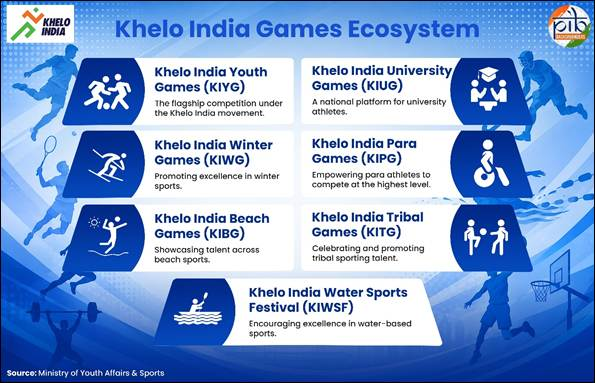
- Target Olympic Podium Scheme (TOPS): Launched in September 2014 to improve India’s performance at the Olympic and Paralympic Games. The scheme was revamped in April 2018 with a dedicated technical support team to provide holistic assistance to athletes.
- TOPS supports athletes through foreign training, international competitions, coaching camps, specialised equipment and a monthly stipend of ₹50,000.
- Khelo India Rising Talent Identification (KIRTI) initiative: Identifies and nurtures sporting talent among children between 9 and 18 years of age.
- Union Budget 2026–27: Announced a dedicated initiative for sports goods manufacturing with an allocation of ₹500 crore.
- National Sports Governance Act, 2025: Aims to enhance athlete welfare and sports governance by mandating all National Sports Bodies to have a Safe Sports Policy, a Code of Ethics and internal grievance redressal mechanisms.
- Khelo Bharat Niti, 2025: Provides a long term roadmap to transform sports into a mass movement and a viable career in line with Viksit Bharat and India’s ambition to host the Olympics in 2036.
- National Sports Day (29 August): The President of India presents National Sports Awards to honour excellence in sports.
- Pension to Meritorious Sportspersons Scheme: Provides a monthly pension ranging from ₹12,000 to ₹20,000 to retired international medal winners.
- Pandit Deendayal Upadhyay National Welfare Programme for Sportspersons: Offers financial aid of up to ₹10 lakh towards medical treatment, sports equipment and participation in competitions.
- National Sports Development Fund (NSDF): Calling for contributions from the private sector, NRIs and philanthropists to supplement government funding for sports infrastructure and athlete development.
- National Centre of Sports Sciences and Research (NCSSR): It was established in 2017 to promote sports science, sports medicine, injury prevention, rehabilitation and performance enhancement through dedicated research and institutional support.
Challenges
- Infrastructure issues: Metro cities and elite centers have world-class facilities, but access to standardised equipment and training facilities is low in rural and tier 2/3 areas.
- Governance Concerns: Transparency, litigation and lack of professional management in some National Sports Federations (NSFs) sometimes delay the support and development programmes for athletes.
- Skill Gaps: India still lacks high performance coaches, biomechanists, sports psychologists and nutritionists and has to depend on expensive foreign experts.
- Social Mindset & Job Security: Non-cricket sports are still seen as a financially risky career path compared to traditional academic paths, even as this is changing.
Suggestions for Improvement
- Increase Collaboration: The National Education Policy (NEP) should integrate sports as part of the core academic curriculum to create a strong talent pool from early childhood.
- Professionalise Governance: All National Sports Federations should have independent athlete representation, transparent financial audits and professional CEOs.
- Strengthen Infrastructure: There is a need to Establish regional sports science centers in collaboration with medical universities to train local physical trainers, physiotherapists and performance analysts
- Public-Private Partnerships (PPP): There is a need to to encourage private businesses to sponsor certain sports, to ensure long-term financial support.
Source: PIB
Next article
Drone-Based Transportation of Tea Leaves in Kerala
