

Syllabus: GS1/Physical Geography
In Context
- Soil supports agricultural productivity, food security, and rural livelihoods in India.
About Soil
- Soil is a natural body comprised of solids (minerals and organic matter), liquid, and gases that occurs on the land surface, occupies space, and is characterized by one or both of the following: horizons, or layers, that are distinguishable from the initial material as a result of additions, losses, transfers, and transformations of energy.
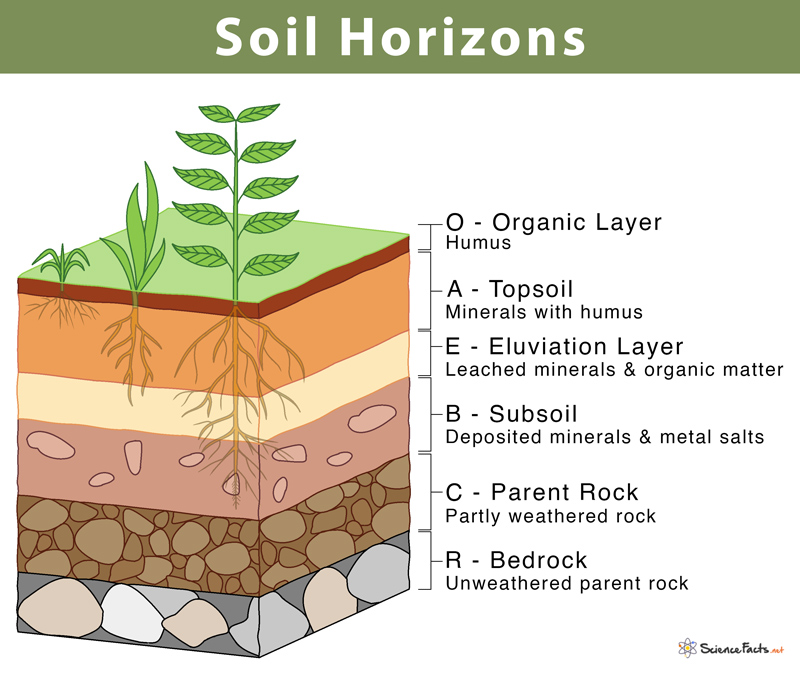
- Soil horizons are the distinct horizontal layers that make up a soil profile from the surface down to bedrock. The main master layers are designated by the letters O, A, E, B, C, and R.
- Soils perform vital functions to sustain plant and animal life, regulate water flow, filter and buffer pollutants, cycle nutrients, and provide physical stability and sort.
Soil Diversity in India
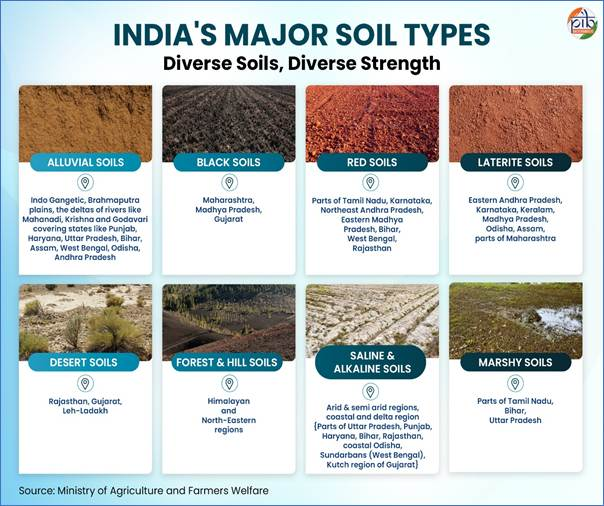
- India’s varied climate, geology, and relief have resulted in a wide range of soils that support region-specific agricultural practices.
- These soils differ in composition and fertility, enabling diverse cropping patterns and improving resilience across regions.
Importance
- Food and Nutritional Security: Soil is the backbone of India’s agriculture, on which 59% of the land area is reported to be under cultivation, and more than 46% of the workforce depends.
- Healthy soil supports productivity, food security and climate resilience, contributing to SDG 2 (Zero Hunger) and SDG 13 (Climate Action)
- Water Regulation and Storage: Healthy soils act as natural sponges like they recharge aquifers, hold soil moisture during dry spells, and reduce surface run-off.
- Carbon Sequestration: Soil plays a vital role in climate change mitigation and adaptation by acting as a natural carbon sink, storing atmospheric carbon as soil organic carbon.
- Higher soil carbon improves soil structure, moisture retention, nutrient availability, fertility, and resilience to climate change.
- Sustainable practices such as carbon farming further enhance carbon sequestration, making soils a key component of climate-smart agriculture.
- Ecological Balance and Biodiversity: Healthy soil contains millions of microbes, fungi, and earthworms that are responsible for the global nutrient cycles (nitrogen, phosphorus, and sulphur).
Issues and Concerns
- Soil erosion: Water and wind erosion carry away large quantities of fertile topsoil every year.
- Water erosion is severe in the Himalayan ecosystem, Western Ghats and Chambal ravines.
- Nutrient Imbalance & Depletion: Decades of skewed chemical fertiliser usage have depleted soil micro-nutrients like Zinc, Boron and Iron.
- Faulty irrigation techniques (especially canal over-irrigation in flood-irrigated areas of Punjab, Haryana and western UP) have brought subsoil salts to the surface through capillary action, making vast tracts infertile (alkalinisation).
- Urbanisation and Pollution: Urban and peri-urban soils are polluted with industrial effluent discharge, leaching of excess agrochemicals, mining spoils and plastic accumulation.
Various steps taken by India
- National Mission for a Green India: It is one of the initiatives under the National Action Plan on Climate Change (NAPCC).
- It enhances climate resilience by increasing forest and tree cover, thereby increasing the natural carbon sinks.
- It helps India meet its Nationally Determined Contributions (NDCs) to add 2.5–3.0 billion tonnes of CO₂ equivalent carbon sink by 2030.
- National Mission for Sustainable Agriculture: It was launched in 2014-15 under the National Action Plan on Climate Change (NAPCC) and aims to promote climate-resilient and sustainable agriculture through improved soil health, water-use efficiency and resource conservation.
- It encourages better soil and water management practices through financial support and incentives.
- National Mission on Natural Farming (NMNF): It was launched in 2024 and aims to promote sustainable, nature-based agriculture by improving soil health, increasing soil organic carbon, reducing input costs and enhancing climate resilience.
- Carbon Credit Trading Scheme (2023): It incentivises climate mitigation by enabling farmers and organisations to generate tradable carbon credits through voluntary carbon markets for verified greenhouse gas reduction, avoidance or removal activities.
- Each carbon credit is equivalent to one metric tonne of CO₂, farmers can earn and sell carbon credits under standards such as the Verified Carbon Standard (VCS) and Gold Standard by implementing sustainable agricultural practices, thus creating an additional source of income while supporting environmental sustainability.
- The Soil Health and Fertility Scheme: It was launched in 2015 and promotes scientific management of soil through Soil Health Cards, which give recommendations for specific nutrients required by the crop for balanced use of fertilisers.
- It promotes judicious use of chemical fertilisers, organic manures and bio-fertilisers, supported by farmer training and demonstration, which enhance soil health and productivity.
- The School Soil Health Programme, where students are involved in soil testing and Soil Health Card preparation, further strengthens the initiative and helps in extending advisory services to farmers.
- Nutrient-Based Subsidy (NBS) Scheme subsidies for 28 grades of Phosphatic and Potassic (P&K) fertilisers, including DAP, are linked to nutrient content to encourage balanced fertiliser application.
- The rates of subsidies are revised separately for the Kharif (April-September) and Rabi (October-March) seasons.
- Direct Benefit Transfer (DBT) in Fertilisers: Aadhaar-linked Point of Sale (PoS) devices authenticate beneficiaries and enable real-time tracking of fertiliser sales.
- Neem Coated Urea: 100 per cent neem coating on urea produced in the country to improve nitrogen-use efficiency and to check diversion for non-agricultural use.
- Integrated Fertiliser Management System (iFMS): Improves monitoring, logistics and availability of fertilisers through better management of supply chains.
- Khet Bachao Abhiyan (June 1-30, 2026): The campaign led by ICAR and Department of Agriculture & Farmers Welfare (DA&FW) with support from NAREES, promoted soil test-based nutrient management, reduced excessive chemical fertiliser use and encouraged climate-resilient farming practices through awareness camps, demonstrations and farmer outreach.
- Geospatial Soil Mapping: The Nationwide Soil Resource Mapping project of Soil and Land Use Survey of India (SLUSI)prepares village-level soil maps by using satellite imagery and field surveys, which are essential for scientific land use planning and crop selection.
- Integrated Digital Agriculture: Platforms like Agri Stack under the Digital Agriculture Mission integrate data on farmers, land, crops and soil to provide location-specific advisory services.
- AI and precision soil management: AI-based platforms like Krishi Decision Support System (KDSS) combine data on soil, weather and crops to provide advisories on crop planning and nutrient management.
- AI also helps with satellite imagery and remote sensing to detect soil nutrient deficiencies and stress.
- Better resource efficiency, lower costs, reduced environmental impacts, targeted use of water and fertilisers.
- More accurate decisions on crop choice, sowing time and nutrient management.
- Agri-robotics such as autonomous tractors and robotic systems for soil analysis, planting, sampling and crop monitoring developed by ICAR–IARI and others.
- AI also helps with satellite imagery and remote sensing to detect soil nutrient deficiencies and stress.
Source: PIB
Previous article
News In Short 25-07-2026
Next article
Start-up Village Entrepreneurship Programme (SVEP)
