

Syllabus: GS3/Economy
Context
- NITI Aayog has recently announced the Roadmap for Building India as a Leading BioEconomy Powerhouse by 2035. The roadmap offers a detailed strategy to make India one of the top three biotechnology powers in the world by 2035.
Key Highlights of the Roadmap
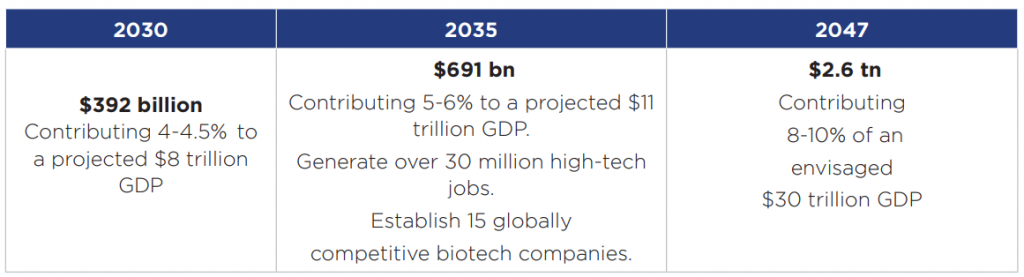
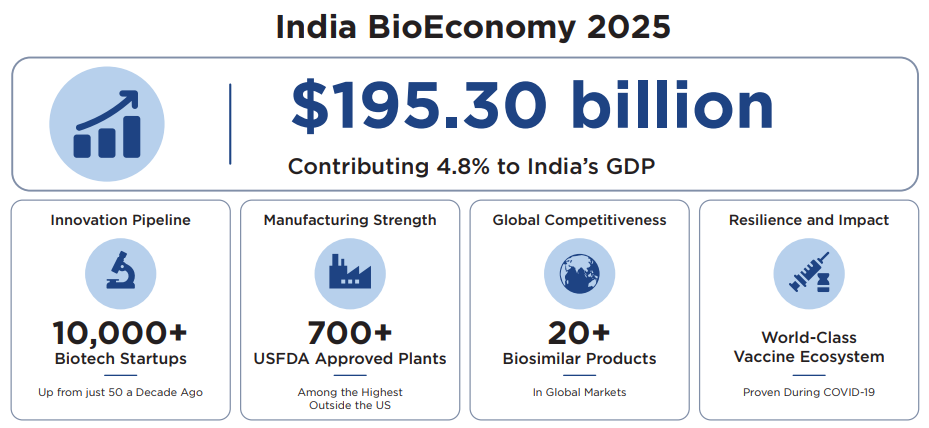
- India’s Ambitious Bioeconomy Targets: Grow from $10 billion in 2014 and $195.3 billion in 2025 (4.8% to national GDP) to $691 billion by 2035, and $2.6 trillion by 2047.
- Create more than 30 million high-value jobs in biotechnology, healthcare, agriculture, industrial biotechnology and the environment.
- Transform India into a research led ecosystem and global biotech innovation and manufacturing hub.
- BioEconomy Growth Fund (2026-35) of ₹50,000 crore: It will bridge the ‘valley of death’ in the biotechnology sector between lab research and commercial production.
- The fund will support Viability Gap Funding (VGF), shared biomanufacturing infrastructure and emerging sectors such as advanced therapeutics, synthetic biology, fermentation technologies, diagnostics and biomanufacturing, as well as investing in blended finance and equity-risk instruments.
- Further, a dedicated Production Linked Incentive (PLI) Scheme has been recommended to boost domestic biomanufacturing, reduce import dependence and enhance global competitiveness.
Six National BioMissions
- The roadmap recommends six mission-mode programmes to ensure focused implementation:
- GeneIndia: Affordable gene and cell therapies; precision medicine and genomic healthcare.
- AgriBio 2.0: Climate-resilient gene-edited crops; biofertilisers and biological crop protection.
- BioX Foundry: Commercialisation of synthetic biology innovations; and bio-based manufacturing platforms.
- One Health Grid: Integrated surveillance of infectious diseases; monitoring antimicrobial resistance (AMR); and human-animal-environment health integration.
- Marine Biotechnology Mission: Expansion of seaweed cultivation; and marine bio-products and blue bioeconomy.
- BioPharmaNext: Global hub for biologics and biosimilars; and AI-enabled drug discovery and vaccine innovation.
Institutional and Regulatory Reforms
- Empowered Committee on National BioMissions for inter-ministerial coordination.
- National BioData Council to govern biological and health data.
- BioEconomy Investment and Policy Forum to align public and private investments.
- BioIP and Innovation Evaluation Agency for biotechnology intellectual property valuation and commercialisation.
- It recommends:
- Fast-track approval pathways for gene therapies, synthetic biology products, and AI-designed drugs.
- Modernisation of the Central Drugs Standard Control Organisation (CDSCO).
- Development of five integrated bio-innovation clusters with shared manufacturing facilities and high-performance computing under the National Supercomputing Mission.
Significance
- The roadmap recognizes biotechnology as strategic national infrastructure, similar to digital public infrastructure and energy systems.
- It seeks to integrate Artificial Intelligence (AI), robotics, computational biology, and automated biofoundries.
- Such convergence may significantly shorten research timelines, improve manufacturing efficiency, strengthen healthcare resilience, facilitate sustainable agriculture and enhance India’s competitiveness in the global bioeconomy.
- The proposals are in sync with national priorities under BioE3 Policy, Atmanirbhar Bharat, Make in India, Startup India and India’s aspiration to be a global innovation hub.
Challenges
- Limited risk capital for biotech startups.
- Lack of synergy between academe and industry.
- Regulatory delays of new technologies.
- Insufficient biomanufacturing infrastructure.
- Fragmented governance of biological and health data.
- Shortage of highly skilled inter-disciplinary work force.
- The Genome India Project has produced rich genomic datasets, but better data-sharing mechanisms and interoperable digital health infrastructure are needed to convert such data to clinical research.
Way Forward
- The success of the roadmap will depend on execution in mission mode, coordinated governance and sustained public-private partnerships. The priority should be to:
- Operationalising the BioEconomy Growth Fund.
- Launching the six BioMissions with measurable outcomes.
- Strengthening of biotechnology R&D and commercialisation.
- Expand bio-innovation clusters and shared infrastructure.
- Fostering responsible data governance and accelerating regulatory approval.
- Developing a globally competitive biotechnology workforce.
- If implemented well, the roadmap can make biotechnology a major engine of India’s economic growth, health security, food security, climate resilience and technology leadership, while fulfilling the Viksit Bharat 2047 vision.
Previous article
News In Short 16-07-2026
Next article
Panel Flags Autonomy Risks under VBSA Bill
