


Trial in Absentia
Syllabus: GS2/ Polity
Context
- The proposed invocation of trial in absentia under Bharatiya Nagarik Suraksha Sanhita (BNSS), 2023 has gained attention after a Special NIA Court in Jammu issued a non-bailable warrant against Hafiz Saeed in connection with the Pahalgam terror attack case.
What is trial in absentia?
- A trial in absentia refers to a criminal trial conducted in the absence of the accused.
- Section 356 of the BNSS provides that if a person declared a proclaimed offender has absconded to evade trial and there is no immediate prospect of arrest, the court may treat the accused’s absence as a waiver of the right to be present during the proceedings.
Whom does it apply to?
- It applies only to a “proclaimed offender”, as defined under Section 84 of the BNSS.
- Under Section 84(4), where a proclamation has been issued against a person accused of an offence punishable with imprisonment of 10 years or more, life imprisonment, or death under the Bharatiya Nyaya Sanhita, 2023, or any other law, and the person fails to appear at the specified place and time, the court may, after making such inquiry as it considers necessary, declare the person a proclaimed offender.
What are the procedural safeguards under Section 356?
- Section 356 lays down several procedural safeguards before a trial can commence in the absence of the accused.
- These include the issuance of two consecutive warrants of arrest within an interval of at least 30 days.
- A notice must also be published in a local or national newspaper, giving the accused 30 days to appear before the court.
- In addition, the notice must be displayed at the accused’s last known place of residence, and a relative or friend of the accused must be informed about the trial.
- The trial cannot commence until 90 days have elapsed from the date of framing of charges, giving the accused sufficient opportunity to appear before the court.
Source: TH
India’s Imports from China soar to $80 bn in First Half of 2026
Syllabus: GS2/IR
Context
- As per the data released by the China’s General Administration of Customs India’s imports from China rose 21.8% in the first half of 2026 to a record $79.41 billion.
About
- China has overtaken the US to emerge as India’s largest trading partner in 2025-26, with bilateral trade reaching USD 151.1 billion, while the country’s trade deficit with China widened to USD 112.16 billion during the period.
- The US was India’s largest trading partner for four consecutive years till 2024-25.
- India’s exports to China rose 36.66% to USD 19.47 billion during the last fiscal year, while imports increased 16% to USD 131.63 billion.
- There is a high growth in merchandise imports and a rise in the value of crude oil, electronics and gold imports.
- India imports not only large quantities of finished electronics and other equipment from China, but also intermediates that are needed for Indian manufacturing and fuel India’s own exports.
Source: TH
First Monthly Services Production Index
Syllabus: GS3/Economy
Context
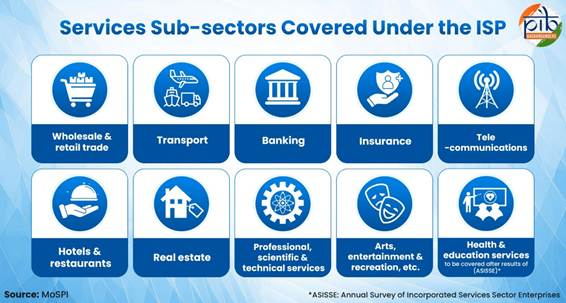
- The Ministry of Statistics and Programme Implementation (MoSPI) released the country’s first trial Index of Services Production (ISP) for 19 sub-sectors.
About
- The Index of Services Production (ISP) is a short-term indicator designed to measure changes over time in the volume of output produced by the services sector relative to a specified base period. It measures changes in the real output of service-producing industries over time.
- It serves as the services sector counterpart to the Index of Industrial Production (IIP), which measures industrial output.
- The base year of the index has been fixed at 2024–25.
Need for a Deflator
- Since service sector data are generally available in value (nominal) terms, price changes need to be removed to measure actual output.
- A price deflator converts nominal values into real (volume-based) values, thereby reflecting genuine growth in services production.
- Currently, different price deflators are used based on the sub-sector:
- Wholesale Price Index (WPI): Applied specifically to deflate wholesale trade.
- Consumer Price Index (CPI): The relevant or closest matching CPI series is used for most other sectors.
- CPI–General: Applied to banking, insurance, and repair & maintenance.
- CPI–Services: Applied to sub-sectors where a specific individual CPI is unavailable.
Key Findings
- Fourteen out of nineteen service sub-sectors recorded double-digit growth during April 2026.
- Among the top performers, Accommodation and Food Services registered the highest growth at 37.2 per cent, followed by Retail Trade (30.8 per cent), Administrative and Support Services (28.7 per cent) and Real Estate (27.7 per cent).
- Telecommunications expanded by 22.8 per cent, while Wholesale Trade, Banking, Insurance and IT services also recorded healthy double-digit growth.
- However, Air Transport contracted by 13.9 per cent, while Railway Transport recorded a marginal decline of 0.4 per cent during the month.
NIDAR 2.0
Syllabus: GS3/Science and Technology
In News
- The Ministry of Electronics and Information Technology (MeitY), in collaboration with Drone Federation India (DFI) launched the second edition of the National Innovation Challenge for Drone Application and Research (NIDAR 2.0, 2026-27) under the SwaYaan initiative.
NIDAR
- The National Innovation Challenge for Drone Application and Research (NIDAR) empowers India’s College Graduates to build collaborative autonomous drones for defined problem statements.
- The first edition of NIDAR 2025-26 was launched in March 2025.
- It drew 3,448 students from 22 States, 4 Union Territories and 109 cities, who built autonomous drone solutions for Disaster Management and Precision Agriculture.
NIDAR 2.0
- It extends the challenge from traditional drone platforms to autonomous systems, indigenous avionics and core drone components.
- Track 1 (Drone Innovation) will challenge teams to build autonomous swarm drones for disaster response and GPS-denied drones for indoor industrial inspection.
- Under Track 2 (Component Innovation), teams are required to develop an indigenous flight controller and autopilot using VEGA processor and indigenous electronic components, top 100 teams will be provided with VEGA processor kits for further development and testing.
VEGA processor
- It is a family of indigenous microprocessors designed by the Centre for Development of Advanced Computing (C-DAC) under MeitY’s Microprocessor Development Programme, based on the open-standard RISC-V architecture.
SwaYaan initiative
- The SwaYaan initiative, approved by MeitY in July 2022 with an outlay of about Rs 89.87 crore over five years, builds the skilled workforce needed for India’s drone sector.
- It runs through a Hub-and-Spoke model of 30 premier institutions, including IISc, IITs, IIITs, NITs, C-DAC and NIELIT, across five work themes: Aeromechanics, Drone Electronics, GNC Algorithms and Simulation, Drone Applications, and Allied UAS Technologies.
- It has trained more than 51,000 people so far. It has also supported M.Tech and minor degree programmes, retrofitting electives, online courses, research papers and patents in drone technology.
- NIDAR is its flagship innovation platform.
Source :PIB
Expansion of Carbon Credit Trading Scheme (CCTS)
Syllabus: GS3/Environment
In News
- The Union Cabinet has approved a draft notification for bringing the iron and steel sector under India’s Carbon Credit Trading Scheme (CCTS).
Carbon Credit Trading Scheme (CCTS) in India
- It is a mechanism designed to reduce greenhouse gas (GHG) emissions through carbon pricing.
- It was notified by the Government of India in 2023 and provides an overall framework for the functioning of the Indian Carbon Market (ICM).
- The emission intensity reduction targets are to be achieved in the compliance year of 2026-27, with the baseline year being 2023-24.
- Coverage: The CCTS, which currently covers sectors like aluminium, cement, pulp and paper, petroleum refineries, petrochemicals and textiles has its coverage increased with the change.
- Mechanism: The CCTS operates through two mechanisms: the Compliance Mechanism and the Offset Mechanism.
- Under the Compliance Mechanism, emission-intensive industries designated as Obligated Entities are required to meet assigned Greenhouse Gas Emission Intensity (GEI) targets.
- Obligated Entities that outperform their targets are eligible to receive Carbon Credit Certificates which they can trade with obligated entities which are unable to meet their targets.
- Each obligated industry is assigned a GEI target, expressed as emissions per unit of output.
- If an industry achieves or exceeds its GEI targets, it is awarded Carbon Credit Certificates (CCC) which can be sold in the carbon market.
- Industries that do not meet their targets have to buy carbon credits or pay environmental compensation. The compensation is calculated as twice the average carbon credit trading price.
Key Facts: India’s Steel Sector
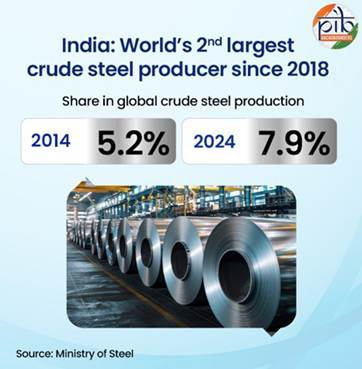
- India’s steel sector is the second-largest in the world with an approximate crude steel production of 151 million tonnes in FY 2024-25, while contributing 10-12 per cent to the country’s total CO2 emissions.
- The National Steel Policy 2017 envisions expanding crude steel capacity to 300 MTPA and production to 255 MTPA by 2030–31.
- Major steel zones are located in Kalinganagar, Angul, Rourkela, Jharsuguda, Nagarnar, Bhilai, Raipur, Jamshedpur, Bokaro, Durgapur, Kolkata and Vizag.
- Green steel is the manufacturing of steel without the use of fossil fuels. So-called “green hydrogen” is one solution that could help reduce the steel industry’s carbon footprint.
- AI in Steel Pavilion, is first-of-its-kind collaborative platform which is designed as a problem-to-solution marketplace.
Source :DTE
Forward Deployed Engineering (FDE)
Syllabus: Miscellaneous
In Context
- Forward Deployed Engineering (FDE) is quickly becoming one of the buzziest roles in AI hiring.
About
- Forward Deployed Engineering (FDE) is a multidisciplinary role combining software engineering, AI implementation, solutions architecture and business consulting.
- It turns AI experiments into things people actually use like secure, working systems embedded in daily business operations.
- They embed directly with clients, learn the real business problem up close, and build AI solutions that securely plug into the client’s own (often sensitive) data.
- To get different AI agents and platforms talking to each other, they lean on emerging standards like Model Context Protocol (MCP) and Agent2Agent (A2A).
Source: TH
Previous article
ISRO Clears Three Key Gaganyaan Crew Module Safety Tests
Next article
Cabinet Approves Semicon 2.0
