

Syllabus: GS3/Disaster Management
In News
- Dams have greatly supported agriculture, industry, and overall socio-economic development in India over the decades.
Status of Dams In India
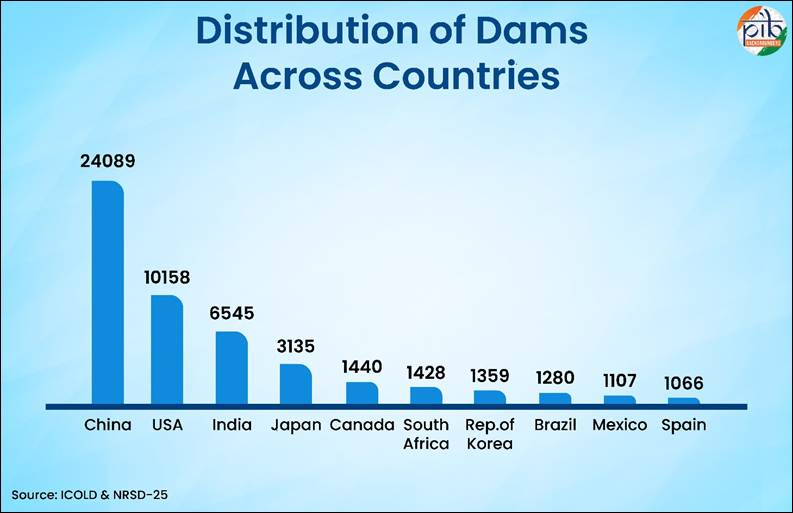
- India manages one of the largest dam portfolios globally.
- It ranks third in the world, with 6628 specified dams, of which 6,545 are operational and 83 are under construction.
- The gross water storage capacity of these dams is about 330 billion cubic metres.
- India’s oldest, the Kallanai (Grand Anicut) in Tamil Nadu, has functioned for nearly 2,000 years—showcasing enduring engineering and maintenance.
- Maharashtra has the highest number of specified dams, followed by Madhya Pradesh, Gujarat, Chhattisgarh, Rajasthan, Karnataka and Odisha.
Importance of Dams
- Agriculture & Irrigation: Dams are vital for India’s agriculture as they provide irrigation to large farmlands, support multi-cropping, and reduce dependence on monsoon rainfall, strengthening food security.
- Hydropower: Dams support hydropower generation, providing renewable energy and helping maintain grid stability while meeting peak electricity demand.
- Flood Control: Dams help control floods by regulating river flow during monsoon and reducing downstream flood risks when managed effectively.
- Socio-economic development: Dams support socio-economic development by improving rural livelihoods and enabling activities like fisheries, tourism, and inland navigation in certain regions.
- Industrial Growth: Dams Ensures water for manufacturing and economic activity.
Challenges and Issues
- Ageing Infrastructure: Many older dams face risks due to structural ageing, fatigue, and outdated design standards.
- Institutional Gaps: Dam safety in India is affected by fragmented responsibilities across states, leading to uneven safety standards, funding gaps, and differences in technical capacity that result in inconsistent performance.
- Social & Environmental Issues:Climate change is increasing extreme rainfall and floods, making dam safety and reservoir management more challenging.
- Dams can also cause displacement, ecological damage, and water-sharing conflicts.
- Sedimentation: It reduces dam storage capacity over time and lowers the efficiency of irrigation and hydropower.
- Safety Concerns : Dam failure can cause severe downstream disasters, so continuous monitoring and timely repairs are essential for safety.
Various Initiatives of the government
- The Dam Rehabilitation and Improvement Project (DRIP): It is India’s flagship programme to improve the safety and performance of existing dams through structural repairs, modernisation, and advanced monitoring systems.
- It is being implemented in three phases with World Bank and other international support, reflecting a shift towards risk-based dam safety management.
- The Dam Safety Act, 2021: It provides a comprehensive framework for surveillance, inspection, operation and maintenance of specified dams across the country.
- It establishes a four-tier system (national to state level) for dam safety regulation and makes dam owners legally responsible for regular inspections, emergency planning, monitoring systems, and proper funding for maintenance.
- A specified dam under the Act refers to a dam that is more than 15 metres in height, or between 10 and 15 metres in height if it satisfies prescribed technical criteria.
- It establishes a four-tier system (national to state level) for dam safety regulation and makes dam owners legally responsible for regular inspections, emergency planning, monitoring systems, and proper funding for maintenance.
- National Committee on Dam Safety (NCDS): It is the apex body under the Dam Safety Act, 2021, responsible for framing policies and setting national standards for dam safety.
- It guides the overall dam safety framework to prevent dam-related disasters and ensure uniform safety norms across India.
- National Dam Safety Authority (NDSA): It is responsible for implementing the policies, guidelines, and standards set by the National Committee on Dam Safety.
- State-Level Institutions and Dam Owners: The Dam Safety Act, 2021, mandates the constitution of State Committees on Dam Safety (SCDS) and the establishment of State Dam Safety Organisations (SDSOs).
- Dam owners must ensure inspections, emergency plans, risk assessments, funding for repairs, safety instruments, and early warning systems.
- Capacity Building: Centres of Excellence (CoEs) for dam safety are being set up at IIT Roorkee and IISc Bengaluru to focus on seismic hazard, risk assessment, rehabilitation, and dam safety technologies.
- A National Centre for Earthquake Safety of Dams is also being established at MNIT Jaipur.
- M.Tech programmes in dam safety have been started at IIT Roorkee and IISc Bengaluru since 2021–22 to build specialised expertise in this field.
- Digital Initiatives : Digital platforms such as DHARMA, along with instrumentation and Early Warning Systems, are strengthening real-time monitoring and data-driven dam safety management.
Conclusion and Way Forward
- India’s dams are vital for water, food, and energy security, supporting irrigation, hydropower, drinking water supply, and flood control, and have driven long-term socio-economic development.
- However, many are aging and increasingly affected by sedimentation and climate variability, making safety and asset management a growing priority over expansion.
- India is responding through the Dam Safety Act, 2021, the Dam Rehabilitation and Improvement Project (DRIP), and digital monitoring tools to improve safety and governance.
- The focus is shifting to rehabilitation, climate resilience, and technology-driven predictive maintenance for safer and more sustainable dam management.
Source :PIB
Previous article
Thunderstorms: Causes, Impacts and Policy Response
Next article
News In Short 16-05-2026
