


Syllabus: GS1/Geography; GS3/Environment
Context
- More than 100 people lost their lives due to severe thunderstorms and dust storms that struck Uttar Pradesh during the pre-monsoon season.
What are Thunderstorms?
- A thunderstorm is a weather phenomenon associated with lightning, thunder, strong winds, heavy rainfall and sometimes hailstorms.
- These events are common during April and May and are observed in many arid and semi-arid regions of the world.
- Key features include sudden development, strong gusty winds, lightning and thunder, short duration but high intensity, and associated dust storms in dry regions.
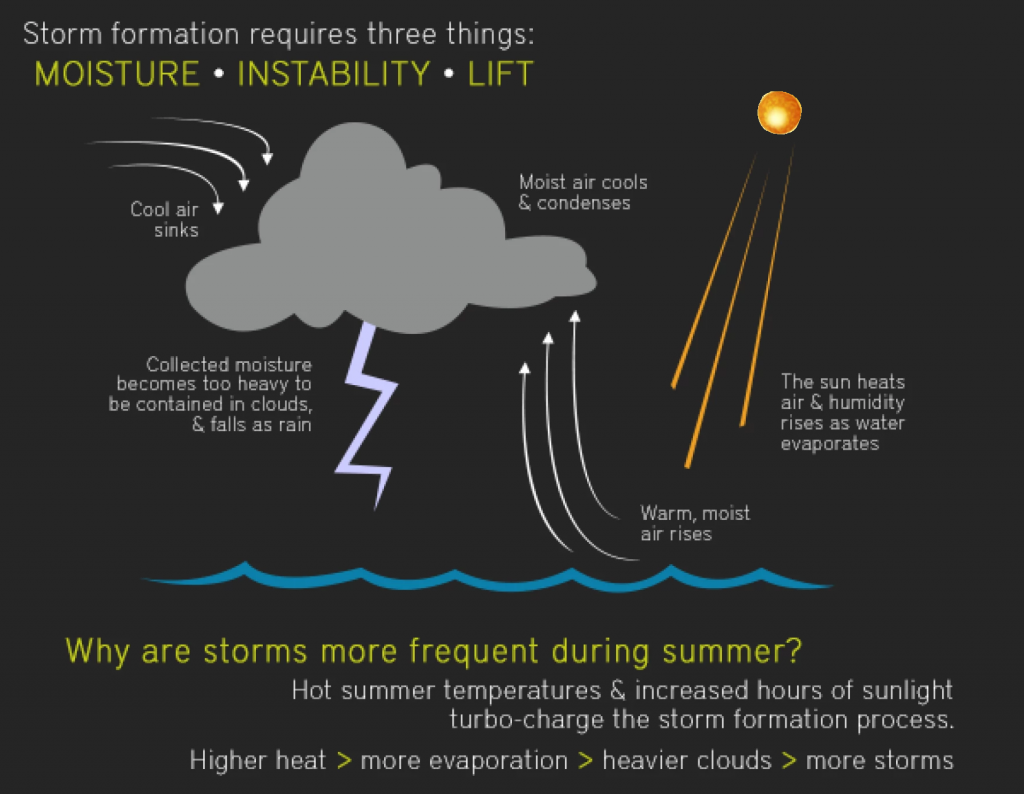
- Thunderstorms form due to atmospheric instability caused by differences in temperature and moisture between the lower and upper atmosphere.
Conditions Responsible for Formation
- Intense Surface Heating: Northern India experiences extremely high temperatures, often above 45°C during summer. This heats the land surface rapidly.
- Availability of Moisture: Moisture-laden winds from the Bay of Bengal move towards northern India through southeasterly winds.
- Cool and Dry Upper Air: Western Disturbances bring cooler air in the upper atmosphere. When warm moist air rises and meets cooler dry air above, instability develops.
- Convection Process: The warm air rises rapidly, condenses into cumulonimbus clouds and releases latent heat, strengthening vertical air movement and producing thunderstorms.
Types of Thunderstorms
- Single-Cell Thunderstorms: Small and short-lived; usually less destructive; and common in summer afternoons.
- Multi-Cell Thunderstorms: Multiple storm cells clustered together; longer duration; and produce strong winds and heavy rainfall.
- Squall Lines: Organized lines of thunderstorms; common in northern India during pre-monsoon months; and associated with severe wind damage.
- Supercell Thunderstorms: Highly organized rotating storms; rare in India; and can produce extreme winds and hail.
- The recent Uttar Pradesh storms resembled organized multi-cell thunderstorms with severe squall-line characteristics.
| Occurrence of Thunderstorms in India | |
| Region | Local Name |
| Uttar Pradesh & North India | Andhi |
| West Bengal & Assam | Kalbaisakhi/Nor’wester |
| Karnataka | Mango Showers |
| Kerala | Blossom Showers |
Impacts of Severe Thunderstorms
- Loss of Human Life: The recent storms caused over 100 deaths, mainly due to falling trees, wall collapses, lightning strikes, and flying debris.
- Damage to Infrastructure: High-speed winds uprooted trees and damaged electricity poles, transmission lines, houses and weak structures, hoardings and billboards.
- Agricultural Losses: Thunderstorms and hailstorms damage standing crops, affecting wheat, vegetables, and mango orchards. It impacts farmer incomes and rural livelihoods.
- Disruption of Public Services: Power outages, communication disruption, and transport interruptions.
- Increased Disaster Vulnerability: Rapid urbanization, weak housing structures and inadequate awareness increase vulnerability to such localized disasters.
- Challenges in Forecasting: Evacuation is difficult because thunderstorms are dispersed and unpredictable in movement, unlike cyclones.
- Localized Nature: Thunderstorms are highly localized and evolve rapidly.
- Rapid Intensification: Wind speeds can intensify within minutes.
- Multiple Storm Cells: Several storms can occur simultaneously across different districts.
Do You Know?
- Thunderstorms and lightning are not currently among the 12 nationally notified disasters eligible for automatic financial compensation under the State Disaster Response Fund (SDRF) or National Disaster Response Fund (NDRF).
- However, states have the flexibility to utilize up to 10% of their SDRF allocation for local disasters, such as lightning and thunderstorms.
- Nationally Notified Disasters In India: Cyclone, Drought, Earthquake, Fire, Flood, Tsunami, Hailstorm, Landslide, Avalanche, Cloudburst, Pest attack, Frost and cold wave.
Government Measures and Policy Support
- IMD’s Early Warning Systems: IMD regularly issues weather bulletins, thunderstorm alerts, and nowcasts (short-term forecasts). IMD has strengthened its observation infrastructure in Uttar Pradesh with nearly 2,400 weather stations for real-time monitoring.
- Key initiatives include Doppler Weather Radars, mobile weather alerts, and nowcast services.
- National Disaster Management Authority (NDMA): NDMA has issued guidelines for lightning safety, thunderstorm preparedness, and public awareness campaigns.
- Sachet Portal (National Disaster Alerts): NDMA has envisioned a Common Alerting Protocol (CAP) based Integrated Alert System on Pan India basis. It involves near real-time dissemination of early warning through multiple means of technology using geo-intelligence.
- Suggested measures are to avoid open fields during lightning, stay indoors during storms, secure loose objects and structures, and strengthen local disaster response systems.
- Lightning Resilient India Campaign: A multi-stakeholder initiative aimed at reducing lightning deaths, community awareness, and scientific forecasting.
- State Disaster Response Measures: State governments undertake compensation for victims, emergency restoration of power supply, relief and rehabilitation assistance.
Way Forward
- Improve Forecast Accuracy: Better high-resolution weather models, expansion of radar networks, and AI-based forecasting systems.
- Strengthen Public Awareness: Community-level preparedness can reduce casualties significantly.
- Climate-Resilient Infrastructure: Stronger housing structures, underground power lines where feasible, and disaster-resilient urban planning.
- Integration with Disaster Management: Thunderstorms should receive greater attention under local disaster management plans similar to floods and cyclones.
Previous article
Drug Menace and the Need for Global Cooperation
Next article
Dam Safety Framework
