


Syllabus: GS2/Governance
Context
- The Government of India and International Fund for Agricultural Development (IFAD) launched a new eight-year Country Strategic Opportunities Programme (COSOP) for 2026–2033.
About
- Aim: Strengthening rural incomes, improving resilience and expanding sustainable livelihood opportunities across India.
- It focuses on two major priorities: Enhancing the social, economic and climate resilience of rural communities, and strengthening knowledge systems to scale successful development models across India and other countries of the Global South.
- Major Objectives: Strengthening grassroots institutions including self-help groups, farmer producer organisations and cooperatives.
- They are expected to play a key role in linking finance, technology, infrastructure and markets.
- India and IFAD have partnered for nearly five decades, during which 35 rural development projects have been implemented across multiple states.
International Fund for Agricultural Development (IFAD)
- IFAD was established in 1977 following the 1974 World Food Conference.
- It was created in response to global concerns about food crises and rural poverty, particularly in developing nations.
- Headquarters: Rome
- India is a founding member of IFAD.
- Objectives:
- Reducing rural poverty.
- Enhancing agricultural productivity.
- Improving food and nutritional security.
- Promoting inclusive rural development.
- Supporting small and marginal farmers, women, and indigenous communities.
Rural Development in India
- There is a gradual shift away from a purely government-led model of development towards more community-driven, decentralised approaches.
- Local governments and grassroots institutions are increasingly recognised as critical actors in planning, implementation, and monitoring of development initiatives.
- Key Developments:
- Rural Development Budget allocations rose over 211% from ₹87,765 crore (2016-17) to ₹2.73 lakh crore (2026-27).
- Poverty has declined significantly, with extreme poverty at 5.3% (2022-23), which is less than the global average, and multidimensional poverty has reduced to 11.28%.
- Women-led collectives anchor last-mile delivery, mobilizing 10.05 crore women across 90.09 lakh SHGs, supported by 9 lakh community cadres.
- Rural connectivity is near-universal, with budgetary allocations for Pradhan Mantri Gram Sadak Yojana increasing by 51% since 2017.
National Panchayati Raj Day
- India celebrates National Panchayati Raj Day on April 24 every year to mark the foundation of the Panchayati Raj System, when the Constitution (73rd Amendment) Act, 1992, came into force.
- It celebrates theimportance of grassroots democracy, strengthens local governance and helps empower rural communities.
Government Initiatives
- The Swachh Bharat Mission (Grameen): It was launched in 2014 to achieve Open Defecation Free (ODF) status nationwide by October 2019, and all districts were declared ODF by 2019–20.
- As of December 31, 2025, over 96 percent of villages under the Swachh Bharat Mission have attained ODF Plus status.
- An ODF Plus village is defined as one that sustains its ODF Status, ensures solid and liquid waste management, and remains visually clean.
- Pradhan Mantri Sahaj Bijli Har Ghar Yojana (SAUBHAGYA): It was launched in 2017 to achieve universal household electrification by providing electricity connections to all willing un-electrified households in rural areas and all willing poor households in urban areas in the country.
- Pradhan Mantri Awaas Yojana-Gramin (PMAY-G) aims to achieve the objective of Housing for All by 2029 by providing pucca dwellings with basic amenities to eligible rural households.
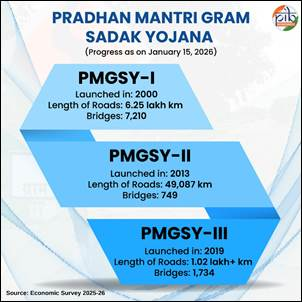
- Launched in 2000, the Pradhan Mantri Gram Sadak Yojana (PMGSY-I) was designed to provide all-weather road connectivity to eligible unconnected habitations.
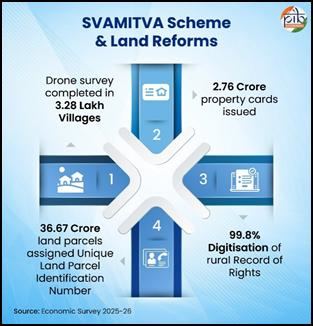
- Digitalisation and Technology-Led Service Delivery in Rural Areas: Digitalisation has emerged as a critical enabler of inclusive and efficient service delivery in rural India.
- The Deendayal Antyodaya Yojana – National Rural Livelihood Mission (DAY-NRLM): It was launched in 2010 by restructuring the earlier Swarnajayanti Gram Swarozgar Yojana (SGSY), the initiative was renamed in 2016 as Deendayal Antyodaya Yojana – National Rural Livelihood Mission (DAY-NRLM).
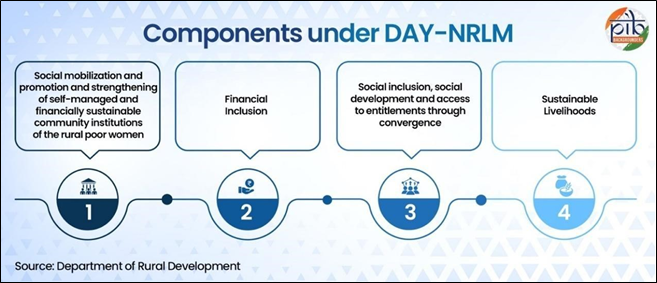
- Community Resource Persons (CRPs), including Bank Sakhis, Krishi Sakhis, Pashu Sakhis, and Enterprise Promotion CRPs, facilitate the smooth functioning of women-led community institutions.
- The Deen Dayal Upadhyaya Grameen Kaushalya Yojana (DDU-GKY): It is a demand-driven skill training linked to assured placements, with quality and industry relevance ensured through mandatory third-party certification by National Skill Development Corporation (NSDC) Sector Skill Councils.
- Entrepreneurship Pathways for Women in Rural India: Aligning skill development initiatives with emerging sectors such as manufacturing, renewable energy, digital services, and agro-processing broadens economic opportunities for women.
- Complementary measures, including ‘Back to Work’ and ‘Returnship Programmes’, facilitate workforce re-entry.
Conclusion
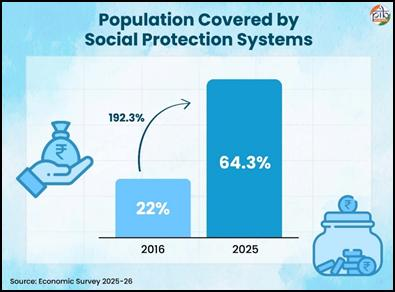
- Sustained public investment has broadened access to housing, rural connectivity, drinking water, sanitation, digital services, and social protection.
- Central to this transformation has been the empowerment of local institutions, including Panchayati Raj Institutions, Self-Help Groups, and community cadres.
- These reforms position rural India not merely as a recipient of development interventions but as a pivotal driver of inclusive growth.
Source: PIB
Previous article
Windfall for Agrifood Corporations Amid Geopolitical Shocks
Next article
India’s Gold Import Problem & UAE Treaty
