


Syllabus: GS2/ Health, GS3/ Economy
Context
- India is steadily emerging as a major global destination for medical tourism, with the country’s medical value travel (MVT) market projected to grow from an estimated $8.7 billion in 2025 to nearly $16.2 billion by 2030.
What is Medical Tourism?
- Medical tourism refers to the practice of traveling to another country or region for medical treatment, procedures, or health-related services.
- It involves both curative care (surgeries, specialised treatments) and, in some cases, preventive or diagnostic services.
- Reasons:
- Individuals seek medical care in countries where the quality of treatment is high, but the costs are significantly lower than in their home country.
- Travel for specialized treatments not available locally or for services that have long wait times.
Key Trends in Medical Value Travel
- The global Medical Value Travel market was valued at about USD 115.6 billion in 2022. It is projected to reach around USD 286.1 billion by 2030.
- The market is growing at a compound annual growth rate (CAGR) of about 10.8%.
- According to the Medical Tourism Index 2020–21, India ranks:
- 10th among the top 46 medical tourism destinations globally
- 12th among the world’s top 20 wellness tourism markets
- 5th among the top 10 wellness destinations in the Asia-Pacific region.
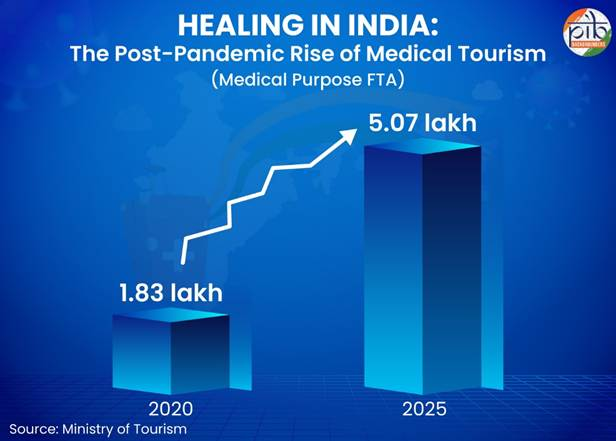
- As per the Ministry of Tourism estimates, 507,244 foreign nationals visited India in 2025 specifically for medical treatment.
- It shows that medical tourism constitutes approximately 5.5% of total Foreign Tourist Arrivals (FTAs).
- Leading Markets: Bangladesh followed by Iraq, Uzbekistan, Somalia, Turkmenistan, Oman, and Kenya.
- Popular destinations for medical tourism in India include cities like Delhi, Mumbai, Chennai, Bangalore, and Hyderabad.
- Patients primarily travel to India for specialised treatments such as: Cardiac surgery, Orthopaedic procedures, Cancer treatment, Organ transplants, AYUSH-based wellness therapies etc.
Factors Responsible for the Growth of Medical Tourism in India
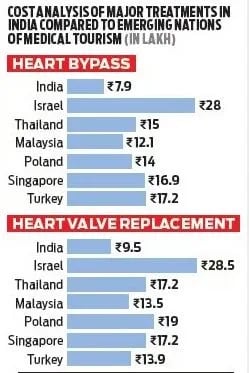
- Cost-Effective Treatment: India offers medical procedures at a fraction of the cost compared to countries like the US or Europe.
- High-Quality Healthcare: India has a well-established healthcare infrastructure with internationally accredited hospitals and skilled medical professionals.
- India has 69,364 hospitals (43,486 private hospitals, and 25,778 public hospitals) with 1.2 million registered doctors.
- Availability of Advanced Medical Technology: Indian hospitals are equipped with state-of-the-art medical technology and cutting-edge treatments, particularly in fields like cardiology, oncology, and orthopedics.
- Shorter Wait Times: Medical tourists can access timely treatment, often avoiding long wait times common in some Western healthcare systems.
- Government Support and Policies: The Indian government has implemented policies that encourage medical tourism, including medical visa facilitation and promoting the sector internationally.
- Strengthening AYUSH-led Medical Value Travel: India possesses a unique advantage in wellness tourism through its centuries-old traditional systems of medicine collectively known as AYUSH — Ayurveda, Yoga, Naturopathy, Unani, Siddha and Homeopathy.
Government Initiatives to Strengthen Medical Tourism
- National Medical & Wellness Tourism Promotion Board (NMWTB): Constituted by the Ministry of Tourism in 2015, chaired by the Union Minister for Tourism. It promotes and facilitates medical and wellness tourism in India.
- Strengthening AYUSH Ecosystem:
- The establishment of three new All India Institutes of Ayurveda has been proposed to enhance education, research, and clinical services in Ayurveda.
- Upgradation of the WHO Global Traditional Medicine Centre in Jamnagar for evidence-based research and global collaboration.
- Visa Reforms:
- e-Medical Visa and e-Medical Attendant Visa extended to 172 countries.
- Introduction of e-AYUSH Visa for traditional treatment seekers.
- Digital Support: Revamped Medical Value Travel Portal offering end-to-end services (planning, booking, payments, follow-up care).
- Heal in India Initiative: The initiative aims to position India as a global hub for integrated healthcare services. It has two key pillar:
- Medical Tourism: Focuses on curative services such as surgeries and advanced treatment.
- Wellness Tourism: Focuses on preventive healthcare and holistic healing through traditional systems.
Challenges in Medical Tourism in India
- Strong competition from Malaysia, Thailand and Singapore.
- Most of the medical care is not covered by insurance and it makes medical value travel (MVT) less attractive.
- The MVT facilitators are not well organized and accredited. Many unprofessional agents exploit the medical value traveller.
- Lack of Regulations: There are no comprehensive regulations to govern the MVT sector, which leaves the sector unorganised and lacks monitoring of the quality of services.
- Promotion of MVT: Individual Hospitals are carrying out their publicity but there is no effective campaign to establish India as a brand for medical value travel.
Way Ahead
- Medical and wellness tourism represents a high-potential sector linking healthcare, economy, and soft power.
- With strategic policy support, quality assurance, and global branding, India can emerge as a leading hub for affordable, holistic, and world-class healthcare services.
Source: PIB
Previous article
Inland Waterways: Fortifying Supply Chains
