


UAE Exit from OPEC and OPEC+
Syllabus: GS2/ Regional Groupings
Context
- The United Arab Emirates announced its withdrawal from OPEC and OPEC+ (effective May 1, 2026).
Reason
- UAE blamed fellow Arab states for not doing enough to protect it from numerous Iranian attacks during the war and decided to exit the grouping.
About OPEC
- The Organization of the Petroleum Exporting Countries (OPEC) is an intergovernmental organization founded in 1960 during the Baghdad Conference. Its original founding members were Saudi Arabia, Iran, Venezuela, Kuwait, and Iraq.
- Objectives: The organization coordinates petroleum supply and demand policies to maintain stable and fair market prices while ensuring a consistent income for oil-producing nations.
- Current Membership: It consists of 11 member nations: Algeria, Congo, Equatorial Guinea, Gabon, Iran, Iraq, Kuwait, Libya, Nigeria, Saudi Arabia, and Venezuela.
About OPEC+
- OPEC+ is an expanded framework now consisting of 21 members. This includes the 11 original OPEC countries plus 10 other major oil-producing nations: Russia, Kazakhstan, Azerbaijan, Brunei, Bahrain, Mexico, Oman, South Sudan, Sudan, and Malaysia.
- Formation: It was established in 2016 following the Algiers Accord (September 2016) and the subsequent Vienna Agreement (November 2016) between OPEC and non-OPEC exporters.
- Purpose: The alliance was primarily created to stabilize the market in response to a significant drop in oil prices triggered by the rapid increase in U.S. shale oil production.
Source: TH
Sacrifice Ratio
Syllabus: GS3/Economy
In News
- Rising oil prices are creating new inflation risks after recent global rate hikes that brought down COVID-era inflation.
- The US reduced inflation with little economic cost, the UK suffered a recession, and India slowed growth but avoided a downturn.
Sacrifice ratio
- The sacrifice ratio is an economic ratio that measures the effect of rising and falling inflation on a country’s total production and output.
- It is calculated by dividing the decrease in production by the percentage drop in inflation, showing how much output is lost for every 1% reduction in inflation.
Importance
- The sacrifice ratio shows the cost of reducing inflation in terms of lost output.
- It helps policymakers estimate how much production may fall when inflation is reduced using tools like higher interest rates.
Source : TH
Index of Service Production (ISP)
Syllabus: GS3/ Economy
Context
- The National Statistical Office has proposed a new Index of Service Production (ISP) with 2024–25 as the base year.
Need of ISP
- The services sector contributes more than 50% to India’s Gross Value Added (GVA), yet there is no equivalent of the Index of Industrial Production to monitor short-term trends.
- The ISP will fill this gap and complement the IIP, enabling a more comprehensive understanding of economic activity.
- The absence of such an index currently limits real-time assessment of services sector performance.
Use of Deflators
- The index will use Service Producer Price Indices (PPIs) for sectors like banking, insurance, and telecommunications to adjust for price changes.
- In sectors where PPIs are unavailable, sector-specific Consumer Price Indices (CPIs) will be used as substitutes.
About National Statistical Office (NSO)
- The National Statistical Office (NSO), under the Ministry of Statistics and Programme Implementation, is India’s central agency for official data. Formed in 2019 by merging the CSO and NSSO, it is headed by the Chief Statistician of India.
Functions
- The NSO conducts large-scale socio-economic surveys, compiles national income (GDP/GNP), and sets statistical standards for uniformity.
- It provides technical guidance to states, ensures data reliability through digital tools, and coordinates with international organizations.
Major Publications
- National Accounts Statistics (NAS): GDP and capital formation.
- Periodic Labour Force Survey (PLFS): Employment trends.
- Index of Industrial Production (IIP) & ASI: Industrial performance.
- Consumer Expenditure & Social Consumption: Poverty and service utilization.
- Statistical Year Book & Energy Statistics: Comprehensive sectoral and energy data.
Source: PIB
Geophagy
Syllabus: GS3/Environment
In News
- Barbary macaques in Gibraltar have been found to eat soil (geophagy) more often than other populations.
Geophagy
- It is the widespread behavior of eating soil, clay, or earth substances like chalk or kaolin.
- It is observed across many animal groups and also among some human populations, especially in tropical regions.
- It is found in many cultures worldwide but especially common in parts of Africa, among pregnant women, children, and rural populations.
- It may be linked to health or nutritional needs, such as relieving nausea, but its exact causes are not well understood.
Barbary macaque (Macaca sylvanus)
- It is a unique primate found in Africa north of the Sahara and is the only wild monkey in Europe.
- Once widespread across North Africa and parts of Southern Europe, it now survives mainly in small forest areas in Algeria and Morocco, with an introduced population in Gibraltar.
- The species is listed on Appendix I of CITES and The IUCN Red List of Threatened Species classifies it as Endangered .
Geophagy linkages with Barbary macaque
- Gibraltar macaques frequently eat soil, especially during tourist-heavy periods when they consume many human foods low in minerals.
- This geophagy likely helps relieve digestive problems or detoxify their diet.
- The behavior is common, socially shared, not linked to reproduction, and appears to be a response to human influence on their feeding habits.
Source : DTE
India Becomes 5th Largest Military Spender in 2025: SIPRI
Syllabus: GS3/Defence
Context
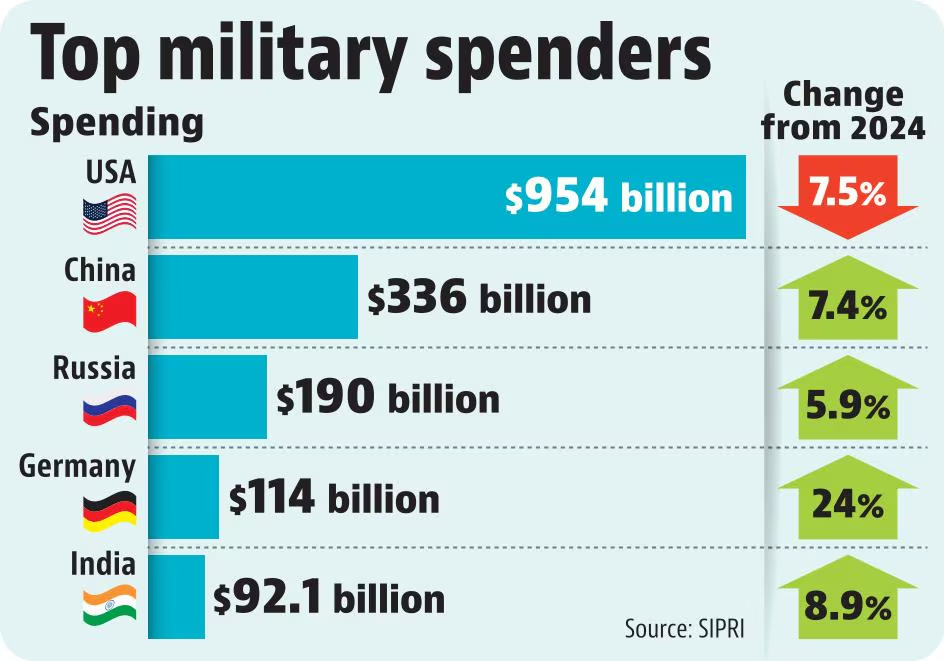
- India emerged as the world’s fifth-largest military spender in 2025, with defence expenditure reaching $92.1 billion, according to the Stockholm International Peace Research Institute (SIPRI).
Key Highlights (India)
- Defence spending rose by 8.9% year-on-year, driven by operational and procurement needs amid India–Pakistan tensions (May 2025).
- India remains the 2nd largest arms importer, accounting for 8.2% of global imports. However, arms imports declined by 4% between 2016–20 and 2021–25.
- Strategic Shift: India has gradually diversified its arms imports away from Russia towards Western suppliers such as France, Israel, and the United States; Russia’s share declined from 70% (2011–15) to 51% (2016–20) and further to 40% in 2021–25.
Global Arms Trends
- Global military expenditure reached a record $2,887 billion, marking the 11th consecutive year of growth and accounting for 2.5% of global GDP.
- Ukraine became the largest arms recipient (2021–25), with 9.7% share.
- Pakistan, ranked 31st globally, increased its defence spending to $11.9 billion (↑11%), driven by post-conflict procurement from China.
About SIPRI
- SIPRI was founded in 1966 by the Swedish parliament as an independent research institute.
- Its main objective is to conduct research on issues related to international peace and security, including arms control, disarmament, and conflict resolution.
- It is funded by a combination of government grants, private donations, and project-based funding.
- SIPRI’s flagship publication is the SIPRI Yearbook, which provides comprehensive data and analysis on global military expenditure, arms transfers, and other relevant security issues.
- SIPRI is based in Stockholm, Sweden.
Source: HT
Previous article
Indonesia’s New Biofuel Push
Next article
Geospatial Ecosystems and Land Governance in India
