

Syllabus: GS3/Economy
Context
- India’s manufacturing strategy has increasingly focused on the development of integrated manufacturing hubs.
Manufacturing Sector in India
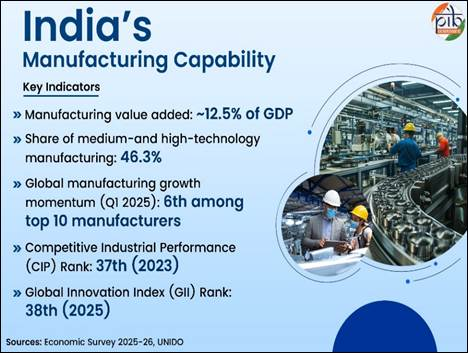
- Manufacturing contributes around 16–17% of GDP and employs over 27 million workers.
- As the country works towards transforming from a $3.7 trillion economy to a $30–35 trillion economy by 2047, manufacturing is expected to play a central role, with its share in GDP rising to at least 25%.
- India is focussing on 14 identified sunrise sectors like semiconductors, renewable energy components, medical devices, batteries and labour intensive industries, including leather and textile, to enhance the share of manufacturing in GDP.
Challenges Faced by India’s Manufacturing Sector
- Infrastructure Bottlenecks: High logistics cost, poor port connectivity, and power shortages leads to low output.
- Low R&D and Innovation: India invests less than 1% of GDP in R&D, limiting high-tech manufacturing.
- Import Dependence: Heavy reliance on imports for semiconductors, electronics components, and defence equipment.
- Skill Gaps: There is a major mismatch between workforce skills and industry requirements.
- Low Productivity: Due to the outdated machinery, small-scale fragmented units, and limited automation productivity remains low.
- Global Competition: Countries like Vietnam, Bangladesh, and China offer cheaper production and better ecosystems making Indian products less competitive.
- Environmental Concerns: Rising pressure for sustainable and green manufacturing with high compliance costs.
Development of Manufacturing Hubs in India
- India’s manufacturing strategy has increasingly focused on the development of integrated manufacturing hubs.
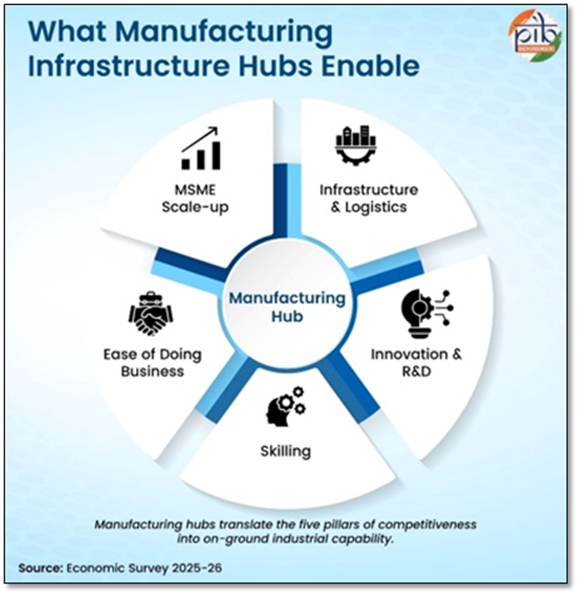
- These hubs are designed to support scale, reduce transaction costs, and anchor long-term manufacturing activity.
- Need for these hubs: Countries that are able to provide stable production environments are supported by infrastructure, logistics, skills, and institutional coordination.
- They are better positioned to sustain manufacturing activity and retain long-term production mandates.
Types of Manufacturing Hubs in India
- Large Integrated Manufacturing Hubs: These are master-planned industrial zones with plug-and-play infrastructure that host anchor manufacturers and their supplier ecosystems in one location.
- Sector-Specific Manufacturing Ecosystems: These hubs integrate production units with supplier networks, testing, regulatory, and skilling infrastructure to support complete value chains.
- Bulk Drug Park Scheme: It is facilitating the establishment of three Bulk Drug Parks in Gujarat, Himachal Pradesh, and Andhra Pradesh to reduce the cost of bulk drug manufacturing.
- Semiconductor and electronics ecosystems are supported under the Semicon India Programme and Electronics Components Manufacturing Scheme (ECMS) 2.0, covering fabrication, assembly, packaging, and testing.
- Micro, Small, and Medium Enterprises (MSME) Manufacturing Clusters: The Micro & Small Enterprises – Cluster Development Programme (MSE-CDP) supports infrastructure creation, Common Facility Centres (CFCs), and technology upgradation in MSME clusters.
- The India Industrial Land Bank (IILB) maps industrial estates, clusters, parks, and zones across the country.
- State Industrial Development Corporations develop and manage industrial estates for MSMEs.
- Corridor-Linked Industrial Nodes: These corridors provide trunk infrastructure, freight connectivity, and multimodal logistics, enabling industrial concentration at scale.
- Industrial corridors such as the Delhi–Mumbai Industrial Corridor (DMIC), Chennai–Bengaluru Industrial Corridor (CBIC), Amritsar–Kolkata Industrial Corridor (AKIC), and Vizag Chennai Industrial Corridor (VCIC) are designed to support manufacturing hubs.
Major Government Policies
- National Industrial Corridor Development Programme (NICDP) is designed to establish Greenfield Industrial Smart Cities across India, positioning the country as a global manufacturing hub.
- 20 industrial smart cities have been approved by the Government which cover 7 industrial corridors and 13 States.
- PM MITRA (Pradhan Mantri Mega Integrated Textile Region and Apparel) represents large integrated manufacturing hubs tailored for the textile value chain, combining processing, manufacturing, logistics, and common facilities within a single park framework.
- These parks have been announced in seven states, including Tamil Nadu, Telangana, Gujarat, Karnataka, Madhya Pradesh, Uttar Pradesh, and Maharashtra.
- PM Gati Shakti National Master Plan: It is an integrated platform that brings together infrastructure-related data and projects of 44 central ministries and 36 states/Union Territories.
- The initiative enables coordinated planning of transport, logistics, and utility infrastructure, with a focus on multimodal connectivity, last-mile linkages, and time-bound execution.
- Biopharma SHAKTI: Outlay of ₹10,000 crore over five years to build a biopharma-focused manufacturing ecosystem, including three new National Institute of Pharmaceutical Education and Research (NIPERs) and a nationwide network of over 1,000 accredited clinical trial sites.
- The National Manufacturing Mission (NMM): It was announced in the Union Budget 2025–26, as a long-term strategic roadmap that integrates policy, execution, and governance into a single, unified vision.
- Public Expenditure: The Government capital outlay has grown from ₹2 lakh crore in FY2014–15 to a Budget Estimate of ₹12.2 lakh crore in 2026–27.
Source: PIB
Previous article
Digital Public Infrastructure (DPI)@2047 Roadmap
Next article
Natural and Organic Farming
