


Syllabus: GS2/Polity and Governance
Context
- More than two-thirds of the MPs of the Aam Aadmi Party in the Rajya Sabha have decided to merge with the Bharatiya Janata Party, raising questions around the application of the anti-defection law.
What is the Anti-defection law?
- Aaya Ram Gaya Ram was a phrase that became popular in Indian politics after a Haryana MLA Gaya Lal changed his party thrice within the same day in 1967.
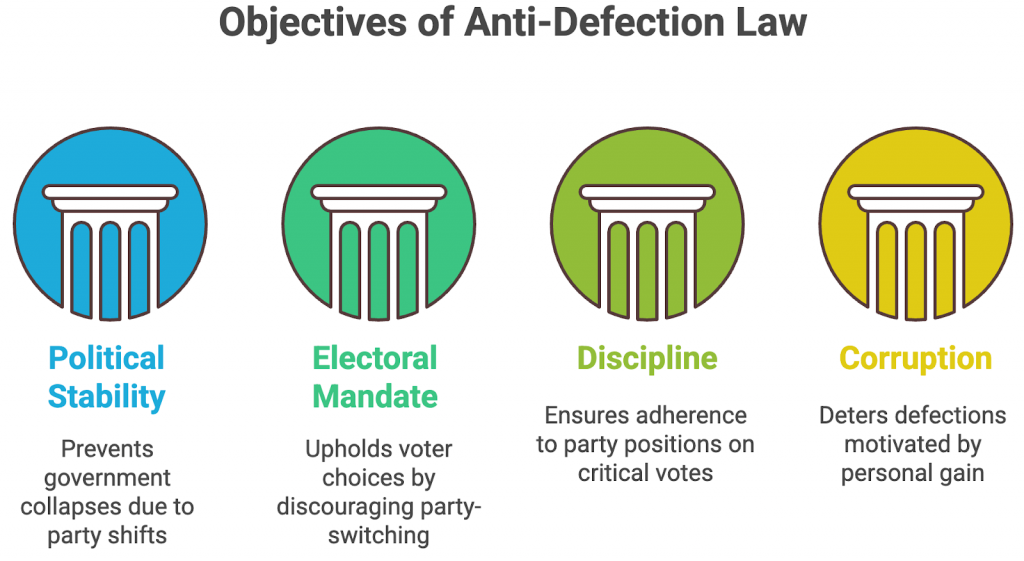
- The anti-defection law (Tenth Schedule of the Constitution) was inserted by the 52nd Amendment in 1985 to prevent political defections.
- Constitutional Disqualifications [Articles 102(1) & 191(1)]: A person shall be disqualified if he/she:
- Holds an office of profit under the Central or State Government;
- Is of unsound mind, as declared by a competent court;
- Is an undischarged insolvent;
- Is not a citizen of India, or has acquired citizenship of a foreign State, or shows allegiance to a foreign State;
- Is disqualified under any law made by Parliament.
Features of the Anti-Defection Law
- Disqualification on ground of defection: A legislator belonging to a political party will be disqualified if he: (i) voluntarily gives up his party membership, or (ii) votes/abstains to vote in the House contrary to the direction issued by his political party.
- A member is not disqualified if he has taken prior permission of his party, or if the voting or abstention is condoned by the party within 15 days.
- Independent members will be disqualified if they join a political party after getting elected to the House. Nominated members will be disqualified if they join any political party six months after getting nominated.
- The decision to disqualify a member from the House rests with the Chairman/Speaker of the House.
Exceptions
- The Tenth Schedule originally provided for two exceptions that would not render the members liable for disqualification.
- One-third members of the ‘legislature party’ split to form a separate group.
- Merger of their ‘political party’ with another party that is approved by two-third members of its ‘legislature party’.
- However, the first exception (one-third split) was removed in 2003 to strengthen the law.
Supreme Court Judgments
- Kihoto Hollohan v. Zachillhu (1992): The decisions of the Speaker regarding disqualification under the Tenth Schedule (Anti-defection Law) are subject to judicial review by the High Courts and the Supreme Court.
- Keisham Meghachandra Singh v. Speaker, Manipur (2020): The Supreme Court set a clear outer limit of three months for the Speaker to decide on a disqualification petition.
Key Issues and Challenges
- Delay in decision-making: In several cases (e.g., Karnataka, Manipur), decisions were delayed for months or even years, affecting government stability.
- Allegations of bias: The Presiding Officer (Speaker/Chairman) is often from the ruling party, raising concerns of partisan decisions.
- Limited judicial intervention: Although judicial review is allowed (Kihoto Hollohan v. Zachillhu), courts generally intervene only after the Speaker’s decision, not during the process.
- Restriction on legislators’ freedom: The law discourages MPs/MLAs from voting independently, limiting freedom of speech and conscience in legislatures.
- Rigid whip system: Party whips are issued even on non-critical issues, reducing scope for intra-party debate and dissent.
- Mass defections still possible: The two-thirds exception allows large-scale defections under the guise of “merger,” weakening the law’s intent. Bodies like the Law Commission (170th Report) and various scholars have argued that the law has failed to fully curb political defections and needs reform.
Conclusion and Way Forward
- The Anti-Defection Law has helped reduce political instability but suffers from implementation flaws and overreach, weakening its democratic purpose.
- Reforms are needed to balance party discipline with accountability, ensure unbiased adjudication, and promote internal party democracy to strengthen India’s parliamentary system.
Source: TH
Previous article
Weakening of Trade Unions in India
