


Syllabus: GS2/Polity & Governance
Context
- Recently, the Union Government has introduced three crucial Bills including the ‘Constitution (One Hundred and Thirty First Amendment) Bill, 2026’ that is expected to reshape India’s parliamentary structure and federal balance.
Phases of Seat Increase in Lok Sabha
- Initial Phase (Post-Independence Expansion):
- First Lok Sabha (1952): 489 (total seats); based on 1951 Census; First Delimitation Commission (1952).
- Second & Third Lok Sabha (1957–1962): Seats increased gradually due to population growth, and reorganisation of States.
- Major Expansion Phase (1960s–1970s): After 1961 Census (Delimitation Commission, 1963), seats increased to around 520.
- After 1971 Census (Delimitation Commission, 1973): Seats increased to 543 (current strength); It reflected rapid population growth.
- Freeze Period (1976–2026):
- 42nd Constitutional Amendment (1976): It froze seat allocation based on 1971 Census; Objectives were to encourage population control, and avoid penalising states with successful family planning.
- 84th Amendment (2001): It extended freeze till 2026; During this period,no increase in total seats; and only readjustment of boundaries (2002 delimitation).
Key Provisions of Constitution (131st Amendment) Bill, 2026
- Increase in Strength of Lok Sabha: The Bill proposes to raise the maximum strength of the Lok Sabha from 550 to 850.
- It includes elected members from States, and representation from Union Territories (Delhi, J&K, and Puducherry).
- It aims to ensure better representation in line with population growth.
- Basis of Seat Allocation: Seats for each State will be allocated based on proportion of population of the State to total population of India.
- Population will be based on such Census as Parliament may specify by law; and not necessarily the latest Census.
- It gives flexibility to Parliament in choosing the reference Census.
- Delimitation Requirement: The Bill links reallocation of seats, and women’s reservation implementation.
- Both will take effect only after a delimitation exercise.
- Women’s Reservation Clause: It provides that one-third of seats shall be reserved for women. Key conditions include:
- Effective after delimitation, and reservation valid for 15 years from commencement.
- Amendment to Existing Constitutional Scheme: The Bill modifies provisions related to:
- Article 81 (composition of Lok Sabha)
- Delimitation framework linked to Census
- Related provisions concerning reservation and seat allocation
Constitution Amendment Bill
- It is a legislative proposal introduced in Parliament to modify, add, or repeal provisions of the Constitution of India.
Who Can Introduce?
- Can be introduced in either House of Parliament (Lok Sabha or Rajya Sabha)
- Only Parliament has the power to initiate (States cannot introduce such Bills)
Procedure (Article 368)
- Special Majority in Parliament: Must be passed by majority of total membership, and 2/3rd of members present and voting in each House.
- State Ratification (if required): Needed when amendment affects federal provisions such as the President’s election, distribution of powers, and judiciary.
- It requires approval by at least half of State Legislatures.
- President’s Assent: After passage, the Bill is sent to the President for assent.
- After assent, the bill becomes a Constitutional Amendment Act.
Key Features
- No provision for joint sitting in case of deadlock;
- Judicial Review applicable (Basic Structure Doctrine);
- Parliament’s power is limited and cannot alter the basic structure
Major Implications
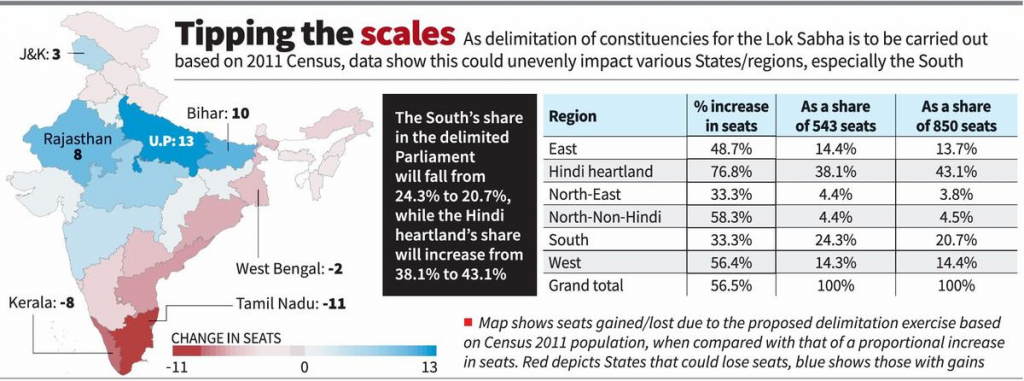
- Redistribution of Political Power: End of freeze on seat allocation (post-2026 condition removed)
- Seat distribution based on 2011 Census.
- It leads to greater representation for populous northern States, and ensures ‘one person, one vote, one value’.
- Such redistribution may intensify regional political asymmetry.
- Strengthening of Lok Sabha vis-à-vis Rajya Sabha: Lok Sabha expanded; Rajya Sabha unchanged.
- Lok Sabha dominance increases in joint sittings.
- It weakens bicameral balance and federal safeguards.
- Executive Dominance in Delimitation Decisions: Parliament can decide when to conduct delimitation, and which Census to use.
- It requires a simple majority, and gives the ruling government significant control.
- It raises concerns about politicisation of delimitation.
- Expansion of Council of Ministers: Cap of 15% of Lok Sabha strength may lead to increased executive patronage, and governance complexity.
- Reduced Legislative Participation: Larger Lok Sabha leads to lower individual MP participation. There are fewer chances in Question Hour, and Zero Hour.
- Problem aggravated by Parliament sitting which is less than 70 days/year.
Comparative Perspective
- United Kingdom Example: House of Commons include 650 members; and key strengths include more than 150 sitting days/year, strong committee system, and mandatory scrutiny of Bills.
Conclusion
- The proposed reforms aim to enhance representational equity, but they simultaneously alter federal balance, strengthen executive control, weaken bicameralism, and risk reducing legislative deliberation quality.
| Daily Mains Practice Question [Q] The proposed delimitation of Lok Sabha seats after 2026 is likely to reshape India’s federal balance. Discuss the implications of delimitation on representation, federalism, and political power dynamics. |
Previous article
India’s Heat Crisis & Mapping Legislative Vacuum
Next article
India’s Rural Models: Shaping Development Diplomacy
