


Syllabus: GS3/Disaster Management; Climate Change
Context
- Disaster funding under the 16th Finance Commission (FC) raises critical concerns about the design of India’s disaster finance framework, as 27 of 36 states/UTs are exposed to recurrent disasters.
- Over 58% of the land is vulnerable to earthquakes, 12% to floods, 68% to drought, and 5,700 km of coastline is at risk from cyclones.
About Disaster Finance in India
- It refers to the institutional and fiscal mechanisms for funding prevention, preparedness, response, and recovery from disasters. With increasing climate risks, it has become a core component of fiscal federalism and disaster governance.
- India follows a federal, rule-based financing system, largely guided by the Finance Commission (FC).
Institutional Framework
- Constitutional & Legal Basis
- Article 280: Finance Commission recommends disaster funding
- Disaster Management Act, 2005: Establishes NDMA, SDMAs
- Key Funds:
- State Disaster Response Fund (SDRF): Primary fund for immediate disaster response. Used for Relief, evacuation, temporary shelter, food, etc.
- Funded by: Centre (75% for general states, 90% for special category states); and States (remaining share)
- National Disaster Response Fund (NDRF): Supplementary fund for severe disasters; activated when SDRF is insufficient.
- Mitigation Funds (Often Underutilized): National Disaster Mitigation Fund (NDMF) & State Disaster Mitigation Fund (SDMF), these funds focus on long-term risk reduction (rarely operationalized effectively).
- State Disaster Response Fund (SDRF): Primary fund for immediate disaster response. Used for Relief, evacuation, temporary shelter, food, etc.
Role of Finance Commission
- Each Finance Commission determines total allocation, and designs a distribution formula among states.
- Recent Trends:
- 15th FC: Additive approach
- 16th FC: Introduced Disaster Risk Index (DRI)
Understanding the 16th FC’s Approach
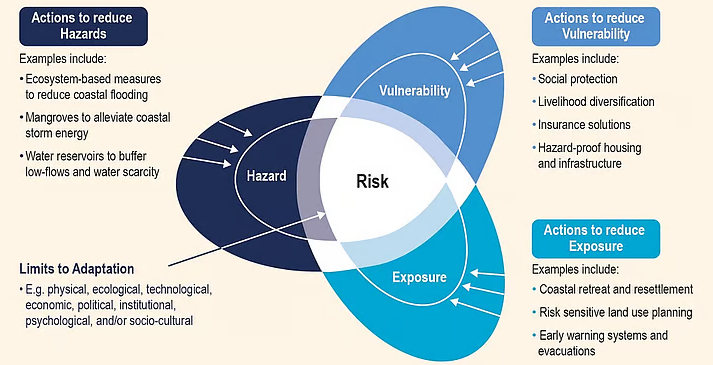
- Shift to a Multiplicative Disaster Risk Index (DRI): The 16th FC introduced a multiplicative model: DRI = Hazard × Exposure × Vulnerability
- It replaces the earlier additive approach of the 15th FC and aligns with global disaster risk theory.
- Components of the DRI
- Hazard: The Commission expanded the hazard variable to include ten specific disasters: flood, drought, cyclone, earthquake, landslides, hailstorms, cold wave, cloud burst, lightning, and heatwave.
- Exposure: It is measured using the projected population for October 2026. FC utilises population as a surrogate for exposure because it is highly correlated with the crops and infrastructure susceptible to damage.
- Vulnerability: It is calculated using the per-capita income of States; Susceptibility to damage.
Key Structural Issues in the Current Formula
- Mis-measurement of Exposure: Current approach focuses on exposure that is the total population of the State.
- According to the IPCC Sixth Assessment Report, exposure refers to ‘presence of people in places that could be adversely affected’.
- Thus, a large inland population is not high disaster exposure, and a smaller coastal population in hazard zones are higher real exposure.
- Examples:
- Odisha: High hazard, low population score: Lower DRI
- Uttar Pradesh & Bihar: Lower hazard but high population: Higher DRI
- Inadequate Proxy for Vulnerability: Current approach focuses on vulnerability that is inverse of per capita NSDP. However, it has limitations like:
- Measures economic capacity, not disaster vulnerability; and ignores housing quality, health infrastructure, early warning systems, and localized inequalities.
- Examples:
- Kerala floods (2018): ₹31,000 crore damage: Low vulnerability score due to high income.
- Jharkhand: High poverty but still loses funding share.
Broader Implications
- Distorted Allocation Outcomes: Almost 20 States lose funding share; common pattern includes smaller population, higher income, and better preparedness.
- Undermining Risk-Based Governance: The framework unintentionally penalizes prepared States, rewards demographic size over disaster risk, and weakens incentives for long-term resilience building.
What Needs to Change?
- Redefining Exposure: Exposure should reflect population in hazard-prone zones, not total population.
- Data Sources: BMTPC Vulnerability Atlas; and Census block-level data.
- Building a Composite Vulnerability Index: It includes kutcha housing share, agricultural labour dependence, health infrastructure density, insurance penetration (PMFBY), and early warning effectiveness.
- Data Sources: NFHS-5; NHM surveys; and IMD records.
- Institutional Reform: NDMA should publish an Annual State Disaster Vulnerability Index; and standardize methodology across Finance Commissions; and reduce arbitrariness and contestation.
Way Forward: Aligning Finance with Climate Reality
- Climate projections indicate intensifying cyclones (East & West coasts), expanding drought zones, and increased extreme rainfall events.
- States like Odisha, Andhra Pradesh, Kerala, and Assam are likely to face greater future risks, but remain underserved.
Conclusion
- The current disaster finance formula is conceptually sound but operationally flawed.
- It reduces a complex risk landscape into a demographic headcount, by equating exposure with total population and vulnerability with income.
- For a climate-vulnerable country like India, disaster finance needs to reflect where risk actually exists, not just how many people live within political boundaries.
| Daily Mains Practice Question [Q] Examine the challenges in India’s disaster finance architecture, and suggest measures to make disaster fund allocation more equitable and climate-resilient. |
Previous article
Ensuring Federalism Within Delimitation
Next article
India’s Opportunity In Global Supply Chain Reset
