

Tribal Arts in Conversation
Syllabus: GS1/ Culture
Context
- The Tribes Art Fest 2026, held at Travancore Palace in New Delhi, showcased India’s rich tribal artistic heritage.
Major Tribal Art Forms Highlighted
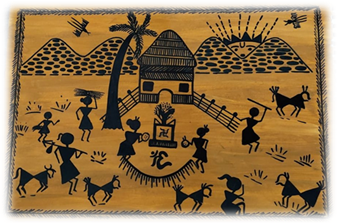
- Warli Painting: It originates from Maharashtra and is practised by the Warli tribe. It has roots possibly dating back to the Neolithic period (2500–3000 BC). Key features are;
- Use of white pigment made from rice paste on mud walls.
- Representation through basic geometric shapes (circles, triangles, squares).
- Themes include agriculture, rituals, hunting, and Tarpa dance.
- Rabha and Tamang Masks: Mask-making is central to the Rabha tribe of Assam and North Bengal. Masks are made using wood, bamboo, gourd, or clay, and painted in vibrant colours.
- They depict gods, spirits, animals, and mythological beings, used in ritual dances and folk theatre.
- Similar traditions exist among the Tamang community of the Himalayan region.
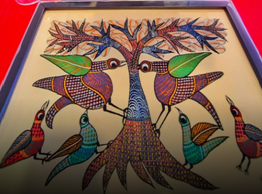
- Gond Art: Gond painting originates from central India, especially Madhya Pradesh. It has received a GI tag, ensuring legal protection and recognition. Key features are;
- Use of dots and lines to create intricate patterns.
- Themes rooted in folklore, animals, forests, and ecology.
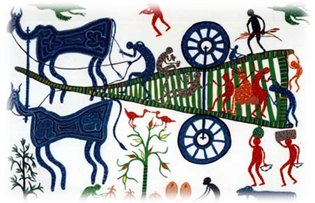
- Bhil Painting: It is practised by the Bhil tribe, one of India’s largest indigenous groups mainly from Madhya Pradesh, Maharashtra, Gujarat, and Rajasthan. It is considered among the oldest tribal art traditions. Key features are:
- Use of thousands of coloured dots, symbolising seeds and nature’s rhythm.
- Themes include deities, animals, forests, and daily life.
Source: PIB
Nor’wester Season
Syllabus: GS1/Geography
Context
- A severe Nor’wester struck Odisha recently.
About
- A “Nor’wester” (short for northwester) refers to a specific type of violent pre-monsoon thunderstorm common in parts of South Asia, especially in eastern India and Bangladesh.
- It is a sudden, short-lived but intense storm that typically occurs during March to May.
- It is known locally in eastern India (especially West Bengal) as “Kalbaisakhi”.
- It is Caused by intense heating of land during summer.
- When the hot, dry air meets the cool, moist air, it creates instability in the atmosphere.
- The warm air rises rapidly (convection), forming towering thunderclouds (cumulonimbus).
- This leads to heavy rain, strong winds, lightning and thunder.
Source: AIR
Fujairah Port
Syllabus: GS1/Geography
Context
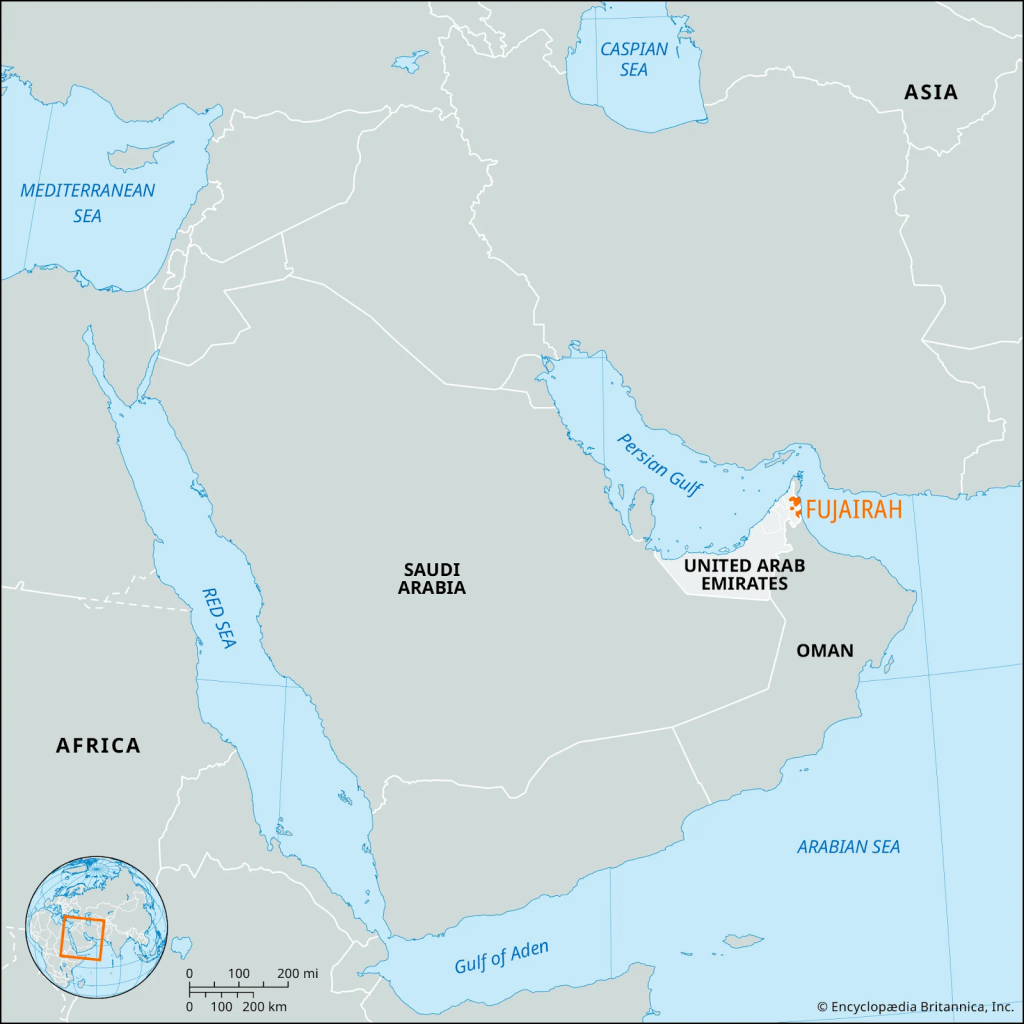
- A targeted drone attack happened at the Port of Fujairah in the United Arab Emirates (UAE).
About
- It is the only multi-purpose maritime facility on the east coast of the United Arab Emirates.
- Strategically located just 70 nautical miles outside the Strait of Hormuz, the Port provides an essential economic link between Europe and Asia.
Other Ports in the News Due to Ongoing West Asia Conflict
- Ras Tanura (Saudi Arabia)
- Jebel Ali (UAE)
- Umm Qasr (Iraq)
Source: TOI
NMDC Iron Ore Production
Syllabus: GS1/Geography; GS3/Economy
Context
- NMDC Limited has become India’s first mining company to achieve 50 million tonnes (MT) of iron ore production in a single financial year (FY 2025–26).
About Iron Ore
- Iron ore refers to rocks and minerals from which metallic iron is extracted.
- Iron ore is categorized into four main types based on iron content and quality: Magnetite (best quality, >70% iron), Hematite (most important industrial ore, 60-70% iron), Limonite (lower grade, 40-60% iron), and Siderite (poor quality, <40% iron).
- India is the 4th largest producer, after Australia, Brazil, and China.
- Odisha leads in production, followed by Chhattisgarh and Karnataka.
About NMDC
- Established in 1958 to develop India’s iron ore resources.
- India’s largest iron ore producer and a Navratna CPSE under the Ministry of Steel.
- Production increased from ~10 MT (1978) to 50 MT (FY26), reflecting sustained growth.
- Supports India’s target of 300 MT steel production capacity by 2030.
Source: PIB
Gynandromorphy
Syllabus: GS3/ Environment
Context
- A rare case of gynandromorphy has been reported in a freshwater crab species Vela carli from Silent Valley National Park in the Western Ghats.
What is Gynandromorphy?
- Gynandromorphy refers to the presence of both male and female characteristics in a single organism. It occurs due to;
- Errors in cell division (mitosis/meiosis).
- Chromosomal anomalies during early development.
- It is different from;
- Hermaphroditism: Organism has functional reproductive organs of both sexes.
- Intersex conditions: Mixed sexual characteristics but not distinct male/female halves.
Silent Valley National Park
- It is located in the Nilgiri hills, Kerala.
- Silent Valley was declared as a National Park in 1984 and formally inaugurated in the year 1985.
- The Bhavani River, a tributary of the Kaveri River, and Kunthipuzha River, a tributary of Bharathapuzha river, originate in the vicinity of Silent Valley.
- The indigenous tribal groups that live within park boundaries includeIrulas, Kurumbas, Mudugas and Kattunaikkars.
Source: TH
India’s First National Report (NR1) on Nagoya Protocol
Syllabus: GS3/ Environment
In News
- India recently submitted its first National Report (NR1) on Nagoya Protocol implementation to the CBD Secretariat, marking a key milestone in biodiversity governance.
About
- The report, prepared by the Ministry of Environment, Forest and Climate Change in collaboration with the National Biodiversity Authority, covers the period from November 2017 to December 2025.
- During the reporting period (2017–2025), India issued 12,830 Access and Benefit Sharing (ABS) approvals, including 5,913 approvals by the National Biodiversity Authority and 6,917 approvals by State Biodiversity Boards (SBBs/UTBCs) for commercial utilisation of biological resources.
What is the Nagoya Protocol?
- Adopted on October 29, 2010, in Nagoya, Japan, and effective from October 12, 2014, it ensures fair access to genetic resources and benefit-sharing (monetary or non-monetary) via prior informed consent and mutually agreed terms.
- India ratified it in 2012, aligning with its Biological Diversity Act, 2002.
India’s Framework
- India’s ABS framework operates under the Biological Diversity Act, 2002, supported by the Biological Diversity Rules, 2024 and the ABS Regulations, 2025, through a three-tier institutional structure comprising the National Biodiversity Authority, State Biodiversity Boards/Union Territory Biodiversity Councils, and Biodiversity Management Committees (BMCs) at the local level.
- India issued 3,556 IRCCs globally, over 60% of the total.
Source: PIB
Nominations for Padma Awards-2027 Begins
Syllabus: Miscellaneous
In News
- The Centre has opened nominations and recommendations for the Padma Awards 2027, one of the country’s highest civilian honours.
- The nomination process began on March 15 and will remain open until July 31, 2026.
Padma Awards
- The Padma Awards are among India’s highest civilian honours instituted in 1954.
- They are presented in three categories: Padma Vibhushan, Padma Bhushan and Padma Shri.
- ‘Padma Vibhushan’ is awarded for exceptional and distinguished service;
- ‘Padma Bhushan’ for distinguished service of high order and
- ‘Padma Shri’ for distinguished service in any field.
- The awards recognise “work of distinction” and are given for exceptional achievements or service across a wide range of fields, including art, literature and education, sports, medicine, social work, science and engineering, public affairs, civil service, trade and industry.
- All individuals are eligible for the awards regardless of race, occupation, position or gender.
- However, government servants, including employees of public sector undertakings, are generally not eligible, except for doctors and scientists.
- The government is committed to transform Padma Awards into “People’s Padma”, encouraging citizens to nominate deserving individuals.
- Self-nominations are also allowed.
- The nominations must include detailed information about the nominee’s distinguished achievements in their respective fields
- nominations will be accepted only through the online Rashtriya Puraskar Portal.
- The awards are announced on the occasion of Republic Day every year.
- These Awards are conferred by the President of India at ceremonial functions which are held at RashtrapatiBhawan usually around March/ April every year.
Source :PIB
