


Syllabus: GS3/Economy
Context
- For the Indian population, the Global Capability Centres (GCCs) boom has catalysed high-value employment and regional development.
What are Global Capability Centres?
- Global In-house Centres or Captives (GICs) or Global Capability Centres (GCCs), are mainly offshore centres established by global level firms/MNCs to provide various services to their parent organisations.
- These centres operate as internal organisations within the global corporate structure, providing specialised solutions such as IT services, Research and Development (R&D), customer support and other business tasks.
- GCCs have evolved from being cost-saving centres that were largely set up to gain from lower labour costs to becoming strategic hubs that encourage innovation and lead to value creation, over the past couple of decades.
India’s GCC Landscape
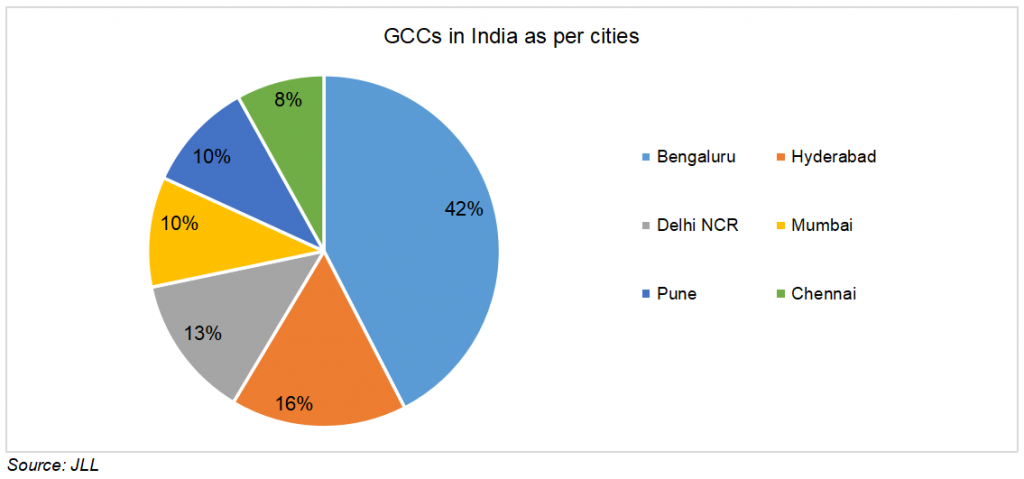
- India already hosts more than 1,800 GCCs employing 2.16 million professionals and contributing about $68 billion in direct gross value addition (GVA), which roughly works out as 1.8% of GDP.
- According to The Confederation of Indian Industry (CII) framework, by 2030 the number of centres could rise to 5,000, generating $154–199 billion in direct GVA.
- Including indirect and induced effects, the overall impact could touch $470–600 billion.
- Employment potential: By 2030, it could translate into 20–25 million jobs, including 4–5 million high-quality direct roles in areas such as artificial intelligence, engineering R&D, cybersecurity and digital platforms.
Drivers of GCC Growth in India
- Talent Hub: India is known globally for its diverse pool of talent with expertise in domains ranging from IT, engineering, analytics, and finance.
- The availability of a skilled workforce has enabled GCCs to implement high-value and complex projects in India.
- Technological innovations: ML, AI, Internet of Things (IoT) and blockchain are some of the advanced technologies that have been adapted rapidly.
- This in turn has enabled GCCs in India to deliver innovative solutions and digitally transform their parent companies.
- Strategically focused: From being known as a cost-saving centre to becoming a strategic hub, over the years, MNCs have recognised the potential of setting up GCCs in India.
- These centres are now viewed as a strategic asset that enables businesses to drive growth, improve operational efficiency and gain competitive advantages.
- Government support: Various reforms of the Indian government, such as the Digital India Campaign aimed at enabling ease of doing business, have contributed to making a favourable environment in India for the growth of GCCs.
Challenges
- Widening Talent Gap: Although India produces millions of engineers, the demand for niche skills in AI security, cloud architecture and quantum-resistant cryptography vastly outstrips the supply.
- This has triggered a fierce war for talent, leading to wage inflation that could eventually erode the value proposition of multinational corporations (MNC).
- Cyber Attacks: India-based centres now handle 13.7% of global cyber-attack incidents, the threat of state-sponsored espionage and intellectual property theft has made cybersecurity the most expensive operational mandate for modern GCCs.
- Organisation for Economic Co-operation and Development’s Global Minimum Tax (Pillar Two): The introduction of the OECD’s Global Minimum Tax (Pillar Two) reduces the tax advantages that many multinational companies earlier enjoyed.
- With a minimum global tax rate of 15%, and ongoing concerns over India’s 24% Safe Harbour markup for software R&D, companies are now more worried about tax certainty and fiscal stability.
- Geopolitical Volatility: Geopolitical volatility and protectionism pose long-term risks to investment.
- As of early 2026, global trade professionals are increasingly wary of United States tariff volatility and reshoring policies that encourage MNCs to return critical data operations to their home markets.
- Digital Sovereignty: While India remains an attractive destination, owing to its scale, any shift toward digital sovereignty in western nations could slow the pace of new GCC setups.
Way Ahead
- To secure India’s position as the world’s innovation capital, policymakers must transition from regulators to active facilitators.
- The National GCC Policy Framework, proposed in the 2026-27 Budget cycle, is a step in the right direction, but execution is the key.
- A national framework will be formulated as guidance to states for promoting Global Capability Centres in emerging tier 2 cities.
- The government should introduce a “Single-Window Clearance” system specifically for GCCs to streamline the establishment of legal entities.
- Additionally, rationalising transfer pricing norms and providing tax safe harbours for R&D-intensive operations will provide the fiscal certainty that global boards demand.
Conclusion
- By fostering deeper industry-academia collaborations to upskill the workforce in deep tech and offering capital subsidies for Tier-II expansion, India can ensure that its GCC revolution remains sustainable for the next decade.
Source: TH
Previous article
India AI Impact Summit 2026
