


Syllabus: GS3/Science and Technology
Context
- The India AI Impact Summit 2026 concluded in New Delhi recently.
Background of AI Summits
- 2023 Bletchley Park Summit (UK): The first global AI summit was held at Bletchley Park and focused on safety. It brought together countries and experts to discuss AI risks and resulted in the Bletchley Declaration.
- 2024 Seoul Summit (South Korea): The second summit was held in Seoul in May 2024, building on the discussions from the Bletchley Park meeting and broadening to include innovation and inclusivity alongside safety.
- 2025 AI Action Summit (Paris, France): In February 2025, the AI Action Summit took place at the Grand Palais in Paris. It was co-chaired by France and India and followed the earlier Bletchley Park and Seoul events.
- 2026 India AI Impact Summit (New Delhi): This is the next major summit in the series, held in India in February 2026.
India–AI Impact Summit 2026
- Hosted by the Ministry of Electronics and Information Technology (MeitY).
- The India–AI Impact Summit 2026, was announced by the PM at the France AI Action Summit and it will be the first-ever global AI summit hosted in the Global South.
- It will strengthen existing multilateral initiatives while advancing new priorities, deliverables, and cooperative frameworks.
- The Three Sutras: Three foundational pillars, known as ‘Sutras’ i.e. People, Planet and Progress, define how AI can be harnessed through multilateral cooperation for collective benefit.
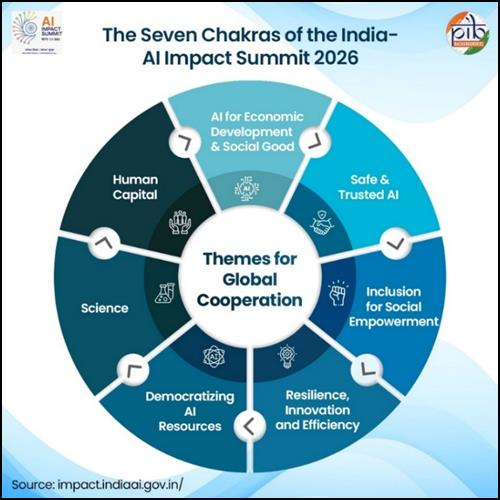
India-hosted Summit Goals
- AI’s capabilities must be available to as many people as possible;
- more work must be done to make it relevant in the Global South, such as by expanding representation for languages that have been under-represented in the training of western LLMs (large language models);
- and that the technology should be “safe and trusted”.
- On the domestic front, the government sought to project India as an attractive destination for AI infrastructure and research, and for encouraging the technology’s adoption in India.
Outcomes of the summit
- Wide Participation: The summit attracted over five lakh visitors, a record that easily surpassed the attendance of the G20 summit in 2023.
- The event also hosted over 500 individual discussions, with speakers from around the world.
- Investments: The government also mentioned $250 billion in investment commitments, as well as $20 billion in commitments for frontier deep tech research.
- Delhi Declaration: India also achieved broad consensus among 88 countries and international organisations for the New Delhi Declaration on AI.
- It was signed by the U.S., China, France, and several other countries who are key for the development and deployment of AI at present.
- Nearly all commitments are described in the statement as “voluntary” and “non-binding,” encouraging wider participation.
- These include a charter for the “democratic diffusion” of AI; a “Global AI Impact Commons,” which would serve as a database of use cases for countries to draw inspiration from; a “Trusted AI Commons,” described as a “repository of tools, benchmarks, and best practices; an “International Network of AI for Science Institutions” which would link technical institutes around the world.
- India Joined Pax Silica: During the summit, India joined the U.S.-led Pax Silica initiative, which seeks to build a network of like-minded countries opposed to concentration of power in electronics manufacturing and critical minerals.
- Sarvam AI: The event saw the long-anticipated launch of India’s first domestically trained multi-billion parameter LLMs by Sarvam AI.
- Investment commitments:
- Reliance Industries Ltd. announced commitments of ₹10 lakh crore in domestic AI, only slightly more than the Adani Group’s similar commitment.
- Google gave a few fresh details about its existing $15 billion investment in data centre and AI projects in India, such as a subsea cable system that would directly connect India and the U.S.
Conclusion
- The summit is expected to catalyse long-term international partnerships and position AI as a key driver of economic growth.
- The government mentioned there was “broad-based global consensus on leveraging AI for economic growth and social good”.
Source: TH
Previous article
AI to Power India’s Next Agricultural Transformation
Next article
India’s Global Capability Centre Revolution
