

Syllabus: GS3/Economy
Context
- Recently, China’s trade surplus surpassed $1 trillion in the first eleven months of 2025, underscoring China’s dominance in global manufacturing and exports.
- It also reveals underlying economic vulnerabilities and global trade distortions.
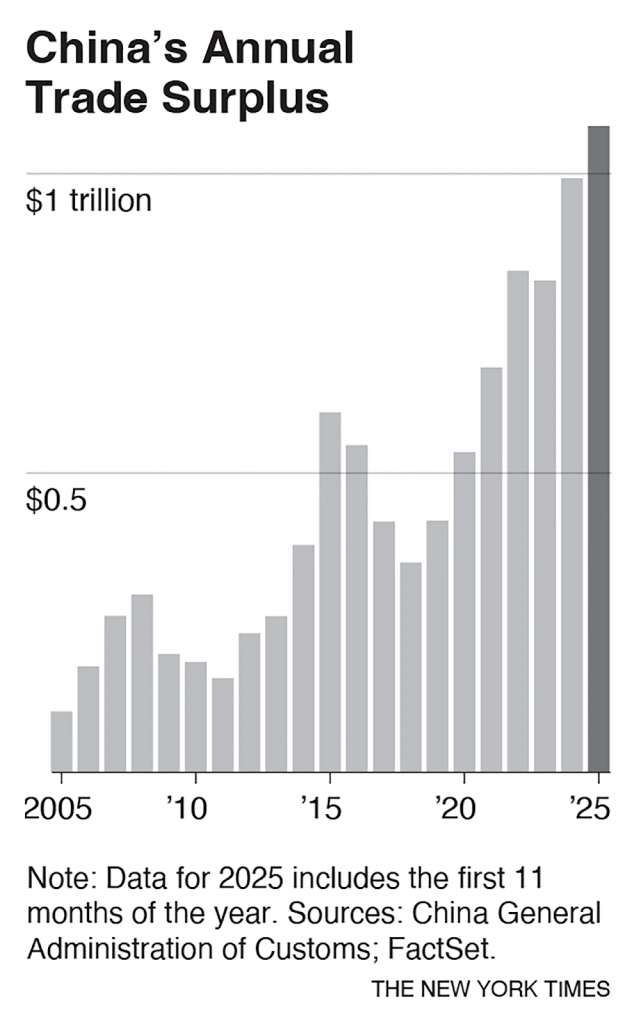
Milestone and Its Meaning of $1 Trillion Trade Surplus
- It is the culmination of two decades of industrial scaling and policy continuity of China including the tightly integrated supply chains, infrastructure depth, and manufacturing ecosystem.
- It is added by weaker Renminbi (exchange rate effects), but the fundamental driver remains production strength.
- It comes amid weak domestic demand and a volatile global trade environment.
Behind the Trade Surplus
- China’s Manufacturing Dominance: According to a study, no nation since the UK’s Industrial Revolution or the US post–World War II era has held such extensive control over global manufacturing like China.
- The global trade-to-GDP ratio has more than doubled since 1970, from 25% to over 60% by 2022, amplifying the consequences of China’s industrial strength.
- Over two decades, Chinese manufactured exports have grown 25-fold, powered by low labor costs, economies of scale, and state support.
- Export Composition: It reveals a decisive shift toward higher-value manufacturing.
- Strong sectors: Automobiles, integrated circuits, and advanced electronics.
- Weak sectors: Labor-intensive industries such as apparel, textiles, and toys.
- Changing Trade Geography: Shipments to the United States fell 29% year-on-year, largely due to renewed tariffs and softer American demand.
- But, overall exports surged because China diversified its markets, primarily towards the Global South and emerging economies.
- Transshipment through Southeast Asia, reflecting firms’ adaptive responses to tariff barriers.
- It represents both strategic resilience and an evolving global trade map where China’s influence extends deeper into developing economies.
| Do You Know? – First ‘China Shock’: It reshaped global manufacturing after China joined the WTO in 2001. a. Millions of Western industrial jobs vanished as cheap Chinese goods flooded markets. – Second ‘China Shock’: China’s emergence in advanced manufacturing and clean technology, particularly in electric vehicles, batteries, solar panels, and electronics. |
Policy Implications
- China’s Central Economic Work Conference (CEWC), the country’s annual economic policy meeting, aims to interpret the record surplus both as a success story and a warning signal. It likely includes:
- Rebalancing growth toward stronger domestic demand.
- Containing overcapacity and mitigating involution.
- Promoting technology upgrading and green manufacturing.
- Stabilizing confidence amid global headwinds.
- The central focus will remain on structural reform, innovation, and sustainable growth rather than headline surplus numbers, while trade tensions will frame discussions.
- The International Monetary Fund (IMF) attributes the surplus partly to a real depreciation of the Yuan, driven by China’s low inflation relative to its trading partners.
- The IMF urged China to stimulate domestic consumption and allow greater exchange rate flexibility to address these imbalances sustainably.
Global Implications of China’s $1 Trillion Trade Surplus
- Overcapacity and Global Friction: China’s expanding surplus intensifies domestic and international dilemmas.
- Trading partners accuse China of dumping goods and distorting markets, as recently France signals unease over China’s role in industries such as electric vehicles and green tech.
- Trade Imbalances and Currency Wars: The US and EU face record deficits with China.
- US deficit in 2025 projected at $480 billion, leading to renewed tariff escalation.
- Deflationary Pressures: China’s export-driven glut (EVs, steel, solar) depresses global industrial prices, raising risks of ‘imported deflation’ in OECD economies.
- Geoeconomic Repercussions: China’s surplus strengthens its global liquidity dominance, increased lending to Global South via Belt & Road and Yuan-denominated trade.
- But Western powers interpret this as ‘mercantilist aggression’, triggering industrial policy retaliation (e.g., EU’s CBAM).
- Asian Economies’ Realignment: ASEAN economies, Taiwan, and India benefit partially from supply chain shifts, but also face price competition and dumping risks.
Implications For India
- Rising Trade Deficit and Manufacturing Pressure: India’s trade deficit with China reached $95 billion in FY2025, as imports of electronics, solar components, and APIs surged.
- Domestic manufacturing under ‘Make in India’ and Production-Linked Incentive (PLI) schemes faces intensified competition from China’s cost-efficient exports.
- Investment and Supply Chain Realignment: Multinationals are diversifying from China. ‘China+1’ strategy, benefiting India, Vietnam, and Mexico.
- However, India lacks equivalent logistics and infrastructure, slowing relocation inflows.
- Currency & Inflation Spillovers: Yuan depreciation exerts deflationary pressure on global prices, including India’s imports, which helps inflation control but hurts local producers.
- Strategic Dependencies: India’s critical sectors (pharma APIs, electronics) remain dependent on Chinese imports.
India’s Strategic Responses
- Trade Diversification: FTAs with UAE, EU in progress, but need to prioritize ASEAN & Africa markets.
- India is pushing for supply chain diversification and self-reliance (Atmanirbhar Bharat) to reduce dependence on Chinese imports.
- Manufacturing Incentives: PLI in electronics, solar, semiconductors, and need to accelerate value-chain localization.
- Geopolitical Leverage: Need to use trade diplomacy to balance China’s dominance, as India is an active partner in QUAD & IPEF.
- India’s response to China’s trade surplus needs to twofold:
- Short-term: Tighten quality controls, incentivize domestic production, and monitor dumping practices.
- Long-term: Invest in R&D, skill development, and infrastructure to build globally competitive industries.
Previous article
News In Short 11-12-2025
