

Syllabus: GS3/ Economy
Context
- India’s banking sector has undergone a remarkable transformation, and Banking Laws (Amendment) Act, 2025 is a step towards strengthening governance standards in the banking sector.
Banking Laws (Amendment) Act, 2025
- It contains a total of 19 amendments across five legislations;
- The Reserve Bank of India Act, 1934,
- Banking Regulation Act, 1949,
- State Bank of India Act, 1955 and
- Banking Companies (Acquisition and Transfer of Undertakings) Act, 1970 and 1980.
Need for the Banking Amendment Act, 2025
- Rising Unclaimed Deposits: A substantial amount in banks remains unclaimed due to the absence of nominees. The Act addresses this challenge by establishing a structured, seamless succession mechanism.
- Expanding Financial Inclusion: As more households enter the formal banking system, the complexity of services rises.
- Modern frameworks are needed to handle the scale, technology adoption, and increased transaction volumes.
- Clarity and Uniformity in Banking Operations: Establishes uniform terminology for smoother integration with emerging technologies.
- Reduces disputes between banks and depositors by formalising asset succession rules.
Key reforms under Banking Laws (Amendment) Act, 2025
- Modernised Nomination Framework (Sections 10 – 13): Depositors can nominate up to four persons for their bank accounts via either simultaneous or successive nominations
- Simultaneous nominations allow percentage-wise allocation totalling to 100%.
- Successive nominations ensure seamless succession in case of a nominee’s death for articles in safe custody and safety lockers
- Redefinition of ‘Substantial Interest’ (Section 3): Threshold increased from ₹ 5 lakh (1968 limit) to ₹ 2 crore. This regulatory change is designed to revamp governance standards.
- Governance in Co-operative Banks (Section 4 & 14): Align director tenures in cooperative banks with the 97th Constitutional Amendment by increasing the maximum tenure from 8 years to 10 years (excluding the chairperson and whole-time director). Tenure for directors in other banking companies remains unchanged.
- Audit Reforms in PSBs (Sections 15-20): Empower PSBs to fix the auditors remuneration.
- PSBs will now be permitted to transfer unclaimed shares, interest, and bond redemption amounts to the Investor Education and Protection Fund (IEPF), bringing them in line with practices followed by companies under the Companies Act.
Impact of the Banking Reforms with National Vision
- Depositor-centric: The Act includes robust measures to safeguard public trust in banking institutions by simplified claim settlement for their families.
- Improved Financial Transparency: Transfer to the Investor Education and Protection Fund aims at creating a more transparent system for fund management.
- Enhanced Audit Quality: The PSBs will now be able to attract more qualified professionals and improve audit quality by paying better auditor remuneration.
- Improved Operational Efficiency: The Act simplifies certain procedures, such as updating certain operational definitions.
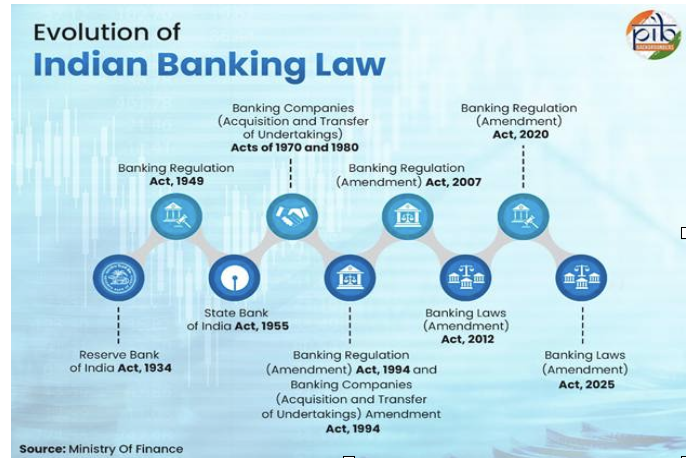
Source: PIB
Previous article
Supreme Court on Rohingya Deportation Case
