


Syllabus: GS3/Internal Security
Context
- President Droupadi Murmu said that India is committed to the idea of the oceans remaining “open, stable and rules-based” drawing attention to the strategic and critical importance of the Indian Ocean Region as a maritime space.
About
- The Indian Ocean Region is a conduit for global energy supplies and trade. Being positioned at its centre, India bears a special responsibility.
- By securing sea routes, protecting marine resources, preventing illegal activities, and supporting maritime research, the Navy strengthens the vision of safe, prosperous, and sustainable oceans,”.
- The President observed that modernisation is crucial for the combat readiness of the armed force.
Indian Ocean Region
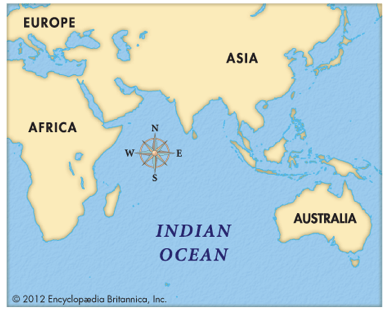
- The Indian Ocean covers approximatelyone-fifth of the total ocean area of the world.
- The Indian Ocean is bounded by Iran, Pakistan, India, and Bangladesh to the north; the Malay Peninsula, the Sunda Islands of Indonesia, and Australia to the east; the Southern Ocean to the south; and Africa and the Arabian Peninsula to the west.
- The Indian Ocean Region (IOR) comprises 36 countries and has a population of approximately 2.5 billion, accounting for 35% of the global population and 40% of the world’s coastline.
Significance of the Indian Ocean Region (IOR)
- Geostrategic Importance: The Indian Ocean is the third largest ocean, linking the Middle East, Africa, South Asia, and Southeast Asia.
- It is home to crucial maritime chokepoints — Strait of Hormuz, Bab-el-Mandeb, Malacca Strait, Lombok Strait — which together handle a bulk of global energy and trade flows.
- The IOR acts as a bridge between the East and the West, making it a central theatre for power competition among India, China, the U.S., and other major players.
- Economic Significance: The region carries nearly 50% of global container traffic and 80% of seaborne oil trade.
- It is a hub of blue economy activities: shipping, fisheries, seabed mining, and tourism.
- Energy Security: The IOR is the lifeline of global energy flows: oil and gas from West Asia transit to East Asia via its sea lanes.
- Countries like India, China, Japan, and South Korea are energy-import dependent, making stability of the IOR vital.
- Blue Economy and Resource Potential: Beyond energy and trade, the Indian Ocean Region represents an untapped frontier for sustainable ocean-based economic development.
- The Indian Ocean supports approximately 15% of the world’s total fish catch, with the fishing industry providing critical employment and nutrition for millions of people across the region.
Why has the focus on IOR been increased recently?
- Rise of New Economies: India and China’s emergence has revived trade networks in IOR and the region is becoming a new economic growth centre.
- Maritime Security Threats: Piracy (especially near Somalia) threatened global shipping lanes and led to increased efforts to secure Sea Lines of Communication (SLOCs).
- Indo-Pacific Construct: The Indo-Pacific combines the Indian and Pacific Oceans into one strategic theatre and highlights the centrality of IOR in shaping new global maritime order.
- This geographical reimagination enhances IOR’s visibility in global diplomacy and security.
- Implications for Global Order: Control over the IOR can shape:
- Trade flows (especially oil & gas),
- Strategic maritime chokepoints (like the Strait of Hormuz, Malacca, Bab el-Mandeb),
- Military posturing and base logistics.
Challenges in IOR
- Expansion of Chinese Naval Power in IOR: Increased naval vessel deployments in the region in terms of both number and duration.
- Maritime Domain Awareness Activities: Deployment of Chinese research and survey vessels to gather sensitive oceanographic and marine data under the guise of scientific research.
- Piracy hotspots near the Horn of Africa and in the Malacca Strait threaten shipping.
- Terrorism, arms smuggling, and trafficking networks exploit porous maritime borders.
- Strategic Port Development Near India: China is actively involved in developing ports and infrastructure in littoral states of the IOR, including those close to India’s maritime boundaries.
- The objective aligns with China’s long-term goal of becoming a maritime power.
India’s Strategic Responses
- Diplomatic and Security Leadership: India positions itself as first responder in disasters.
- India is a preferred security partner in HADR (Humanitarian Assistance and Disaster Relief), Maritime Domain Awareness (MDA), and development.
- Indo-Pacific Oceans Initiative (IPOI), 2019: India-led initiative announced at the East Asia Summit.
- Focus Areas: maritime security, ecology, resource sharing, disaster management, connectivity, and trade.
- Launch of MAHASAGAR (Mutual and Holistic Advancement for Security and Growth for All in the Region) reflects India’s strategic rebranding in the IOR.
- Naval Modernisation and Indigenous Development: India is modernising naval capabilities:
- Commissioning indigenous warships (e.g., INS Vikrant, INS Visakhapatnam).
- Boosting maritime domain awareness and power projection.
- This strengthens India’s force posture and maritime deterrence in the IOR.
- India’s Response and Regional Diplomacy: India is working with regional partners to raise awareness about the long-term implications of Chinese infrastructure projects.
- Emphasize the risks to internal and regional security from China’s military use of these assets.
- Multilateral Engagements:
- Indian Ocean Rim Association (IORA): India is a founding member (1997). Focus areas: maritime security, disaster management, blue economy, trade & investment facilitation.
- Indian Ocean Naval Symposium (IONS): Initiated by the Indian Navy in 2008. Activities include: Information exchange, Joint exercises, HADR cooperation, Anti-piracy coordination.
- QUAD (India–US–Japan–Australia): Central focus on maritime security, freedom of navigation, and a rules-based Indo-Pacific.
- Colombo Security Conclave (CSC): India, Maldives, Mauritius, Sri Lanka and Bangladesh are members. Focus: Maritime security, Counter-narcotics, Cyber security, HADR, Illegal fishing control, and strengthening Indian Ocean island states’ capacities.
- India on Militarisation of the IOR: India asserts that Militarisation of the Indian Ocean Region is not desirable and will adversely impact security in the Indian Ocean and the wider Indo-Pacific.
- This reflects India’s stance against military usage of Chinese-funded infrastructure in the IOR.
Conclusion
- For India, the IOR is not merely a neighbourhood but a strategic imperative central to its national security, economic growth, and global leadership ambitions.
- Initiatives such as Act East Policy, Indo-Pacific Vision, and Blue Economy strategy reinforce India’s centrality in the IOR.
Source: TH
Previous article
Banking Laws (Amendment) Act, 2025
