


Syllabus: GS3/Environment
Context
- The first of its kind R&D Roadmap to Enable India’s Net Zero Targets through Carbon Capture, Utilization and Storage (CCUS) was launched.
About
- It is prepared by the Department of Science and Technology (DST).
- The roadmap highlights the need for supportive frameworks—including skilled human capital, regulatory and safety standards, and early-shared infrastructure.
- It also provides strategic guidance on thematic priorities and funding pathways needed to accelerate CCUS development.
India’s Emissions
- India is the 3rd largest emitter of CO2 in the world after China and the US, with estimated annual emissions of about 2.6 gigatonne per annum (gtpa).
- The Government of India has committed to reducing CO2 emissions by 50% by 2050 and reaching net zero by 2070.
- Even though renewable energy growth is strong, power sector emissions are only one third of total emissions; the rest are from “hard-to-abate” industrial and process sectors.
- India still depends heavily on fossil energy (coal, oil, gas) to meet industrial and baseload energy needs — phasing them out will take time.
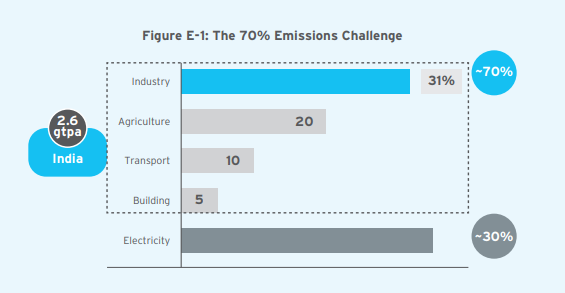
- Hence, to meet long-term climate goals (e.g. net-zero by 2070), merely scaling renewables isn’t enough: carbon capture, utilization and storage (CCUS) becomes crucial.
What is CCUS & How can it Help?
- Carbon Capture, Utilization, and Storage (CCUS): Capturing CO₂ from industrial plants/power plants or emission sources; then either using the CO₂ (utilization) or storing it permanently (storage, e.g. geological storage).
- Utilization Pathways Envisaged: Converting CO₂ into value-added products — such as green urea (fertilizer), building materials (concrete, aggregates), chemicals (methanol, ethanol), polymers/bioplastics, aggregates for construction, etc.
- Also, CO₂ could be used for enhanced oil recovery (EOR).
- For Storage: India potentially has very large CO₂ storage capacity — report estimates up to 600 gigatonnes (Gt) of storage capacity across geological formations, giving sufficient headroom for large-scale CCUS deployment.
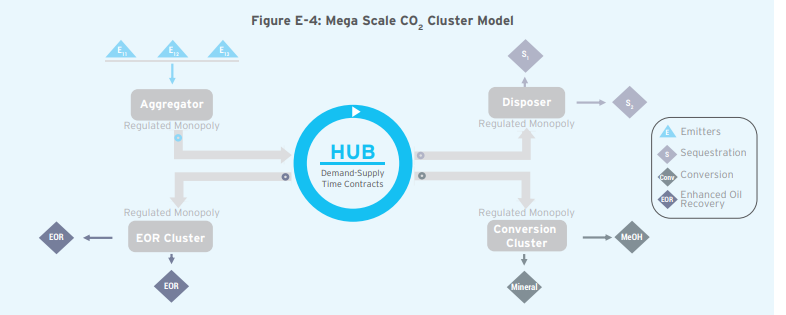
- The report advocates a “cluster model”: Creating CCUS hubs/clusters where multiple industrial plants capture CO₂, and share common transport and storage infrastructure. This can improve economies of scale and cost-effectiveness.
Sectors and Emissions Sources Priority for CCUS in India
- Steel and iron manufacturing.
- Cement production.
- Petrochemicals, oil & gas, fertilisers and chemical industries.
- Fossil-fuel power generation (especially coal-based thermal plants) — to manage baseload power demand while reducing emissions.
- These sectors are emission-intensive and not easily replaced by renewables or electrification alone.
Projection For India’s Future with CCUS
- The report estimates that India could potentially capture up to ~750 million tonnes per annum (mtpa) CO₂ by 2050 via CCUS.
- It argues that widespread CCUS adoption could also contribute to economic growth, self-reliance (less import dependence), industrial competitiveness, and a circular carbon economy by turning waste CO₂ into useful products.
- Potential for Job Creation: Large-scale CCUS deployment could generate significant employment (full-time equivalent jobs) over time.
- CCUS is positioned as a key enabler for India to meet its climate commitments (like installing non-fossil capacity, reducing emission intensity, and eventual net-zero by 2070) without sacrificing industrial growth or baseload power needs.
Key policy Recommendations
- Suggests public-private partnerships, financing mechanisms (possibly via clean-energy cess, bonds, government support), and frameworks to manage large infrastructure (transport pipelines for CO₂, storage sites, monitoring).
- Promotes the idea of CCUS clusters/hubs region-wise — leveraging shared infrastructure (capture, transport, storage) to reduce costs and improve feasibility.
- Encourages value-added utilisation of captured CO₂ (not just storage) to create economic value e.g. building materials, chemicals, fertilizers, etc. This helps integrate CCUS into a circular carbon economy.
Conclusion
- The CCUS Report smartly acknowledges India’s dual challenge: need for rapid industrial & economic growth, and imperative to decarbonize.
- CCUS offers a pragmatic, transitional tool helping decarbonize “hard” sectors and coal-based power over the medium-to-long term, while renewable deployment and clean alternatives scale up.
- If India pushes CCUS along with supportive policy, financing, and value-added CO₂ utilization, it could emerge as a major strategy for a circular carbon economy.
Source: PIB
Previous article
‘Persistent & Systemic Challenges’ Undermine IBC’s Full Potential: Parliamentary Committee
Next article
News In Short 4-12-2025
