


Syllabus: GS3/Economy
Context
- Recently, the Parliamentary Standing Committee on Finance, in its report ‘Review of Working of Insolvency and Bankruptcy Code and Emerging Issues’, warned that systemic inefficiencies and structural delays are undermining India’s Insolvency and Bankruptcy Code (IBC) effectiveness.
About Insolvency and Bankruptcy Code (IBC)
- It was enacted in 2016, at a time when mounting non-performing assets (NPAs) and ineffective recovery mechanisms — such as SARFAESI, Lok Adalats, and Debt Recovery Tribunals — were weakening the banking system.
- It replaced the older debtor-in-possession model like the Sick Industrial Companies Act (SICA) with a creditor-in-control approach, ensuring that financial creditors lead the resolution process.
Purpose and Objectives of the IBC
- The IBC serves as a time-bound mechanism to resolve insolvency and bankruptcy cases in a structured manner. Its key objectives, as outlined by the Insolvency and Bankruptcy Board of India (IBBI), are:
- Resolution: Revive viable businesses through restructuring or ownership change.
- Maximization of Asset Value: Prevent further value erosion.
- Promotion of Entrepreneurship and Credit Flow: Encourage risk-taking by providing an efficient exit mechanism.
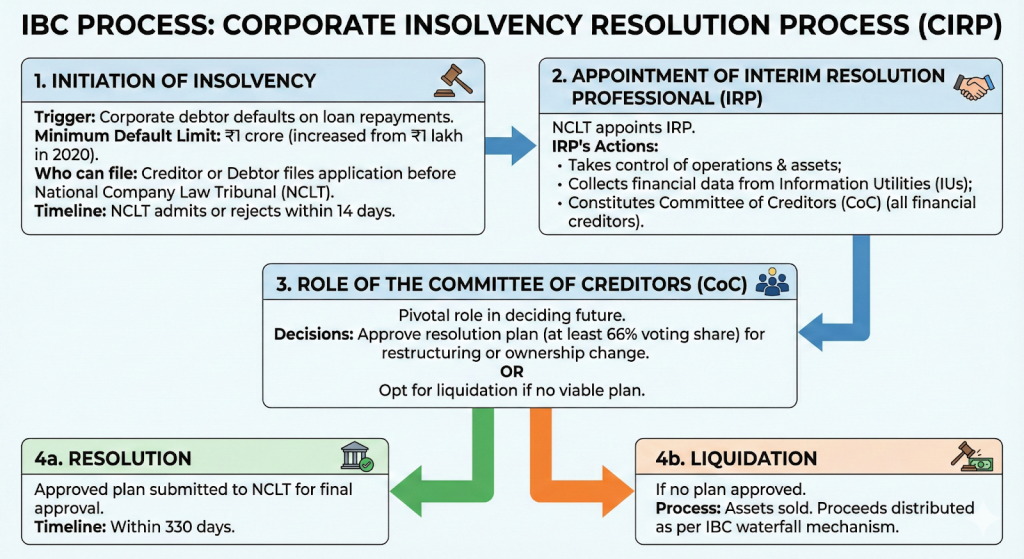
IBC’s Achievements Since Its Enactment
- IBC has resolved 1,194 companies through the Corporate Insolvency Resolution Process (CIRP).
- Creditors have recovered over 170% of the liquidation value and 93% of the fair value of these companies, reflecting the Code’s impact on financial discipline and creditor confidence.
- Pre-Packaged Insolvency for MSMEs: The IBC was amended in 2021 to introduce the Pre-Packaged Insolvency Resolution Process (PIRP), specifically for Micro, Small, and Medium Enterprises (MSMEs).
- It allows out-of-court settlements between debtors and creditors.
- The debtor retains control of business operations.
- Applicable to defaults not exceeding ₹1 crore.
Concerns & Issues Highlighted in Parliamentary Standing Committee’s Report
- Slow Processes and Delayed Resolutions: The report underscored that slow admission of insolvency applications has become a major barrier to quick value realisation, resulting in asset deterioration.
- The average duration for completing CIRP stands at 713 days, more than double the mandated 330 days under the Code.
- Key Reasons Behind the Delays: The Committee attributed the delay in resolution to several structural issues:
- Shortage of NCLT benches and vacant judicial positions.
- Administrative staff gaps hampering tribunal efficiency.
- Frequent and frivolous litigation, often initiated by promoters or unsuccessful bidders, eroding asset value.
- Concerns Over Low Recovery Rates: The overall recovery remains at 32.8% of admitted claims, revealing a substantial shortfall, while creditors recover about 170% of liquidation value.
- According to the Insolvency and Bankruptcy Board of India (IBBI), the average recovery rate has dropped to around 32% from over 43% in 2019.
- It is largely due to companies entering the IBC process too late, when their assets are already heavily stressed.
- Issues in Asset Valuation and Resolution: The Committee found that asset valuation often reflects liquidation potential rather than enterprise value, leading to lower recovery.
- It cited concerns about a limited pool of quality resolution applicants and a lack of transparency and accountability in the valuation process.
- Excessive Haircuts: Creditors face massive losses in many cases. Average haircut is 80% of claims in over 70% of cases.
- Example: Videocon Group resolution saw a 95.3% haircut, meaning creditors recovered less than 5% of their dues.
- Capacity Constraints: The NCLT and the IBBI are under-resourced. The committee emphasized the need for more benches, better infrastructure, and enhanced training for insolvency professionals.
Recommendations to Improve Efficiency
- Expedite establishment of additional NCLT benches to reduce case backlogs.
- NCLT should admit insolvency cases within 30 days.
- Accelerate operationalisation of the Integrated Technology Platform (iPIE) for centralised digital case management.
- Introduce deterrents for frivolous appeals, including:
- Mandatory upfront deposits by unsuccessful resolution applicants filing appeals.
- Substantially increased penalties for vexatious or frivolous applications.
- Strengthening Institutional and Judicial Capacity: Expanding the NCLT’s bench strength and improving case management systems to expedite admissions and hearings.
- Address 50% vacancy in NCLT benches and recruit proactively.
- Pre-Pack Framework for All Sectors: Encouraging the use of pre-packaged insolvency resolutions beyond MSMEs to reduce litigation and improve efficiency.
- Improved Monitoring and Transparency: Enhancing oversight of resolution professionals and Committee of Creditors (CoC) to ensure fair and transparent decision-making.
- Specialized IBC Benches can handle insolvency cases efficiently.
- Revised Haircut Metrics: IBBI suggests measuring haircuts based on actual asset value at entry, not on the original loan value, to present a more realistic picture of recoveries.
- Data-Driven Oversight: Leveraging technology and data analytics to monitor delays, identify bottlenecks, and improve accountability.
Previous article
India Committed to Idea of Open and Rules-based Oceans
