


Syllabus: GS3/Economy
Context
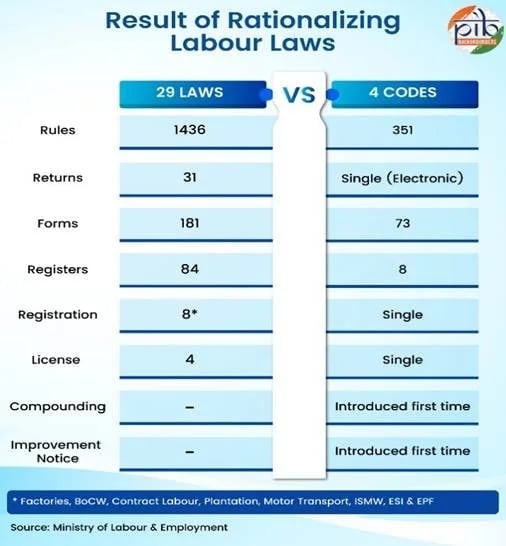
- The Government of India has announced the implementation of the four Labour Codes with effect from 21st November 2025 rationalising 29 existing labour laws.
About
- The four Labour Codes include the Code on Wages, 2019, the Industrial Relations Code, 2020, the Code on Social Security, 2020 and the Occupational Safety, Health and Working Conditions Code, 2020.
- The key reasons behind this reform include:
- Simplifying compliance: Multiplicity of laws leads to difficulty in compliance.
- Streamlining enforcement: Multiplicity of authorities in different labour laws led to complexity and difficulty in enforcement.
- Modernizing outdated laws: Most labour legislations were framed during the pre-Independence era, necessitating alignment with today’s economic realities and technological advancements.
The Four Labour Codes
Code 1: The Code of Wages, 2019
- Subsumed Laws: Payment of Wages Act, 1936; Minimum Wages Act, 1948; Payment of Bonus Act, 1965; Equal Remuneration Act, 1976.
- Universal Minimum Wages: The Code establishes a statutory right to minimum wages for all employees across both organized and unorganized sectors.
- Introduction of Floor Wage: A statutory floor wage shall be set by the Government based on minimum living standards, with scope for regional variation.
- No state can fix minimum wages below this level, ensuring uniformity and adequacy nationwide.
- Universal Coverage for Wage Payment: Provisions ensuring timely payment and preventing un-authorized deductions will apply to all employees, irrespective of wage limits.
- Overtime Compensation: Employers must pay all employees overtime wages at least twice the normal rate for any work done beyond the regular working hours.
Code 2: The Industrial Relations Code, 2020
- Subsumed Laws: Trade Union Act, 1926; Industrial Employment (Standing Orders) Act, 1946; Industrial Disputes Act, 1947.
- Fixed Term Employment (FTE): Allows direct, time-bound contracts with full parity in wages and benefits; gratuity eligibility after one year.
- Permission During Layoff: Raises the threshold for government approval for layoffs, retrenchment, and closure from 100 to 300 workers, with states allowed to increase further.
Code 3: The Code on Social Security, 2020
- Subsumed Laws: 9 laws including Employees’ Compensation Act, 1923; Maternity Benefit Act, 1961.
- Expanded ESIC (Employees’ State Insurance) Coverage: ESIC now applies pan-India, eliminating the criteria of “notified areas.”
- Time-bound EPF (Employees’ Provident Fund) Inquiries: A five-year limit has been set for initiating EPF inquiries and recovery proceedings, to be completed within two years (extendable by one).
- Inclusion of Gig and Platform Workers: New definitions are included- “aggregator,” “gig worker,” and “platform worker” to enable social security coverage.
- Social Security Fund: A dedicated fund to finance schemes for unorganised, gig, and platform workers.
- Commuting Accidents Covered: Accidents during travel between home and workplace are now deemed employment-related, qualifying for compensation.
Code 4: The Occupational Safety, Health and Working Conditions Code 2020
- Subsumed Laws: 13 laws including Factories Act, 1948; Plantation Labour Act, 1951; Mines Act, 1952.
- Health Checkup: Employers must provide free annual health check-ups for all workers aged above 40 years.
- Expanded Provision: Provisions can be extended to establishments with a single employee engaged in hazardous or life-threatening work.
Source: PIB
Previous article
News in Short – 21 November, 2025
Next article
UN and International Order Need Reform
